

Maddy summaryHF 3014 appropriates $68,000 from the general fund for the Minnesota Humanities Center to provide a one-time grant to Global Synergy Group, a 501(c)(3) nonprofit organization. The funds are specifically designated to operate the YouLead2025 program during fiscal year 2026. This bill directly affects the Minnesota Humanities Center (as the administering agency) and Global Synergy Group (as the grant recipient). The key provision is the allocation of state funds for this specific program, with no ongoing funding commitment beyond the single fiscal year.
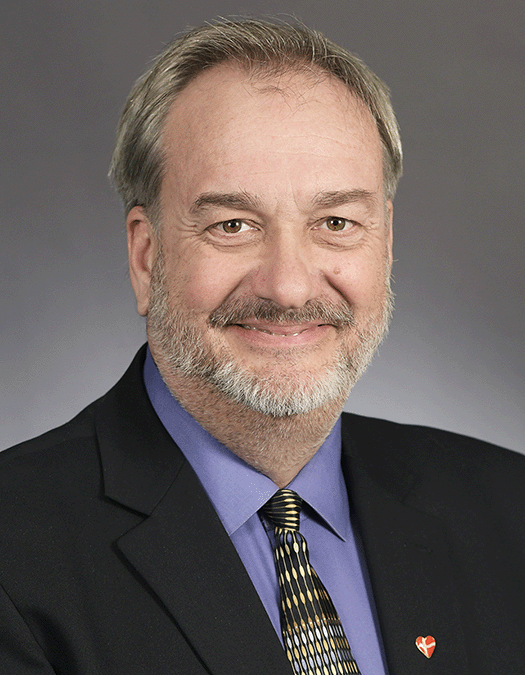
Rep. Rick Hansen
Sponsored bills
Maddy summaryHF 1624 establishes a $5 assessment on every mattress and box spring sold in Minnesota, paid by both producers (manufacturers) and retailers. The collected funds will go into a dedicated mattress recycling account, with money annually appropriated to the Pollution Control Agency. This agency will then award grants to local governments to expand and support their mattress recycling programs. The bill directly affects mattress/box spring sellers (through the assessment) and local governments (through grant funding), creating a new state-funded recycling infrastructure.
Maddy summaryHF 2387 amends Minnesota Statutes § 124D.118 to establish a program allowing schools to provide free half-pint milk to students who do not participate in the full school lunch program. This directly affects public and nonpublic schools in Minnesota, enabling students to receive milk without needing to take a complete lunch, thereby reducing food waste from uneaten meals. The bill authorizes state reimbursement of 20 cents per milk serving for kindergarten students and up to 50 cents (or USDA rate) for lunch milk, with funding appropriated for fiscal years 2026 and 2027. Schools must follow commissioner-established guidelines to participate, focusing on daily milk access as a nutritional supplement.
Maddy summaryHF 2917 allows Minnesota counties to impose administrative fines (instead of criminal misdemeanor charges) for specific violations of park ordinances through county-level rules. Counties adopting this system would collect fines from violators and deposit them into local park funds. The bill amends Minnesota Statutes section 398.34 to clarify that county ordinances on park violations can use this penalty approach, while remaining supplementary to city park rules. This policy change takes effect August 1, 2025.
Maddy summaryHF 2978 appropriates $300,000 from Minnesota's arts and cultural heritage fund for the Saint Stefan Romanian Orthodox Church in South St. Paul. The funds are specifically designated to repair and preserve the church building, designated as a cultural and historic landmark, to support the Romanian community's heritage. This direct grant targets the church itself as the recipient of state funding for physical preservation work. The bill does not create new programs or policies but allocates existing funds for a specific preservation project.
Maddy summaryHF 1299 amends Minnesota law to allow emergency shelter facilities as a permitted use in zoning districts designated for multifamily housing, commercial, or industrial development. It defines an "emergency shelter facility" as one providing safe, sanitary shelter for homeless individuals or families, regardless of operating hours. The bill directly affects homeless shelters seeking to operate in these zoning areas by removing a barrier to their establishment where local zoning already permits such uses. It does not require new construction but ensures shelters can operate in specified zones without needing special permits. The change applies to existing zoning regulations in Minnesota communities.
Maddy summaryHF 1352 modifies Minnesota's definition of "residential generator" for solid waste management billing. It clarifies that multi-unit properties like apartment buildings, condos, or manufactured home parks where residents aren't separately billed for waste services (and the owner/association pays directly) are explicitly included as residential generators. This directly affects property owners, associations, and waste service providers managing such properties. The change ensures consistent billing responsibility for waste services in these multi-residence settings, effective July 1, 2025.
Maddy summaryThis bill appropriates $900,000 from Minnesota's arts and cultural heritage fund for the Serbian Home in South St. Paul. The funds are specifically designated to repair and preserve this historic site, which is listed on the National Registry of Historic Places, serving the Serbian community. The Minnesota Historical Society will administer the grant to support the cultural landmark's maintenance. This is a direct funding allocation for preservation, not a policy change affecting broader legislation or regulations. The bill directly benefits the Serbian Home organization and the local Serbian cultural community.
Maddy summaryHF 2576 prohibits burning pesticide containers in Minnesota, directly affecting farmers, agricultural workers, and anyone handling pesticide containers. The bill amends Minnesota Statutes 18B.07, adding a specific prohibition against disposing of pesticide containers by burning, while requiring disposal to follow existing environmental and federal (FIFRA) guidelines. This law becomes effective January 1, 2026, replacing the previous allowance for burning containers under disposal rules. The change creates a clear legal requirement to avoid burning, aiming to prevent environmental harm from toxic fumes.
Maddy summaryHF 2577 modifies Minnesota's agricultural waste handling rules, primarily affecting farms, fertilizer distributors, and entities handling sewage sludge. The bill requires detailed record retention for all sewage sludge transfers - including date, amount, and parties involved - and mandates these records be available to the Department of Agriculture upon request. It also clarifies the Department's role in regulating PFAS-containing fertilizers and prohibits applying fertilizer or sewage sludge to impervious surfaces like driveways or parking lots. These changes aim to improve tracking of waste materials and prevent environmental contamination from improper handling.