

Maddy summaryThis bill modifies how Minnesota's cannabis gross receipts tax revenue is used by directing 10% of those funds to a new Cannabis Youth Grant Program starting in 2026. The program will provide grants to organizations offering youth development services, including after-school programs, mentorship initiatives, and restorative justice efforts that address past cannabis criminalization impacts. Eligible projects must focus on building skills like financial management and entrepreneurship, improving mental health, preventing substance use, and fostering community engagement, with priority given to communities disproportionately affected by cannabis enforcement. The commissioner must submit annual reports to the legislature detailing how grant money is awarded and used.
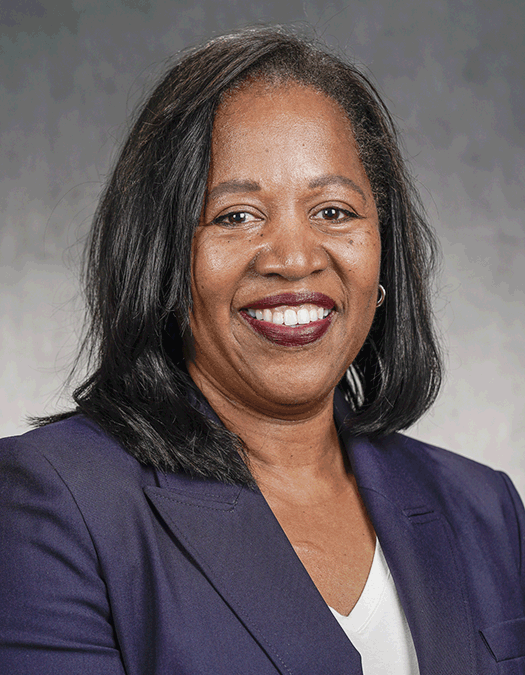
Rep. Mary Clardy
Sponsored bills
Maddy summaryHF 3781 establishes a Legislative Commission on Legislative Security in Minnesota. The commission will study security needs for state legislators and staff while serving in their districts and review proposed bills affecting security for elected officials. It consists of 14 members (seven from each chamber, with majority limits) appointed at the start of each legislative session, and must elect a chair alternating between the Senate and House annually. The bill creates a new permanent body to analyze security issues and make recommendations, without changing existing laws.
Maddy summaryHF 3465 amends Minnesota Statutes to increase penalties for theft when the victim is a vulnerable adult, as defined in section 609.232, subdivision 11. It specifically enhances penalties: misdemeanor theft becomes a gross misdemeanor, gross misdemeanor theft becomes a felony (up to 2 years imprisonment or $5,000 fine), and felony theft sentences increase by 25%. This directly affects vulnerable adults in Minnesota who are victims of theft, aiming to hold offenders accountable for targeting those at heightened risk. The bill takes effect August 1, 2026, for crimes committed on or after that date.
Maddy summaryHF 3745 bans the sale, purchase, use, or manufacturing of orthochlorobenzalmalononitrile (a chemical compound used in tear gas) within Minnesota. The bill directly affects individuals, businesses, and organizations handling this specific chemical, including law enforcement or manufacturers. It requires the Minnesota Pollution Control Agency to provide disposal guidance for existing supplies of the chemical or products containing it. The law takes effect immediately upon final enactment.
Maddy summaryHF 3744 prohibits Minnesota law enforcement officers and agencies from using tear gas, chemical weapons, and kinetic energy munitions (like rubber bullets) on civilian populations. It directly affects all state and local police departments, requiring them to stop using these tools in public safety operations. The bill mandates that law enforcement agencies develop written policies by January 15, 2027, based on a model policy created by the state board by November 15, 2026. This law updates existing statutes to ban these specific crowd-control methods while allowing limited use by the National Guard for official duties.
Maddy summaryHF 3774 (Minnesota Statutes §169.222, new Subd. 4b) would require bicycle operators to stop before entering an intersection or crosswalk when approaching a steady yellow traffic light at a signal-controlled intersection. This bill directly affects cyclists in Minnesota who ride through intersections with traffic signals. The key provision mandates stopping for yellow lights, while clarifying that it does not change existing right-of-way rules (§169.20) and excludes situations where traffic is controlled by police or authorized personnel. The bill is currently in committee referral after its February 2026 introduction.
Maddy summaryHF 974, the Equal Access to Broadband Act, updates Minnesota's broadband laws by defining key terms like "broadband" (meeting FCC standards for high-speed internet), "underserved areas" (lacking 100/20 Mbps wired service), and "broadband infrastructure." The bill requires broadband providers to coordinate with local governments when placing infrastructure in public rights-of-way, including notifying them before installation to minimize future disruptions. It preserves local governments' authority to require franchises from broadband providers, while excluding electric cooperatives and satellite-only providers from these requirements.
Maddy summaryThis bill increases funding for Minnesota's Family Homeless Prevention and Assistance Program, raising the annual appropriation from $10.27 million to $45.27 million. The additional funds will be used to reduce homelessness risks and improve program effectiveness, with a portion designated for the housing development fund. The legislation also grants agencies flexibility in awarding grants to existing grantees and allows new grantees in certain areas to work with advisory committees or local care systems without meeting specific statutory requirements. These changes take effect immediately and establish a future funding base of $10.72 million starting in fiscal year 2028.
Maddy summaryThis bill allows Minnesota school districts and charter schools to keep counting students in their enrollment numbers for the rest of the 2025-2026 school year, even if those students haven't officially reenrolled. It applies only to students who were enrolled before January 1, 2026, and have not yet signed up for another Minnesota school. The law requires the state education commissioner to approve this continued enrollment count for the specified period and makes the change effective retroactively from January 1, 2026. This provision helps schools maintain their funding levels during a transition period when students may be temporarily unenrolled.
Maddy summaryThis bill creates a new grant program to provide social services and mental health support to victims of Operation Metro Surge, a federal immigration enforcement operation. The program will fund organizations that help affected individuals with basic needs like housing, food, and employment assistance, as well as mental health care. Eligible applicants include nonprofits, government agencies, tribal nations, and legal service providers, with priority given to areas most impacted by the operation. The bill appropriates unspecified funding from the state's general fund for one-time use through June 2029, requiring grantees to report on program participation and outcomes.