

Maddy summaryHF 3776 prohibits publicly funded preschool and kindergarten programs in Minnesota from allowing children to use individual screens (like tablets or smartphones) during school hours. The bill specifically bans screen use without teacher engagement or peer interaction, applying to all children except those with an active individualized education plan (IEP), 504 plan, or individualized family service plan. It does not restrict screen use for educational purposes under teacher supervision. The law would take effect on July 1, 2026, for all covered programs.
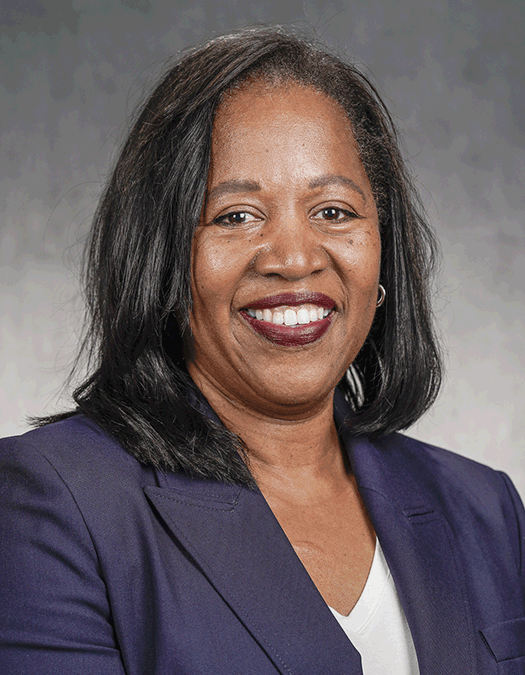
Rep. Mary Clardy
Sponsored bills
Maddy summaryThis bill requires the Metropolitan Airports Commission to increase transparency regarding flights at Minneapolis-St. Paul International Airport that transport detained immigrants. Specifically, it mandates that the airport operator notify the commission whenever U.S. Immigration and Customs Enforcement arrives or departs with passengers being held in restraints. The legislation also requires the commission to install a live-streaming camera to record these flights and to submit monthly reports detailing the number of detained individuals, including minors, on each trip. These measures are designed to provide the public and state officials with real-time data and regular updates on immigration-related air traffic at the airport.
Maddy summaryThis Minnesota bill creates a $100 million relief program to help small businesses that experienced significant revenue declines between July 2024 and February 2026, which the bill attributes to federal enforcement activity. The program provides grants to operators of indoor retail or food market spaces with at least 25 small tenant businesses, requiring that most funds be used to offer rent forgiveness to existing tenants. To qualify, businesses must be Minnesota-based, have fewer than 50 employees, operate from a physical location, and show at least a 20 percent drop in revenue or sales during the specified period. Grant applications will be processed through a lottery system, with funds usable for payroll, rent, utilities, inventory, and other operational expenses, and the state must report on the program's outcomes by December 2026.
Maddy summaryHF 60 modifies Minnesota teacher licensure requirements by adding dyslexia training as a mandatory component for license renewal. The bill requires all licensed teachers renewing their licenses under sections 122A.181-122A.184 to complete two hours of free professional development on dyslexia, covering its effects on reading skills, instructional needs, and related health comorbidities. This training must be provided by the Professional Educator Licensing and Standards Board with input from dyslexia specialists, and teachers must complete it once - either during initial licensure or upon renewal. The requirements apply to all renewing teachers and take effect for licenses issued on or after July 1, 2027. The bill also updates renewal conditions for Tier 1 and Tier 2 licenses to include this dyslexia training.
Maddy summaryHF 3119 establishes minimum pay standards for Minnesota teachers and certain unlicensed school staff starting July 1, 2026. It sets teacher compensation thresholds at $60,000-$100,000 annually (based on education and experience) and a $25 hourly wage floor for unlicensed staff who regularly interact with students. The bill requires annual inflation adjustments using the Consumer Price Index, beginning in 2030, and creates state aid programs to help school districts cover these costs. School districts, charter schools, and other public education entities directly affected must meet these standards or receive state funding to do so.
Maddy summaryThis bill (HF 3556) is a naming resolution that commemorates Melissa Hortman by designating Minnesota's community solar garden program as the "Melissa Hortman Community Solar Garden Program." It does not change any program rules, funding, or operations - it only adds a short title to Minnesota Statutes section 216B.1641. The bill directly honors Melissa Hortman, a former state legislator, through this naming. It is procedural and has no policy impact beyond the name change.
Maddy summaryThis bill modifies how Minnesota school districts and charter schools receive funding for student support staff, such as counselors and nurses. It establishes a minimum funding floor, ensuring districts receive at least $40,000 per year while charter schools receive a minimum of $20,000, with amounts calculated based on the number of students. The legislation also sets specific dollar amounts for the per-student allowance for these positions, starting at $17.08 in 2025 and increasing to $34.32 in 2027 and later years. Additionally, the bill appropriates money from the state's general fund to provide extra aid for these personnel in fiscal year 2027.
Maddy summaryHF 3461 ensures that state and local government employees elected to the Minnesota legislature retain all employment benefits during their mandatory leave of absence for legislative service. It requires that accrued seniority, vacation, insurance, sick leave, and other benefits remain intact as if the employee had not taken leave, and prohibits deducting the leave period from their length of service. The bill also aligns pension and retirement benefits with those provided to local government employees under existing law. This applies to all affected employees covered by collective bargaining agreements effective July 1, 2027. The legislation directly affects current and future state/local government workers serving in the legislature.
Maddy summaryThis bill creates the Minnesota Business Recovery Loan Program to help businesses that have suffered financial losses due to increased immigration enforcement activities in the state. It appropriates $100 million in fiscal year 2026, with $18 million designated for zero-interest loans to businesses in greater Minnesota and $82 million for zero-interest loans to businesses in the seven-county metropolitan area through nonprofit lenders. To qualify, businesses must be located in Minnesota, owned by state residents, demonstrate a revenue loss of more than 30 percent between enactment and December 1, 2025, and show that losses resulted from staffing shortages, reduced customer access, or other immigration enforcement-related factors. The program provides loans ranging from $25,000 to $200,000 depending on business size and location, which must be used exclusively for business operations in Minnesota and cannot be used to repay prior debt or for real estate speculation.
Maddy summaryThis bill restricts how members, officers, and employees of the Minnesota Senate and House of Representatives can use legislative email addresses, telephone numbers, and office space. It prohibits giving out official legislative contact information to anyone who is not a legislator, staff member, or authorized employee, and limits member phone lines to exclusive use by the member and their assigned staff. The law also requires written notification to caucus leaders before allowing non-legislators to occupy assigned office space. Enforcement and penalties for violations are handled through rules adopted by the Senate and House, with courts barred from intervening in disputes over these provisions.