

Maddy summaryHF 3005 appropriates $497,500 for fiscal years 2026 and 2027 to fund home-delivered meals for veterans through Metro Meals on Wheels, plus technical assistance for member programs. The bill requires Metro Meals on Wheels to submit detailed reports by September 1, 2026 and 2027, documenting how funds were used and the number of veterans/servicemembers served. This is a one-time funding appropriation, not a recurring budget item, directly supporting veterans' access to meal services in Minnesota. The bill affects veterans receiving meals and Metro Meals on Wheels as the grant recipient.
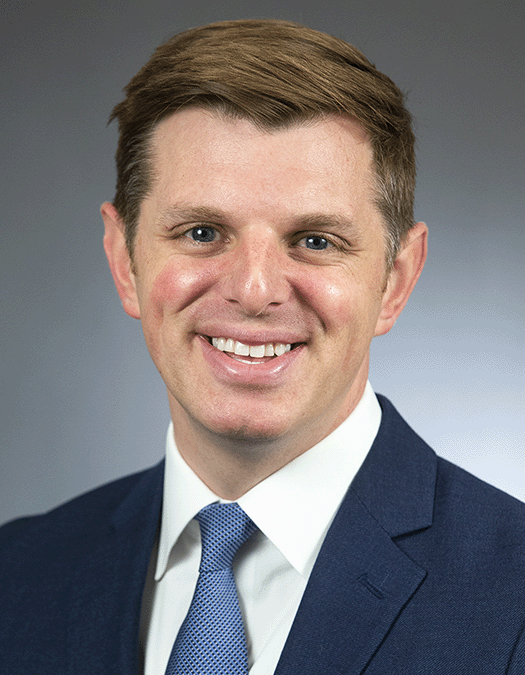
Rep. Mike Howard
Sponsored bills
Maddy summaryHF 1309 prohibits Minnesota local governments (cities and counties) from requiring minimum parking spaces for new residential, commercial, or industrial buildings. The bill directly affects developers and property owners by removing a common zoning requirement that previously mandated a set number of parking spots. Key provisions state that political subdivisions cannot impose these minimums, though they may still require ADA-compliant disability parking or make non-binding parking space recommendations. This change aims to increase flexibility for development projects, potentially allowing more housing or commercial space without dedicated parking.
Maddy summaryHF 1340 amends Minnesota law to allow housing infrastructure bonds to fund adaptive reuse projects (converting existing buildings like offices or stores into housing) for permanent and supportive housing. It directly affects low-income households earning 50% or less of the area median income (AMI) and housing developers seeking bond financing. The bill expands existing bond program uses to specifically include adaptive reuse for these affordable housing projects, requiring new construction to meet accessibility standards (e.g., roll-in showers, sensory-accessible units). This change to Minnesota Statutes 462A.37, section 2, broadens the program’s scope without creating new funding.
Maddy summaryHF 3074 creates legal rights for transportation network company (TNC) drivers in Minnesota to form and join labor organizations for collective bargaining. It directly affects "active drivers" who completed at least the median number of rides in the most recent two quarters, as defined by the bill. The law establishes a certification process where drivers can designate an exclusive representative (like a union) through the Bureau of Mediation Services, while prohibiting TNCs from controlling or dominating driver representation groups ("company unions"). Drivers gain the right to negotiate terms and conditions of work, including grievance procedures, with TNCs, and the bill defines "lockout" to prevent TNCs from restricting driver access to the platform during disputes.
Maddy summaryHF 2900 creates a $10 million grant account to reimburse Minnesota local governments (counties, cities, townships, and school districts) for specific legal costs related to federal executive orders. The funds cover expenses like challenging federal censorship or segregation orders, continuing special education services, reducing disparities, or upholding state law against conflicting federal actions effective after January 19, 2025. Grants are awarded on a first-come, first-served basis with a $500,000 maximum per local government. Unused funds must be returned to the state budget reserve by July 15, 2026.
Maddy summaryHF 2148 establishes a locally controlled housing fund within Minnesota's housing development fund to finance affordable housing projects. The fund provides loans to eligible recipients - including cities, counties, tribes, community land trusts, and housing authorities - to acquire, rehabilitate, or build housing where local entities maintain at least 75% ownership control. Projects must include 30% of units for households earning ≤50% of area median income (AMI) and 30% for households earning 50-100% of AMI, with all housing meeting accessibility standards and avoiding income-based segregation. Repayments to the fund are reinvested to support additional affordable housing production in the recipient’s jurisdiction.
Maddy summaryHF 1770 creates a grant program to fund infrastructure for cooperative manufactured housing developments in Minnesota. Counties and cities can receive grants covering up to 50% of infrastructure costs (like sewers, water systems, and streets) for projects serving manufactured housing cooperatives, with a maximum of $60,000 per housing lot. Applicants must provide local matching funds (cash or in-kind, such as site value) and demonstrate the project will increase workforce housing and attract additional private investment. The bill appropriates $10 million from state bond proceeds to fund these grants, with returned funds recycled for future grants if projects stall beyond five years.
Maddy summaryHF 1489 appropriates $100 million from state bond proceeds to rehabilitate public housing for low-income residents in Minnesota. The funds, administered by the Minnesota Housing Finance Agency, will cover costs for preserving publicly owned, federally financed housing units. Key provisions require prioritizing health, safety, and energy improvements in rehabilitation projects while maximizing federal or local funding. The state will issue up to $100 million in bonds to finance this appropriation, effective upon enactment. This directly supports public housing providers and residents in maintaining safe, affordable housing.
Maddy summaryHF 2618 requires Minnesota condo associations and homeowners associations (HOAs) to provide plain-language explanations of governing laws to unit owners upon request. The bill mandates that board members review these explanations when elected and share them with owners seeking help understanding their rights or responsibilities. It appropriates funding to create a statewide guide explaining laws governing common interest communities, including key provisions in Minnesota Statutes sections 515B.4-102, 515B.4-1021, and 515B.4-107. The requirements become effective August 1, 2026.
Maddy summaryHF 671 establishes two new grant programs to improve children's mental health services in Minnesota. It creates a competitive grant for training direct care staff in residential facilities and day treatment programs (via the "youth care professional grant"), requiring trauma-informed curricula and a registry for trained staff. It also launches a "high-fidelity wraparound grant" to fund comprehensive, family-driven mental health support for children with serious challenges, prioritizing evidence-based models. The bill modifies rates for certain children's mental health services, establishes a working group for psychiatric residential facilities, and appropriates funding for these initiatives. These changes primarily affect licensed residential facilities, day treatment programs, community service providers, and counties delivering children's mental health services.