

Maddy summaryHF 89 amends Minnesota Statutes section 147A.02 to modify requirements for physician assistant collaborative agreements. Currently, the law requires physician assistants to complete 2,080 hours of practice under a collaborative agreement in a hospital or integrated clinical setting, with specific conditions like shared patient care experience between the PA and collaborating physician. This bill changes those requirements, though the exact modifications are not detailed in the provided text. The bill directly affects physician assistants and the physicians they collaborate with in Minnesota.
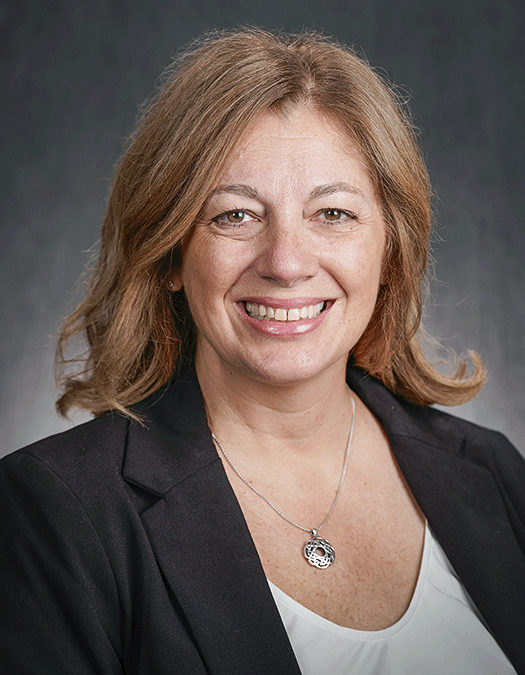
Rep. Julie Greene
Sponsored bills
Maddy summaryHF 1817 increases the annual surcharge for all-electric vehicles from $75 to $100 (effective August 1, 2025), while adding a new $25 surcharge for plug-in hybrid electric vehicles. Both surcharges are adjusted every three years based on changes to Minnesota’s gasoline excise tax, rounded to the nearest $5 increment. Revenue from these surcharges must be deposited into the Transportation Impact Assessment and Mitigation Account. Additionally, if the account balance exceeds 50% of annual deposits, 90% of the excess must be transferred to the Highway User Tax Distribution Fund starting in 2027.
Maddy summaryHF 1757 requires anyone who owns, possesses, or controls a firearm to report a loss or theft to local law enforcement within 48 hours. Failure to report can result in escalating penalties, starting with a minor offense for the first violation and increasing to a gross misdemeanor for repeated failures. The bill also provides immunity from prosecution for storage-related offenses if the report is made on time and mandates that law enforcement agencies report lost or stolen firearms to the state commissioner within seven days. Additionally, the bill appropriates $36,000 for a one-time implementation of a reporting system to support these requirements.
Maddy summaryHF 1812 establishes a state-run Minnesota Health Plan to guarantee comprehensive, affordable health care for every Minnesota resident. The plan covers all necessary medical, dental, vision, mental health, and long-term care services without co-pays, with premiums based on income. It creates new state entities including the Minnesota Health Board, Health Fund, Office of Health Quality and Planning, a patient advocacy ombudsman, and an auditor for the plan. The bill also requests a federal waiver under the Affordable Care Act to modify certain health insurance requirements and appropriates funding for implementation.
Maddy summaryHF 1087 appropriates $300,000 for fiscal year 2026 and $300,000 for fiscal year 2027 from the general fund to the I-494 Corridor Commission. The funds are designated for the Commission's programming, staffing, communications, outreach, education program development, and operations management. This one-time appropriation requires full disbursement by July 31 each year, with no funds retained by the commissioner of transportation.
Maddy summaryHF 1685 requires Minnesota's IT Services agency to combine the state's transit assistance program (currently managed by Metro Transit) into the existing Minnesota Benefits Web Portal by December 31, 2025. The bill mandates coordination with transportation, human services, and children's agencies to ensure seamless integration while allowing Metro Transit to continue processing applications. It also appropriates $1.2 million from the general fund in fiscal year 2026 specifically for this integration work. This change directly affects state agencies managing benefits and Metro Transit, aiming to streamline access for Minnesotans using transit assistance programs.
Maddy summaryHF 1550 allows Minnesota school districts to renew expiring capital projects referendums through a school board resolution instead of holding a new voter election, under specific conditions. It directly affects school districts with referendums nearing expiration that meet all renewal requirements. Key provisions require the renewal amount to match the expiring referendum, the renewal term to be no longer than the original term, and the board to hold a public hearing with a recorded vote before adopting a written resolution. The resolution must be submitted to the commissioner and county auditor by September 1, and cannot be used if the referendum was previously renewed via board action. This streamlines renewal for districts with unchanged project funding needs.
Maddy summaryHF 1293 appropriates $8.4 million from Minnesota's general fund for fiscal year 2026 to fund school bus stop-signal arm camera systems. The money will be distributed as grants to school districts, nonpublic schools, charter schools, and school bus service providers to purchase and install these cameras. The grant program must follow existing rules from 2021 and is a one-time allocation available until June 30, 2027. This directly affects school transportation providers by providing funding to implement safety technology that captures vehicles illegally passing stopped school buses.
Maddy summaryThis bill appropriates $13 million from state bond proceeds to fund sanitary sewer improvements in north central Bloomington, including the Penn American District. The funds will support the city's design, construction, and equipment for expanding sewer capacity to meet growing needs. The state will issue bonds up to $13 million to provide this funding, as authorized under Minnesota Statutes. The money directly benefits Bloomington residents and local infrastructure by addressing capacity limitations in the specified area.
Maddy summaryHF 846 allocates $3 million annually for 2026 and 2027 to fund registered special education apprenticeship programs. It provides $740,000 grants each year to four specific intermediate school districts (287, 288, 916, and 917) for these programs. The funds must cover program administration, apprentice stipends/tuition, mentor teacher stipends, and substitute teacher costs. This directly supports special education apprentices and their training partnerships with higher education institutions. The bill does not change existing laws but provides dedicated funding for these specific programs.