

Maddy summaryHF 3616 modifies Minnesota's individual income tax brackets, increasing the threshold for the lowest tax rate from $38,770 to $48,700 for married couples filing jointly. It increases county program aid to cover costs from federal SNAP (food stamp) program changes and adjusts school district revenue formulas to account for shifts in SNAP participation. The bill requires the state commissioner to estimate costs for these changes and appropriates funds to implement them. School districts will receive adjusted funding based on a new "SNAP adjustment factor" calculated using direct certification data for SNAP-eligible students. This bill directly affects Minnesota taxpayers, county governments administering SNAP, and public school districts.
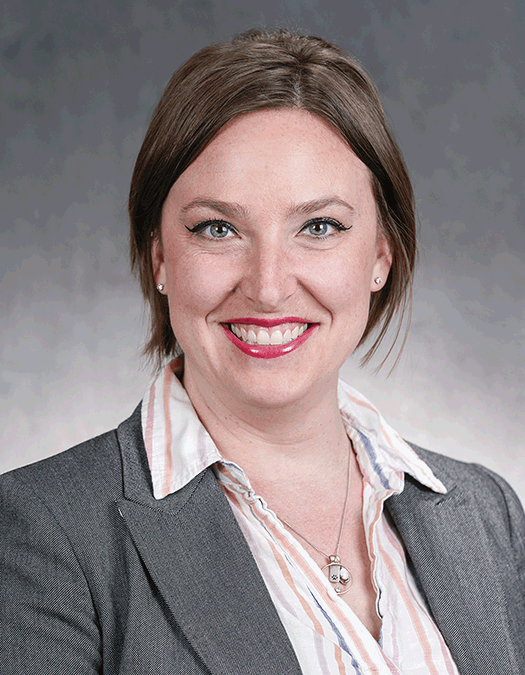
Rep. Carlie Kotyza-Witthuhn
Sponsored bills
Maddy summaryHF 3401 modifies Minnesota law to clarify that firearms are generally prohibited on school property, even for individuals with permits, except for specific authorized groups like active law enforcement or military personnel on duty. The bill establishes new storage requirements for permitted carry, mandating that firearms must be unloaded, secured in a locked container or trunk, and out of plain sight when not actively on duty or participating in authorized activities. These rules apply to school buildings, grounds, buses, and event facilities with posted signs, but exclude active officers and military personnel. The law aims to balance permitted access with safety by ensuring firearms are secured during non-operational periods.
Maddy summaryHF 2516 requires Minnesota public school districts and charter schools to adopt cell phone use policies by March 2025, prohibiting phones and smartwatches for K-8 students and restricting them to classrooms for grades 9-12 starting in 2026-2027, with exceptions for medical needs or disability accommodations. The bill appropriates funds for a statewide awareness campaign about screen overuse (2026-2027) and provides one-time grants to schools for implementing the policy, covering only one-time expenses like equipment, not staff salaries. It directly affects all Minnesota K-12 public schools and students, aiming to address concerns about cell phone impacts on behavior and academic performance. The funding mechanisms include specific annual appropriations for campaign costs and school implementation grants.
Maddy summaryHF 3293 creates the Minnesota Consumer Financial Protection Bureau (MCFPB) to enforce consumer financial laws and protect residents from unfair or deceptive practices in banking, lending, and other financial services. The bill establishes a commissioner appointed by the governor to oversee the bureau, which will investigate complaints, monitor financial markets, and enforce anti-discrimination rules in consumer finance. It appropriates funding for the bureau’s operations in fiscal years 2026 and 2027, and directs the commissioner to recruit staff with federal CFPB experience. The bureau directly affects Minnesota consumers and financial institutions operating in the state by providing a dedicated enforcement agency for consumer financial protection.
Maddy summaryThis bill prohibits Minnesota law enforcement officers from detaining or transporting suspects in vehicles not specifically designed for human transport, such as standard patrol cars. It requires all such vehicles to be owned/leased by a law enforcement agency, clearly marked with the agency's identification, and equipped with seats and seat belts for each person transported. Exceptions apply during emergencies threatening life/safety or for undercover operations. The law directly affects police departments and officers who transport detainees, aiming to standardize safe transport conditions.
Maddy summaryThis bill reenacts Minnesota's 2024 law making it a crime to transfer firearms to ineligible people (such as those with certain criminal records or protective orders) and removes a legal defense that previously allowed family or household members to avoid charges if they transferred under threat. It specifically repeals Minnesota Statutes §624.7141, subdivision 4, which had permitted a defense based on coercion by family members. The law applies to all firearm transfers to prohibited individuals, eliminating the exception for family/household member transfers. The changes take effect after enactment but apply retroactively to August 1, 2024.
Maddy summaryHF 3362 requires property managers of apartment buildings, dorms, nursing homes, and similar multiple-unit housing to grant access to current elected officials and candidates for office who meet specific campaign filing requirements (e.g., organized committees, filed financial reports, or candidacy affidavits). Access is limited to the official’s district or the candidate’s target election area, must occur between 9 a.m. and 9 p.m., and is restricted to campaign or official work (not general visits). Exceptions include denying entry to individual units, requiring ID, health-related restrictions in nursing homes, and limiting visits to reasonable hours or numbers. Property owners are encouraged to notify residents when officials or candidates plan to visit.
Maddy summaryHF 3430 imposes new annual registration surcharges on all-electric vehicles ($100 starting in 2027) and plug-in hybrid electric vehicles ($50 starting in 2027), replacing previous calculation methods. It also creates a weight-based surcharge for passenger vehicles: 7% for vehicles weighing 5,000-5,999 pounds and 10% for heavier vehicles (6,000+ pounds), applied to existing registration taxes. These surcharges apply to registrations beginning January 1, 2027, and revenue must fund highway maintenance. The bill directly affects owners of electric vehicles, plug-in hybrids, and heavier passenger vehicles through updated registration costs.
Maddy summaryHF 3655 appropriates $300,000 from the general fund to the I-494 Corridor Commission for fiscal year 2026. The funding must cover specific activities like staffing, communications, outreach, and program development - excluding administrative costs - and must be fully spent by June 30, 2026. This is a one-time appropriation with no ongoing requirements. The bill directly affects the I-494 Corridor Commission’s operational capacity for community engagement and service planning.
Maddy summaryHF 3610 modifies Minnesota's law on concealing identity in public places. It makes it generally illegal to hide one's identity using a robe, mask, or disguise in public (except for religious reasons, entertainment, weather protection, smoke/gas protection, or medical treatment), with a misdemeanor penalty. The bill specifically adds two exceptions for law enforcement: undercover officers may conceal their identity when necessary for investigations or safety, and tactical team members may use face masks to prevent facial disfigurement during operations. This change affects the public generally and law enforcement officers performing specific duties under defined circumstances.