

Maddy summaryThis bill requires state and local agencies to prepare a detailed risk assessment before approving any projects in Minnesota waters that support wild rice. The assessment must identify potential threats to wild rice, evaluate the likelihood and scale of damage, and explain why the public need for a project justifies the risk. Agencies must also allow at least 30 days for public comment, respond to substantive feedback, and consult with Tribal governments when requested. If 100 or more residents request a hearing, the agency must hold one near the affected water. The final risk justification must be published online and in the State Register before permits are issued.
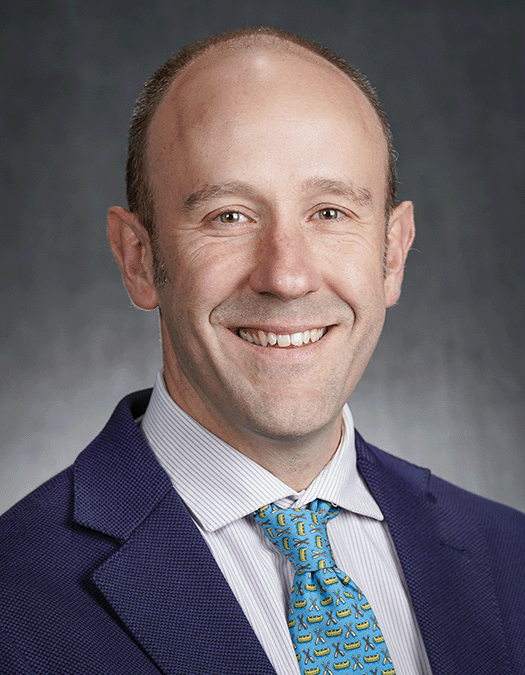
Rep. Alex Falconer
Sponsored bills
Maddy summaryThis bill updates Minnesota's state grain designation to formally recognize wild rice, including its scientific names and both the English and Ojibwe terms for the plant. It amends state statutes to declare wild rice as the official state grain and establishes a policy recognizing the inherent right of uncultivated wild rice to exist and thrive in Minnesota. The legislation also allows a photograph of wild rice to be displayed in the Office of the Secretary of State. This change affects state government records and official symbols while honoring Indigenous language and cultural significance.
Maddy summaryThis bill prohibits operating motorized watercraft in uncultivated wild rice beds in Minnesota, directly affecting boaters and watercraft operators in affected waterways. The law requires that any watercraft entering these areas must be propelled by hand, such as a canoe or skiff, and bans operating at speeds greater than slow-no-wake within 150 feet of uncultivated wild rice beds. These restrictions aim to protect wild rice habitats from damage caused by boat motors and wake. The bill amends existing Minnesota statutes to add these specific protections for uncultivated wild rice beds.
Maddy summaryHF 3652 adds epilepsy to Minnesota's list of chronic diseases that qualify for reduced cost-sharing on prescription drugs and medical supplies under health insurance plans. The bill amends existing law to define "chronic disease" as including diabetes, asthma, allergies requiring epinephrine, and now epilepsy. It ensures that cost-sharing (like co-pays and coinsurance) for epilepsy-related medications and supplies - such as seizure management drugs, medical devices, and related equipment - cannot exceed the same limits applied to other covered chronic conditions. This change would apply to health plans offered, issued, or renewed on or after January 1, 2027.
Maddy summaryHF 309 amends Minnesota Statutes §84.523 to tighten mining restrictions in the Boundary Waters Canoe Area Wilderness (BWCA) and Rainy River headwaters. The bill requires the commissioner of natural resources to determine that proposed mining (for taconite, sand, gravel, or granite) in the Rainy River headwaters would not harm the BWCA before any permits are issued. This modifies existing law by adding this specific assessment step, directly affecting mining operations seeking approval in these areas. The change maintains the general prohibition on mining without legislative approval but adds a new administrative requirement for the commissioner to evaluate environmental impacts. The bill focuses on protecting the BWCA's wilderness character through stricter permitting conditions.
Maddy summaryThis bill requires Minnesota school boards to establish a formal process for including student representation when advising on board matters. The law mandates that students have a voice in school governance starting with the 2026-2027 school year. By changing the current language from "encouraged" to "must," the legislation ensures that student input becomes a mandatory part of the decision-making framework for school boards.
Maddy summaryThis bill allocates $1.5 million from the arts and cultural heritage fund to the City of Minneapolis to create a public memorial honoring Renée Good and Alex Pretti. The memorial will feature statues, educational exhibits, and a space for community reflection, focusing on their deaths and the broader issues of civil rights and immigration enforcement. The project requires a collaborative planning process involving local residents, civil rights groups, artists, and historians, with oversight provided by a partnership including city officials and state legislators. While the state provides the initial funding, the city is permitted to seek additional private donations and partnerships to cover design, programming, and long-term maintenance costs.
Maddy summaryHF 3452 classifies kratom as a Schedule II controlled substance in Minnesota, subjecting it to strict state regulations similar to opioids. The bill adds mitragynine and 7-hydroxymitragynine (the active compounds in kratom) to Schedule II, making unauthorized possession or sale illegal without a prescription. It repeals a prior law that only set penalties for selling kratom to minors or for minors possessing it. This change directly affects individuals who use or sell kratom, including businesses that currently sell kratom products, by applying full Schedule II restrictions.
Maddy summaryHF 3555 establishes rules for small, portable solar panels (under 1,200 watts) that homeowners can install to offset personal electricity use. The bill exempts these plug-in solar devices from requiring utility connection agreements, net metering rules, and additional fees or approvals. It also clarifies that utilities cannot be held liable for damage caused by these devices. This directly affects residential users seeking simple, low-barrier solar energy solutions without utility bureaucracy. The bill creates specific definitions and exemptions within Minnesota's energy code for these devices.
Maddy summaryThis bill establishes a legal framework in Minnesota to create an interstate agreement called the Interstate Fiscal Sovereignty Compact, which would allow member states to hold federal taxes in a state-controlled escrow fund rather than sending them directly to the federal government. The legislation defines key terms such as "member state" and "triggering event," and sets up a process where employers would deposit withheld federal income, Social Security, and unemployment taxes into this new state treasury fund once the compact is officially activated. Currently, no action is required from employers or the state until a governing body issues an order to start the escrow operations, meaning the bill does not immediately change how taxes are collected or paid. By creating a separate escrow fund, the bill aims to give states more control over federal tax revenue, though it requires other states to pass similar laws and join the agreement for the system to function.