

Maddy summaryThis bill modifies how Minnesota calculates registration taxes for passenger cars and hearses by lowering the tax rate based on the vehicle's manufacturer's suggested retail price. It changes the tax calculation for new vehicles registered on or after November 16, 2020, and reduces the percentage of the vehicle's value taxed for each subsequent year of ownership. The legislation also establishes a process to transfer money from the state's general fund to the highway user tax distribution fund to cover any revenue shortfall caused by these tax reductions.
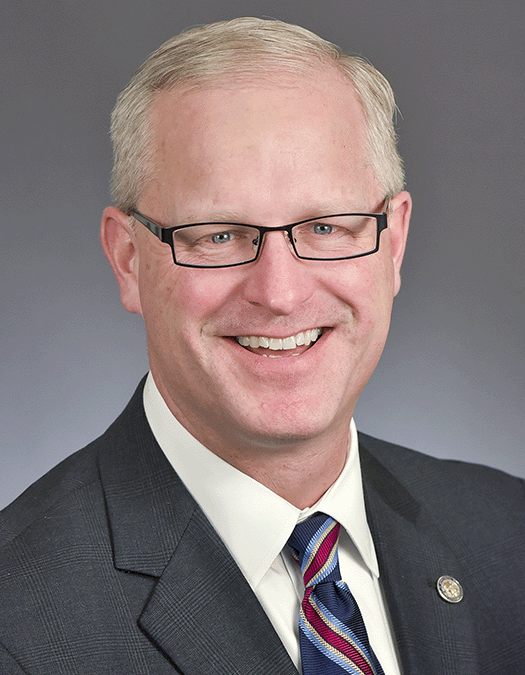
Rep. Jim Nash
Sponsored bills
Maddy summaryThis bill modifies eligibility requirements for Minnesota public television stations to receive state block grants. It updates the statute to specify that only federally licensed stations certified as eligible for community service grants through the Corporation for Public Broadcasting in 2025 will qualify for these funds. The bill maintains existing provisions for equal distribution of block grants for operational costs and matching grants based on previous Minnesota-based contributions, while allowing unused grant funds to carry over into the second fiscal year of a biennium.
Maddy summaryThis bill allocates $1,000,000 from the state's general fund to hire eight additional school safety specialists at the Minnesota School Safety Center for fiscal years 2026 and 2027. The funding is designated as a one-time appropriation that can be used until fully spent, with no restrictions on how the money is distributed among the new positions. This legislation directly affects the Minnesota School Safety Center and the public safety system by increasing the number of available safety personnel. The bill takes effect immediately upon final passage by the legislature.
Maddy summaryHF 936 requires Minnesota state agencies to conduct a cost-benefit analysis before adopting most new administrative rules, demonstrating that projected benefits exceed costs. Agencies must publish preliminary and final analyses, explain changes based on public feedback, and use standardized methods developed by the Office of Administrative Hearings. The bill exempts "exempt rules" (under §14.386), "good cause rules" (§14.388), and "expedited rules" (§14.389), but mandates that agencies notify the legislature upon adopting these exempt rules. This applies to all state agencies creating rules affecting stakeholders like businesses, local governments, and citizens.
Maddy summaryThis bill modifies how the state of Minnesota calculates registration taxes for passenger automobiles and hearses, directly affecting vehicle owners and dealers. It lowers the tax rate applied to the manufacturer's suggested retail price from 1.54% to 1.25% for cars registered before November 2020, and from 1.575% to 1.285% for newer vehicles, while also removing destination charges from the calculation for most cars. The legislation adjusts the percentage of the vehicle price used for tax purposes as the car ages, reducing the rate each year until it reaches a flat fee in the eleventh year. These tax changes are scheduled to take effect for registration periods beginning on or after January 1, 2027.
Maddy summaryThis bill allows law enforcement chiefs to give away old or retired police badges for free to former officers or the families of deceased officers. It specifically permits chiefs to provide these surplus badges to current or retired officers who were originally issued the badge, as well as to the spouses or children of peace officers who have died. The law defines a surplus badge as one bearing a seal before May 11, 2026, or a badge from a retired officer. This measure creates a new exception to existing rules that typically restrict the transfer of law enforcement identification.
Maddy summaryThis bill increases the time limit for prosecuting certain financial crimes in Minnesota, specifically targeting medical assistance fraud and theft of government funds. It directly affects prosecutors and law enforcement by extending the window in which they can file charges for these offenses. The key provision adds a 15-year statute of limitations for theft involving public money belonging to the state or local agencies, while also updating time limits for other financial crimes ranging from five to ten years depending on the specific offense. These changes apply to crimes committed on or after August 1, 2026, and to older crimes if the prosecution deadline has not yet passed.
Maddy summaryHF 2113 exempts small Minnesota employers with 50 or fewer employees from the state's paid leave requirement. This bill amends Minnesota Statutes 2024, section 268B.01, to explicitly exclude such employers from the paid leave mandate. Small businesses that currently meet the 50-employee threshold will no longer be required to provide paid leave under this law. Employers with 50 or fewer employees may still choose to opt into the paid leave program if they wish. The bill directly affects small business owners and their employees in Minnesota.
Maddy summaryThis bill would remove the automatic confirmation rule for state appointments when the legislature does not actively consider them. Currently, if the Senate or both legislative chambers fail to reject a nominee within 60 legislative days, the appointment is considered approved without further action. The legislation repeals the existing provision in Minnesota Statutes 2024, section 15.066, subdivision 3, which established this time limit. This change means appointments requiring legislative confirmation would no longer be automatically confirmed simply because the legislature did not schedule a vote within the specified timeframe. The bill applies to all state appointments except those to the Campaign Finance and Public Disclosure Board.
Maddy summaryThis bill changes how Minnesota handles government appointments by setting a 30-day deadline for legislative confirmation. If the Senate does not confirm a Senate-only appointment within 30 legislative days, or if both chambers do not confirm a joint appointment within 30 legislative days after receiving the appointment letter, the appointment is automatically rejected. The rule applies to most executive appointments but excludes the Campaign Finance and Public Disclosure Board. This amendment shortens the previous 60-day confirmation period to ensure faster decisions on appointed officials.