

Maddy summaryHF 2130 modifies several driver's license and ignition interlock requirements for individuals convicted of driving under the influence (DUI). It extends the required use period for ignition interlock devices after license reinstatement and adds criminal penalties for drivers who operate vehicles without these devices. The bill also adjusts procedures for license revocations, judicial review of extensions, temporary license issuance, and the process for reissuing impounded license plates. These changes primarily affect drivers with DUI convictions who are required to use ignition interlocks or face license restrictions.
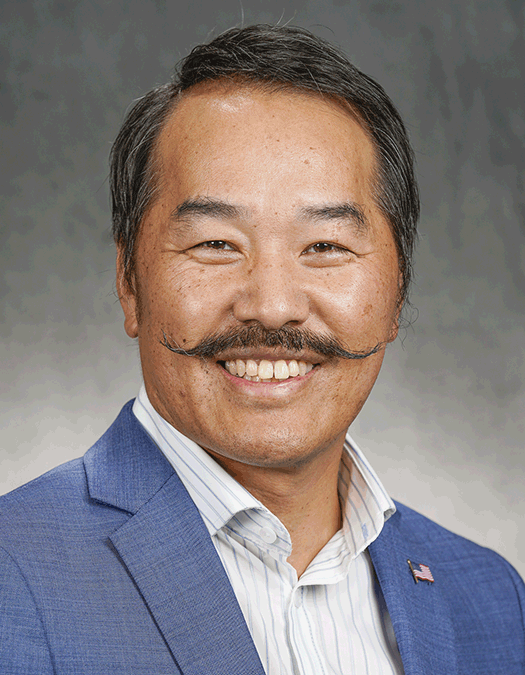
Rep. Ethan Cha
Sponsored bills
Maddy summaryHF 3132 encourages Minnesota school districts to observe Asian American and Pacific Islander Heritage Month in May. The bill directs districts to optionally provide instruction or school programs teaching students about the cultures, traditions, achievements, and contributions of Asian American and Pacific Islander communities to U.S. history and culture. School districts may partner with community groups to promote these observances. The bill does not require specific actions but offers guidance for voluntary commemoration.
Maddy summaryHF 1278 establishes a one-time $30 million reproductive health equity grant fund to support abortion care access in Minnesota. The bill provides funding to abortion providers, government agencies, and nonprofits whose primary work involves abortion care, with grants designed to increase access, cover uncompensated care for low-income patients, secure facility infrastructure, and fund staff training in trauma-informed care. Eligible organizations must apply through the commissioner of health, who will prioritize applications based on local need, health equity impact, and applicant need. The fund becomes effective July 1, 2025, with grants to begin by January 1, 2026, and includes strict privacy protections requiring confidentiality of patient information.
Maddy summaryHF 3248 appropriates $250,000 for fiscal year 2026 and $250,000 for fiscal year 2027 from Minnesota's workforce development fund to provide a one-time grant to SEWA-AIFW (South Asian Women's Empowerment and Advocacy Initiative for Women). The funds are designated to support SEWA-AIFW's workforce development services, which directly assist South Asian women and immigrant communities in Minnesota. The bill specifies the commissioner of employment and economic development will administer the grant. This is a straightforward funding measure with no additional policy provisions.
Maddy summaryHF 2761 updates Minnesota's pesticide regulations to include pesticides from treated seeds in the commissioner's management plans and monitoring. It requires new coordination between state agencies, local governments, and public health agencies for pesticide management, and adds monitoring for pesticides from treated seeds and their breakdown products in groundwater, surface water, and air. The bill establishes new labeling requirements for certain pesticide-treated seeds and defines "systemic pesticides" (like neonicotinoids) for a new regulatory program. These changes primarily affect farmers using treated seeds, state environmental agencies, and local communities managing water and air quality.
Maddy summaryHF 2764 requires Minnesota public schools (including charter schools participating in the National School Lunch Program) to offer at least one plant-based meal option daily starting with the 2026-2027 school year. A "plant-based meal" is defined as one without any animal products (meat, dairy, eggs, fish), and schools must provide this option within four weeks of a student's written request. Schools must also make the request process clear to students and parents, comply with federal nutrition standards, and report annually on implementation to the Department of Education. The bill applies to all public schools serving lunches through the National School Lunch Program.
Maddy summaryHF 1790 appropriates $3 million annually for fiscal years 2026 and 2027 from Minnesota's arts and cultural heritage fund to support the state's 12 regional library systems. The funding must be used to provide educational programs in Minnesota arts, history, literary arts, and cultural heritage, including promoting Minnesota authors from diverse backgrounds. Funds will be distributed using a specific formula based on Minnesota Statutes 134.355 (75%) plus an additional 25% distributed proportionally among all qualifying library entities. This bill directly affects regional library systems, public libraries, and community programs partnering with them to deliver these educational opportunities.
Maddy summaryHF 3051 exempts sales of admission privileges for PGA World Championship golf tournaments and related events from Minnesota's sales and use tax. The bill directly affects tournament organizers and attendees purchasing tickets to these specific events. It amends Minnesota Statutes section 297A.68 by adding a new tax exemption for the "granting of the privilege of admission" to these PGA-sponsored tournaments. The exemption applies to all sales made after June 30, 2025.
Maddy summaryHF 3154 appropriates $200,000 for fiscal year 2026 and $200,000 for fiscal year 2027 from the general fund to provide grants to the Rural Policy and Development Center. The funds are allocated through the commissioner of agriculture under Minnesota Statutes section 116J.421. This bill directly affects the Rural Policy and Development Center by providing dedicated funding for its operations and grant programs in Minnesota.
Maddy summaryHF 1391 appropriates $18,000 for fiscal year 2026 and $18,000 for fiscal year 2027 from the general fund to provide grants to the Minnesota Livestock Breeders Association. This funding supports the Association's existing work with livestock breeders in Minnesota, including breed preservation and industry support programs. The bill directly affects the Association as the recipient of these state funds, with no new regulations or broader policy changes. It is a straightforward funding measure with no additional provisions beyond the specified appropriations.