

Maddy summaryThis bill directs the Minnesota Department of Health to join the World Health Organization's Global Outbreak Alert and Response Network. The commissioner must identify the necessary application process by September 1, 2026, and submit the application by December 1, 2026. This action aims to integrate the state's health response capabilities with a global system for monitoring and addressing disease outbreaks. The legislation does not alter existing funding or staffing but establishes a specific timeline for this international partnership.
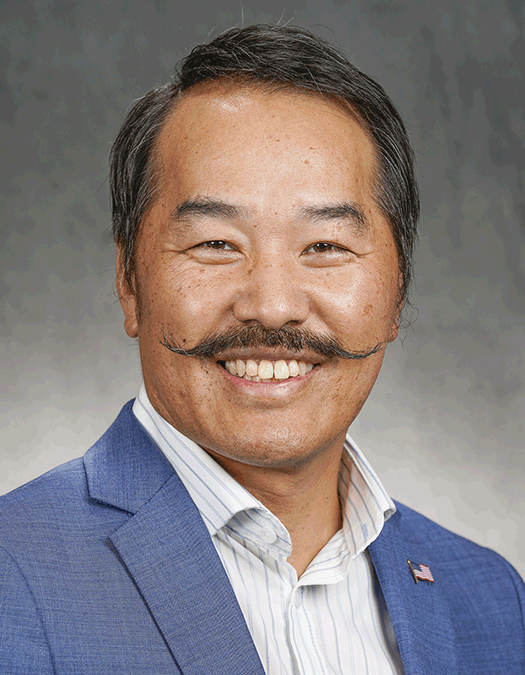
Rep. Ethan Cha
Sponsored bills
Maddy summaryThis bill prohibits the operation and promotion of online sweepstakes games in Minnesota, which are defined as internet-based games that use a dual-currency payment system allowing players to exchange currency for prizes or cash equivalents while simulating gambling. It directly affects game operators, payment processors, financial institutions, and other service providers by banning them from supporting these activities within the state. The bill also requires the commissioner of public safety and attorney general to deny operations to anyone accepting revenue from these prohibited games and to enforce penalties for violations.
Maddy summaryThis bill modifies contribution rates for the Minnesota General Employees Retirement Plan, affecting both public employees and their employers. It lowers employee contributions from 6.5% to 5.5% of salary for school employees starting July 1, 2026, while employer contributions for the same group decrease from 6.5% to 7.5% over the same period. The changes apply only to coordinated members of the retirement plan, with basic members maintaining their current 9.10% contribution rate. The legislation updates Minnesota Statutes 2024, section 353.27, to reflect these new contribution percentages for different employee categories.
Maddy summaryHF 3704 prohibits the sale or distribution of certain crop seeds (like corn, soybeans, and wheat) coated with systemic insecticides after January 1, 2029, unless a commissioner-issued waiver is provided. It also bans applying neonicotinoid insecticides (e.g., imidacloprid) to ornamental outdoor plants and turf, except in specific environmental emergencies approved by the commissioner. Farmers seeking seed waivers must complete integrated pest management training and submit third-party pest risk assessments. The bill requires annual training for applicators and allows limited emergency use if less harmful alternatives are ineffective. It directly affects farmers, gardeners, seed sellers, and pesticide applicators in Minnesota.
Maddy summaryHF 3643 establishes Melissa and Mark Hortman Memorial State Park in Ramsey County, specifically within St. Paul, as a new public park. The bill designates precise boundaries for the park using 18 directional points in St. Paul and requires that no park permit or entry fee be charged. It directs the commissioner of natural resources to manage the park under standard state park rules, while specifying that the commissioner of administration and Minnesota Historical Society retain authority over existing buildings and monuments within the park. The legislation also appropriates funds for the park’s establishment, directly affecting public access to this newly designated green space in the city.
Maddy summaryThis bill authorizes the state of Minnesota to issue up to $95 million in bonds to fund road and utility infrastructure improvements at the Sears site in St. Paul. The funds will support construction of sanitary sewer and clean water systems, public utilities, streets, sidewalks, lighting, and streetscape improvements needed to prepare the area for future development. The legislation also defines the Sears site boundaries and establishes the legal framework for managing bond proceeds, including provisions for environmental remediation and demolition of existing structures. This measure is designed to provide necessary infrastructure support for the redevelopment of the former Sears property.
Maddy summaryThis bill allows county commissioners in Minnesota to join the state's health care savings plan, which helps cover medical expenses after they leave public service. Under the new rules, commissioners who choose to participate must have their pay reduced during their term to match the county's contribution to the plan, and they must notify the county within 30 days of how much they will contribute. The plan keeps separate accounts for each participant's contributions and earnings, with limited investment options available through the executive director. This change does not require counties to negotiate with unions about these contributions and does not create new funding obligations for retiree health care costs.
Maddy summaryThis bill creates a voluntary state statistics literacy graduation seal for high school students in Minnesota who demonstrate proficiency in statistics and data interpretation. Schools will identify eligible students through assessments aligned with established guidelines and add the seal to transcripts and diplomas without charging fees. The legislation also requires the state education commissioner to identify qualifying assessments by 2027 and directs Minnesota State Colleges and Universities to establish criteria for awarding college credits to seal holders by 2028.
Maddy summaryHF 3198 appropriates $2 million for fiscal year 2026 and $1 million for fiscal year 2027 from the state general fund to the city of Brooklyn Park. This funds the Northwest Metro Regional Real Time Crime Center (RTCC), which serves six participating cities (Brooklyn Center, Brooklyn Park, Crystal, Golden Valley, New Hope, and Robbinsdale) to enhance public safety through real-time data analysis, coordination between law enforcement agencies, and community intervention staff. The RTCC must operate as a centralized facility with technology and staff to monitor and respond to criminal activity across jurisdictional lines. An advisory board, composed of police department representatives and mayors from each city, oversees the center and must submit biennial reports to the governor and legislative committees starting in 2027.
Maddy summaryHF 771 establishes a supplemental energy assistance grant program in Minnesota to provide additional support for low-income households that may not have received full federal energy assistance. It targets residents with household incomes below 60% of the state median income, offering crisis grants, primary heat assistance, emergency heating repairs, and outreach support. The bill appropriates a specific sum for fiscal year 2026 (with up to 10% for administration and 5% for outreach to underserved communities) and requires the commissioner to publish annual reports starting in 2026 detailing program participation, benefits, and demographic data by county. This program operates alongside federal LIHEAP funding but prioritizes expanding assistance to new households over increasing aid for existing recipients.