

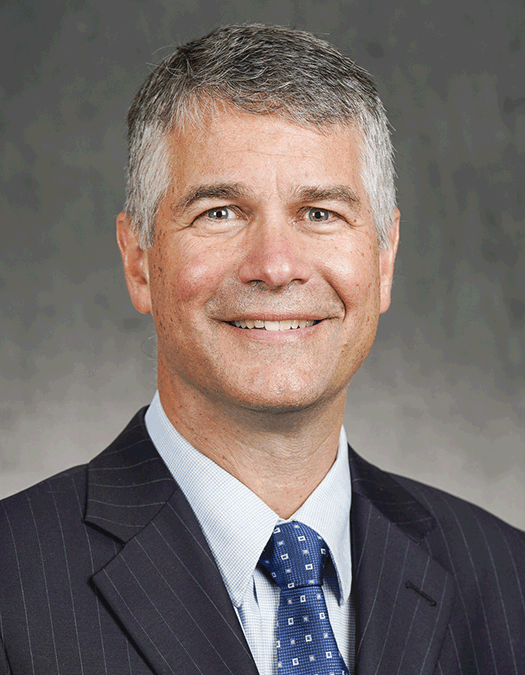
Photo of Larry Kraft
D Minnesota House · District 46A On the 2026 ballot

Rep. Larry Kraft

Compare
Total votes
1,376
all sessions
Attendance
100%
2 missed
Near the chamber average
With party
99%
of cast votes
Near the chamber average
Bipartisan score
0%
crosses aisle rarely
Near the chamber average
Sponsored
613
bills & resolutions
Near the chamber average
Committees
3
assignments
613 bills and resolutions

Sponsored bills

Total
613
Primary
68
Co-sponsor
545
This page
613
matching current filters
Co-sponsor HF 2770
In committee · Minnesota House · Co-sponsor
Sale, use, or application of neonicotinoid pesticides prohibited.

Maddy summaryHF 2770 prohibits the sale, use, or application of neonicotinoid pesticides throughout Minnesota. It directly affects all pesticide sellers, farmers, gardeners, and other users within the state. The bill takes effect January 1, 2027, banning these pesticides for all purposes, including agricultural and residential use. This is a direct policy change eliminating the legal availability of neonicotinoid pesticides in Minnesota.

In committee Apr 21, 2025 1 co-sponsor
Co-sponsor HF 2761
In committee · Minnesota House · Co-sponsor
Pesticides from treated seeds added to commissioner's pesticide management plan requirements, pesticide management plan coordination broadened to include local governments and public health agencies, various other pesticide treated seed provisions modified, and money appropriated.

Maddy summaryHF 2761 updates Minnesota's pesticide regulations to include pesticides from treated seeds in the commissioner's management plans and monitoring. It requires new coordination between state agencies, local governments, and public health agencies for pesticide management, and adds monitoring for pesticides from treated seeds and their breakdown products in groundwater, surface water, and air. The bill establishes new labeling requirements for certain pesticide-treated seeds and defines "systemic pesticides" (like neonicotinoids) for a new regulatory program. These changes primarily affect farmers using treated seeds, state environmental agencies, and local communities managing water and air quality.

In committee Apr 21, 2025 1 co-sponsor
Co-sponsor HF 1644
In committee · Minnesota House · Co-sponsor
Family supportive housing programs funding provided, and money appropriated.

Maddy summaryHF 1644 creates a grant program to fund family permanent supportive housing in Minnesota. It appropriates $1.5 million for fiscal year 2026 to provide $15,000 per family served to nonprofit organizations or Tribal governments operating housing for families facing barriers like homelessness, mental health challenges, or child protection referrals. The program requires grantees to offer specific services - including child-centered education, job training, counseling referrals, and 24/7 on-site staffing - to help families maintain stable housing and support children's well-being. Funding must serve 60% of families in the metro area, 40% outside it, and at least 10% from Minnesota Tribal Nations.

In committee Apr 21, 2025 1 co-sponsor
Co-sponsor HF 2462
In committee · Minnesota House · Co-sponsor
Workforce housing development funding provided, and money appropriated.

Maddy summaryHF 2462 appropriates $20 million from Minnesota's general fund to the housing development fund for fiscal year 2026, with an additional $20 million transferred to the Housing Finance Agency. This one-time funding supports the agency's workforce housing development program under Minnesota Statutes §462A.39, directly aiding housing developers focused on creating affordable homes for essential workers. The bill provides concrete financial resources for housing projects targeting workforce housing needs without altering existing program requirements. It affects the Housing Finance Agency, developers participating in the program, and Minnesotans seeking affordable housing options.

In committee Apr 21, 2025 1 co-sponsor
Co-sponsor HF 2994
In committee · Minnesota House · Co-sponsor
Hennepin County Sheriff's Office grant funding provided for a child care pilot program to assist with retention of law enforcement and first responders, report required, and money appropriated.

Maddy summaryHF 2994 appropriates $1 million from the workforce development fund to create a child care pilot program for Hennepin County law enforcement and first responders. The funding, available until June 2027, will help the Sheriff's Office partner with WomenVenture to recruit child care providers who can accommodate irregular work shifts, covering costs like business planning, training, and family scholarships. The program aims to improve retention by addressing a key challenge for these workers. By December 2027, the Sheriff's Office must submit a report detailing how the funds were used and recommending future child care solutions for public safety staff.

In committee Apr 21, 2025 1 co-sponsor
Co-sponsor HF 3179
In committee · Minnesota House · Co-sponsor
Certain buildings required to meet energy performance standards, reports required, and money appropriated.

Maddy summaryHF 3179 requires large government-owned and private buildings (50,000+ square feet) to meet increasingly strict energy efficiency standards, aiming to cut greenhouse gas emissions from these buildings by 90% by 2045 compared to 2005 levels. Buildings are classified into four tiers based on ownership and size, with deadlines ranging from 2042 for government buildings (Class 1) to 2045 for large private buildings (Class 4). Owners must submit annual progress reports starting in 2028 and demonstrate steady improvement toward interim targets every five years. The law includes limited exemptions for buildings facing financial distress and specifically addresses multifamily affordable housing properties meeting certain eligibility criteria.

In committee Apr 21, 2025 1 co-sponsor
Co-sponsor HF 2469
In committee · Minnesota House · Co-sponsor
Nationally recognized college entrance exam administration allowed.

Maddy summaryHF 2469 requires Minnesota public high schools to provide free administration of nationally recognized college entrance exams (like the ACT or SAT) to all students in grades 11 or 12 starting in the 2026-2027 school year. It mandates school districts to contract with approved providers for these exams, using them to meet federal accountability requirements in English, math, and science. Students eligible for free or reduced-price meals receive full fee coverage, while others may be charged but must be offered fee waivers. The bill also requires districts to provide parental access to exam details and preparation resources. This directly affects Minnesota high school students, school districts, and state education officials managing testing compliance.

In committee Apr 21, 2025 1 co-sponsor
Co-sponsor HF 2764
In committee · Minnesota House · Co-sponsor
Public schools required to offer plant-based meal options.

Maddy summaryHF 2764 requires Minnesota public schools (including charter schools participating in the National School Lunch Program) to offer at least one plant-based meal option daily starting with the 2026-2027 school year. A "plant-based meal" is defined as one without any animal products (meat, dairy, eggs, fish), and schools must provide this option within four weeks of a student's written request. Schools must also make the request process clear to students and parents, comply with federal nutrition standards, and report annually on implementation to the Department of Education. The bill applies to all public schools serving lunches through the National School Lunch Program.

In committee Apr 21, 2025 1 co-sponsor
Co-sponsor HF 2509
In committee · Minnesota House · Co-sponsor
Youth Civic Engagement Act created, youth civic engagement grant program established, and money appropriated.

Maddy summaryHF 2509, the Youth Civic Engagement Act, establishes a state grant program to support civic activities for Minnesota youth aged 14-24. The bill directs the Secretary of State to award grants to eligible organizations (like schools, nonprofits, and community centers) for specific initiatives including civic education curricula, youth-led projects, mentorship programs, and events such as designated "Youth Civic Engagement Day" (the third Friday in October). Grant funds may cover costs like program materials, participant stipends, and outreach to underserved communities. The bill appropriates unspecified funds for fiscal years 2026-2027 to support these activities, aiming to increase youth participation in voting, community service, and public decision-making.

In committee Apr 21, 2025 1 co-sponsor
Co-sponsor HF 2702
In committee · Minnesota House · Co-sponsor
Candidate elected to the office of state senator or state representative permitted to resign the position prior to the commencement of the term for which the candidate was elected, and procedures established for the conduct of a special election in the event of an expected vacancy.

Maddy summaryHF 2702 allows candidates elected to Minnesota's state Senate or House of Representatives to resign before their term begins, creating an "expected vacancy" instead of leaving the seat permanently. If a resignation occurs, the governor must issue a special election writ within five days, requiring the election to be held within 35 days. The winner of the special election takes office at the start of the term or immediately if the legislature is already in session. This bill amends Minnesota election law and applies to candidates elected on or after November 3, 2026.

In committee Apr 21, 2025 1 co-sponsor
Showing 191 to 200 of 613 bills
Previous 1 … 19 20 21 … 62 Next