

Maddy summaryHF 3405 requires Minnesota's Bureau of Criminal Apprehension (BCA) to use its existing Use of Force Investigations Unit to investigate incidents involving federal agents. Specifically, it amends Minnesota Statutes 2024, section 299C.80, to include "federal agents" (defined as those employed by DHS, ICE, CBP, or USCIS) under the unit's duty to investigate cases involving peace officers or federal agents. The bill expands the unit's current mandate - which already covers incidents with state/local officers - to now cover all incidents involving the specified federal agencies. This change directly affects federal law enforcement personnel from those agencies operating in Minnesota.
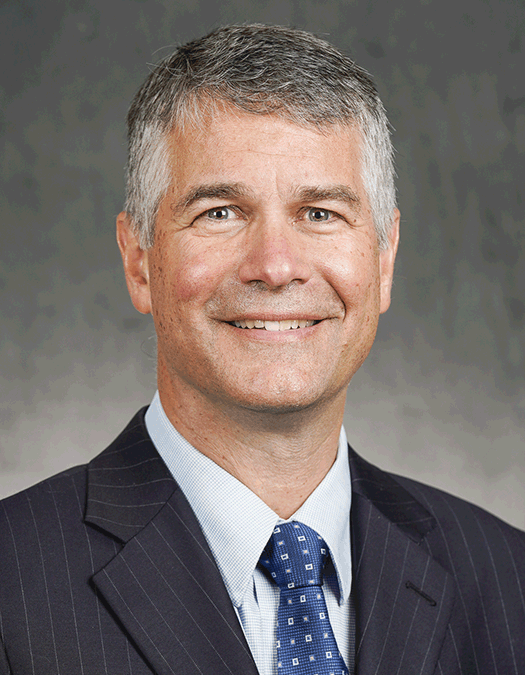
Rep. Larry Kraft
Sponsored bills
Maddy summaryHF 3368 reenacts a 2024 ban on firearm parts known as "binary triggers," which allow semi-automatic guns to fire more rapidly. The law prohibits making, selling, or owning these parts and applies retroactively from January 1, 2025. It takes effect the day after enactment and applies to crimes committed on or after that date.
Maddy summaryHF 3413 prohibits Minnesota state, county, and local government units - including county sheriffs - from entering new agreements with the federal government that allow them to enforce civil immigration law. The bill also requires immediate termination of any existing agreements of this type within 24 hours of the law taking effect. It defines "immigration enforcement agreement" broadly to include contracts, memorandums, or intergovernmental agreements that authorize local entities to carry out federal immigration enforcement actions. This policy change directly affects all state and local law enforcement agencies that previously participated in such federal programs. The law takes effect the day after final enactment, eliminating both new and ongoing participation in these specific federal-local immigration enforcement partnerships.
Maddy summaryHF 3414 creates a new legal pathway for Minnesotans to sue government officials who violate their civil rights under the U.S. or Minnesota Constitution. It allows individuals harmed by such violations to seek damages, injunctions, and attorney fees within six years of the incident. The bill also requires state and local law enforcement agencies to obtain written agreements from federal partners before collaborating, ensuring federal officers follow both U.S. and Minnesota constitutional standards and can be held liable under this new law. This directly affects people experiencing civil rights violations and law enforcement agencies entering federal partnerships.
Maddy summaryThis bill prohibits Minnesota law enforcement officers from detaining or transporting suspects in vehicles not specifically designed for human transport, such as standard patrol cars. It requires all such vehicles to be owned/leased by a law enforcement agency, clearly marked with the agency's identification, and equipped with seats and seat belts for each person transported. Exceptions apply during emergencies threatening life/safety or for undercover operations. The law directly affects police departments and officers who transport detainees, aiming to standardize safe transport conditions.
Maddy summaryHF 1197 requires mining companies seeking permits for nonferrous sulfide ore projects in Minnesota to disclose all environmental violations, fines, or legal actions against them or their key personnel within the past 15 years. The bill prohibits state agencies from conducting environmental reviews or issuing permits to applicants who have been charged, convicted, or fined for environmental violations, bribery, or corruption in that timeframe. This directly affects companies applying for mining permits by blocking approval if they or their leadership have recent environmental compliance issues. The law aims to prevent entities with poor environmental records from obtaining permits for new mining projects.
Maddy summaryHF 2376 establishes a state-funded pilot program starting in 2025-2026 to improve educational outcomes, safety, and accountability for students with disabilities in Minnesota schools. It requires school districts to apply for grants with detailed plans for inclusive classroom models, addressing accessibility, reducing overrepresentation of students of color in restrictive settings, and incorporating neurodiversity-affirming practices. The program mandates collaboration with students, families, and experts to redesign inclusion frameworks and measure success beyond test scores, including disciplinary data and family engagement. The Department of Education must submit two reports to the legislature (2026 and 2027) evaluating the pilot’s effectiveness and developing best practice guidelines for broader implementation.
Maddy summaryThis bill reenacts Minnesota's 2024 law making it a crime to transfer firearms to ineligible people (such as those with certain criminal records or protective orders) and removes a legal defense that previously allowed family or household members to avoid charges if they transferred under threat. It specifically repeals Minnesota Statutes §624.7141, subdivision 4, which had permitted a defense based on coercion by family members. The law applies to all firearm transfers to prohibited individuals, eliminating the exception for family/household member transfers. The changes take effect after enactment but apply retroactively to August 1, 2024.
Maddy summaryHF 3430 imposes new annual registration surcharges on all-electric vehicles ($100 starting in 2027) and plug-in hybrid electric vehicles ($50 starting in 2027), replacing previous calculation methods. It also creates a weight-based surcharge for passenger vehicles: 7% for vehicles weighing 5,000-5,999 pounds and 10% for heavier vehicles (6,000+ pounds), applied to existing registration taxes. These surcharges apply to registrations beginning January 1, 2027, and revenue must fund highway maintenance. The bill directly affects owners of electric vehicles, plug-in hybrids, and heavier passenger vehicles through updated registration costs.
Maddy summaryHF 1816 establishes the Office of Animal Protection within Minnesota's Department of Public Safety to address animal cruelty more systematically. The office will coordinate investigations, prosecutions, forensic veterinary services, and public education on animal cruelty, while collecting statewide data on such cases. It also expands Minnesota's definition of "crime of violence" to include animal cruelty offenses. The bill appropriates funding for the office and requires an annual report on its operations to the legislature. This affects state agencies, law enforcement, and communities by creating a centralized approach to animal cruelty prevention and enforcement.