

Maddy summaryHF 1718 updates Minnesota's estate tax law by automatically allowing surviving spouses to use their deceased spouse's unused estate tax exclusion amount. This change eliminates the need for personal representatives to actively file a separate election - portability is now automatic unless explicitly declined on the estate tax return. The bill also removes outdated filing requirements and permits estates not otherwise required to file a return to claim this exclusion by submitting a return. These provisions apply to estates of decedents dying after June 30, 2025, and affect surviving spouses and their personal representatives managing estates with unused exclusion amounts.
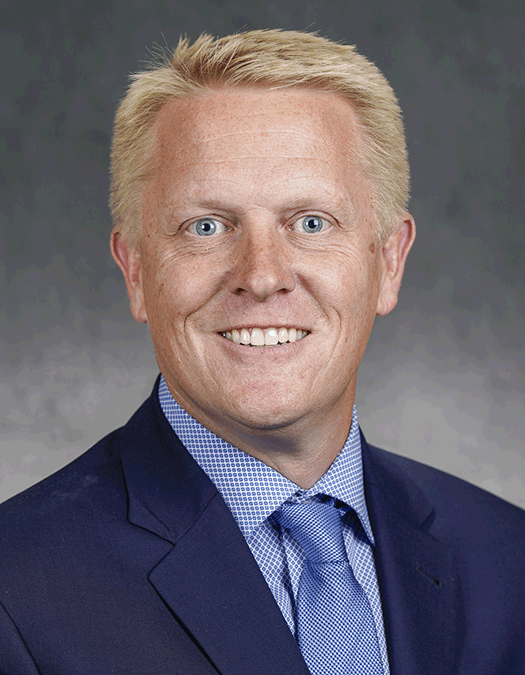
Rep. Andrew Myers
Sponsored bills
Maddy summaryHF 1733 removes a requirement that prevented waste collectors from charging residents who recycle organics a higher fee than those who do not. The bill amends Minnesota Statutes by eliminating the exception in section 115A.93, subdivision 3(c) that previously prohibited higher charges for recycling organic materials. This change allows local waste management authorities to set pricing structures where residents who recycle organics may pay more than those who do not. The policy directly affects Minnesota residents using municipal waste collection services and local waste management agencies. The amendment creates a framework where recycling fees could be structured differently based on participation in organics recycling programs.
Maddy summaryHF 1563 allows Minnesota taxpayers to reduce their taxable income by up to $10,000 (for joint filers) or $5,000 (for others) for employer-provided dependent care assistance, based on federal tax rules. It also establishes a state tax credit for employers who pay for qualified child care expenses in Minnesota, matching the federal Section 45F credit but limited to expenses incurred within the state. The bill affects employers offering dependent care benefits and employees receiving them, directly changing how these costs are treated for state tax purposes. Both provisions take effect for tax years beginning after December 31, 2024.
Maddy summaryHF 1687 creates a sales tax exemption in Minnesota for purchases made by nonprofit organizations focused on preserving specific bird habitats. It directly affects 501(c)(3) nonprofits whose primary work involves developing, preserving, restoring, or maintaining waterfowl, pheasant, or quail habitats in Minnesota. The exemption applies to qualifying items used for these habitat purposes, excluding building materials (under lump-sum contracts), lodging, prepared food, certain beverages, and motor vehicle leases. The law takes effect for sales after December 31, 2025.
Maddy summaryHF 504 requires Minnesota's commissioner of health to establish a school-based telehealth program providing mental and physical health care to students through remote visits. The program will be run by a single telehealth provider selected via competitive bidding, with participating school districts (public and charter schools) required to offer services free of charge to all enrolled students, including waiving costs for uninsured students. Funding includes up to $22 per student annually, one-time setup costs, and program evaluation, with school districts prohibited from using the service to replace existing school health staff like nurses or counselors. The program mandates annual reports on student access to health care, starting in 2027.
Maddy summaryHF 1347 appropriates $20 million from state bonds to fund grants for metropolitan cities in Minnesota to reduce wastewater inflow and infiltration in municipal sewer systems. Eligible cities must be identified by the Metropolitan Council as contributors of excessive inflow/infiltration or within 20% of allowable limits, with grants covering up to 50% of eligible capital improvement costs. The funding supports infrastructure projects to mitigate strain on the regional sewer system, administered through the Metropolitan Council's guidelines. The bonds will be issued under Minnesota's bond authority statutes to provide the necessary capital.
Maddy summaryHF 795 modifies Minnesota's driver's license road skills examination scheduling and cancellation fees. It requires the driver's license department to provide real-time website updates showing next available exam dates and times at each location, with 50% of appointments bookable 3 months in advance, 75% for 2 months, and 100% for 1 month. The bill also increases the cancellation fee for failing to appear or canceling less than 24 hours before a scheduled test from $20 to $50, while keeping a $20 fee for cancellations between 24-72 hours. These changes apply to road skills examinations scheduled on or after August 1, 2025, directly affecting drivers needing to take these tests.
Maddy summaryHF 310 expands Minnesota's dependent care tax credit by including amounts excluded from federal taxable income under Internal Revenue Code section 129 (dependent care flexible spending accounts) as eligible expenses for the state credit. This change directly affects Minnesota taxpayers who pay for dependent care (such as childcare) and claim the state credit, allowing them to count more of their childcare costs toward their credit amount. The bill amends Minnesota Statutes sections 290.0131 and 290.067 to clarify this eligibility, effective for tax years beginning after December 31, 2024. It does not change the credit percentage or maximum limits but broadens the types of qualifying expenses.
Maddy summaryHF 1013 appropriates $5 million from Minnesota's renewable development account for the Minnesota Energy Alley initiative, administered by Clean Energy Economy Minnesota. The funds are a one-time allocation to support energy sector growth through seed funding for businesses, workforce training programs, and recruiting entrepreneurs to Minnesota. The bill also directs the initiative to seek additional federal and private funding to create a long-term revenue model. This funding directly affects energy businesses and economic development efforts within the state.
Maddy summaryHF 1331 requires the commissioner of natural resources to conduct an annual statewide survey to estimate Minnesota's wolf population. The survey must cover the entire state - not just historic wolf habitats - and be completed each year. This amendment to Minnesota Statutes section 97B.646 (wolf management) adds this requirement to the existing framework, which already includes a wolf management plan and quarterly mortality reporting. The bill directly affects state wildlife management practices under the Department of Natural Resources.