

Maddy summaryHF 843 requires legislators serving on Minnesota's children and family policy or finance committees to observe child care facilities for at least 12 hours every two years. This bill directly affects those committee members by adding a new duty to their legislative responsibilities. The key provision mandates these observations to help legislators understand child care operations, and the bill also requires both the House and Senate to adopt rules for implementing this requirement. The bill does not change child care regulations but establishes a procedural obligation for legislative committees.
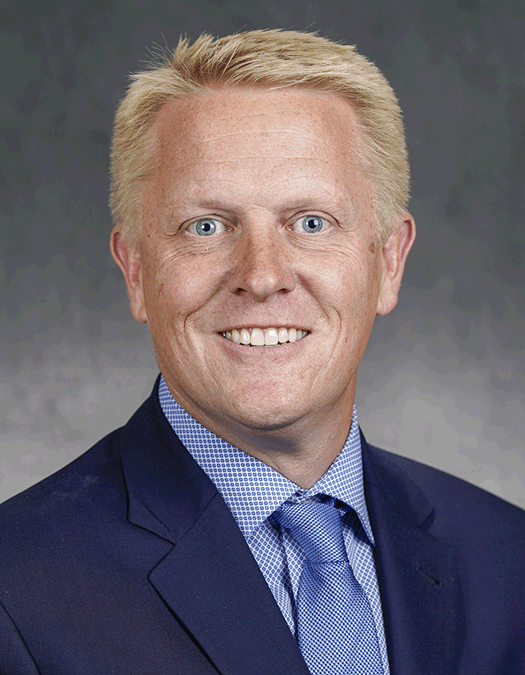
Rep. Andrew Myers
Sponsored bills
Maddy summaryHF 1247 requires Minnesota's Commissioner of Children, Youth, and Families to permanently amend child care licensing rules, allowing teacher's aides to supervise children in child care centers. This change makes permanent an exception that was temporarily permitted under a 2023 law. The commissioner must submit the proposed rule by June 1, 2025, using a specific rulemaking procedure. The bill directly affects child care centers and their staff by expanding the roles of teacher's aides in supervision without requiring a licensed teacher's presence.
Maddy summaryHF 492 appropriates $250,000 for fiscal year 2026 and $250,000 for fiscal year 2027 from the general fund to fund mental health services and outdoor recreational activities for currently serving military personnel and veterans in Minnesota. The funds are directed to Hometown Hero Outdoors, a Stillwater-based nonprofit, to support programs promoting mental wellness, community interaction with professionals, and quality of life through outdoor engagement. This bill specifically provides dedicated funding for an existing nonprofit's established services rather than creating new state programs. It directly affects military members and veterans by expanding access to mental health support and outdoor activities through this designated organization. The appropriation is limited to these specific fiscal years and services as outlined in the bill.
Maddy summaryHF 1989 increases funding for Minnesota school districts by raising the "local optional revenue" allowances used to calculate state aid. It sets the first-tier allowance at $550 for fiscal year 2027 (up from $300) and maintains the second-tier allowance at $424 through 2027, with future increases tied to the general education funding formula. School districts receive more state aid when they levy less than the maximum allowed under these new formulas, which include specific "equalizing factors" for different fiscal years (e.g., $626,450 for second-tier in 2025). The bill appropriates funds to cover this increased aid, effective for fiscal year 2027 and later.
Maddy summaryHF 178 creates a refundable tax exemption for construction materials used in new duplexes and triplexes (the only multifamily housing types covered) where first-time homebuyers own and occupy at least one unit. It exempts taxes paid on the first $460,000 of construction costs for qualifying projects, with builders paying the tax upfront and receiving a refund under existing procedures. The exemption applies to new construction only, expires July 1, 2033, and is effective for sales after June 30, 2025. This directly benefits first-time homebuyers purchasing qualifying duplexes or triplexes by reducing construction costs through a tax refund mechanism.
Maddy summaryThis bill requires legislators serving on public safety policy or finance committees to complete at least 12 hours of ride-alongs with law enforcement or fire departments every two years. It directly affects members of these specific legislative committees in both the House and Senate. The bill also mandates that both chambers adopt rules to implement this requirement. The provisions aim to provide committee members with direct exposure to public safety operations through structured on-the-job observation.
Maddy summaryHF 2315 expands property tax refunds for Minnesota homeowners whose taxes increased significantly. It directly affects homeowners whose property taxes rose more than 12% (with a $100 minimum increase) compared to the previous year, allowing a refund of 60% of the excess over 12% or $100. The bill raises the maximum refund from $1,000 to $2,500 and requires homeowners to submit prior-year tax statements. Counties must provide contact lists of eligible homeowners to help them apply, without charge, for the refund. The changes apply to refunds based on taxes payable after December 31, 2025.
Maddy summaryHF 2218 appropriates $1.5 million from the general fund for fiscal year 2026 to the Metropolitan Council. This funding will be used to provide grants to regional park agencies within the Metropolitan Council system to manage aquatic invasive species. The grants support prevention, containment, control, and enforcement efforts to reduce the spread of these species. The funds are available until June 30, 2027, and directly affect regional park management agencies in the Minneapolis-St. Paul area.
Maddy summaryHF 2468 appropriates $500,000 for fiscal year 2026 and $500,000 for fiscal year 2027 from the general fund to support mental health initiatives in Minnesota's construction industry. The funds, available until June 30, 2027, are designated for outreach, education, stigma reduction programs, and worksite strategies to prevent suicide. They can be used for grants to industry groups and developing resources targeting construction workers. This bill directly affects construction industry workers by funding concrete mental health support services through state-administered programs.
Maddy summaryHF 1534 transfers Minnesota's Healthy Eating, Here at Home program from the Minnesota Humanities Center to the Department of Health. It establishes the Fresh Bucks pilot program, allowing SNAP and Summer EBT recipients to get a dollar-for-dollar match on fresh produce purchases (up to $20 daily/$80 monthly) at participating grocery stores and retailers. Both programs target low-income households using federal nutrition benefits, with the Healthy Eating program providing $10 vouchers for farmers' market purchases and Fresh Bucks focusing on fresh produce. The bill requires annual reports from administering nonprofits and appropriates funding for both initiatives. It amends Minnesota Statutes to clarify program administration, definitions, and reporting requirements.