

Maddy summaryHF 2952 appropriates $1,000,000 from Minnesota's general fund for a grant to the United Heroes League, a nonprofit organization in Hastings. The funds must be used for capital improvements at the League's Hastings campus to directly benefit current service members, veterans, and their dependents. The grant requires the League to report to the legislature by January 15, 2027, detailing how the money was spent, including administrative costs. This bill establishes a specific funding mechanism for a nonprofit's facility upgrades with a required accountability report.
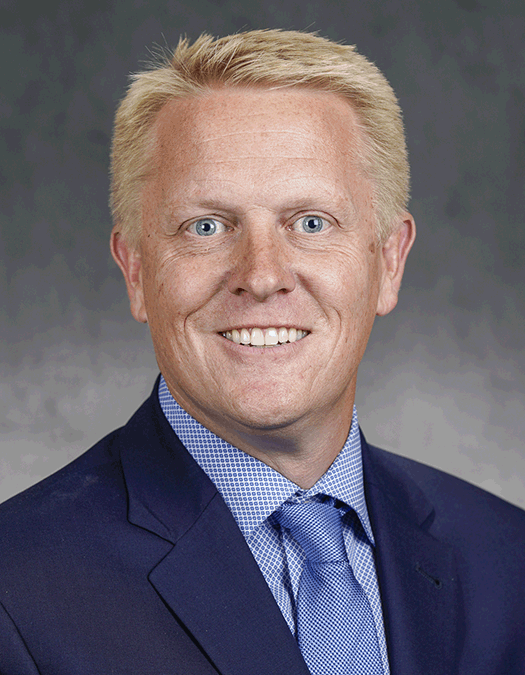
Rep. Andrew Myers
Sponsored bills
Maddy summaryHF 2953 appropriates $750,000 from state bond funds to the city of Shorewood for water main infrastructure improvements along Mill Street. The bill authorizes the state to issue up to $750,000 in bonds to cover costs for acquiring property, designing, constructing, and equipping new water mains. This funding directly supports Shorewood's efforts to replace aging water infrastructure in a specific neighborhood. The state bears the financial obligation through bond issuance, while Shorewood manages the project implementation. The bill does not create new policy but allocates existing state funds for a defined local infrastructure project.
Maddy summaryHF 2387 amends Minnesota Statutes § 124D.118 to establish a program allowing schools to provide free half-pint milk to students who do not participate in the full school lunch program. This directly affects public and nonpublic schools in Minnesota, enabling students to receive milk without needing to take a complete lunch, thereby reducing food waste from uneaten meals. The bill authorizes state reimbursement of 20 cents per milk serving for kindergarten students and up to 50 cents (or USDA rate) for lunch milk, with funding appropriated for fiscal years 2026 and 2027. Schools must follow commissioner-established guidelines to participate, focusing on daily milk access as a nutritional supplement.
Maddy summaryHF 474 appropriates $200,000 from Minnesota's general fund to replace the existing statue of Henry Mower Rice in the U.S. Capitol's Statuary Hall with a statue of Hubert H. Humphrey. The funds cover removing Rice's statue, transporting it to the Minnesota Historical Society, recasting Humphrey's statue (currently at the state capitol), and erecting the new statue. This one-time appropriation is specifically for the physical replacement project in the Capitol. The bill directly affects Minnesota's representation in the Statuary Hall collection.
Maddy summaryHF 1220 modifies Minnesota's definition of "motor vehicle dealer" to include dealers licensed under the laws of neighboring states (contiguous states). This change directly affects out-of-state dealers from states like North Dakota, South Dakota, or Wisconsin who operate in Minnesota. The bill allows Minnesota's commissioner to treat these licensed out-of-state dealers as "licensed dealers" for specific regulatory purposes under sections 168.27, 168.33, 168.345, and 168.346. The policy change takes effect October 1, 2025.
Maddy summaryHF 2829 appropriates $92,000 annually for fiscal years 2026 and 2027 from the general fund to Hennepin County Sheriff’s Office. The funds must be used to provide jail inmates with educational programming toward a high school diploma or GED ($89,000 yearly) and cover licensing fees for anger management, cognitive awareness, personal responsibility, and parenting courses ($3,000 yearly). The sheriff is required to submit an annual report by June 30 detailing fund usage, program accomplishments, and recommendations for future programming. This bill directly affects Hennepin County jail inmates by expanding access to educational and skills training.
Maddy summaryHF 1219 extends the validity period for temporary vehicle permits issued to nonresidents purchasing vehicles in Minnesota from 31 days to 60 days. This change directly affects nonresidents who buy vehicles in Minnesota and need to transport them out of state, allowing them more time to move the vehicle without immediate registration. The bill amends Minnesota Statutes sections 168.091 and 168A.11 to update the permit duration while keeping the $1 fee and electronic format requirements unchanged. The change takes effect October 1, 2025, for permits issued on or after that date.
Maddy summaryHF 1770 creates a grant program to fund infrastructure for cooperative manufactured housing developments in Minnesota. Counties and cities can receive grants covering up to 50% of infrastructure costs (like sewers, water systems, and streets) for projects serving manufactured housing cooperatives, with a maximum of $60,000 per housing lot. Applicants must provide local matching funds (cash or in-kind, such as site value) and demonstrate the project will increase workforce housing and attract additional private investment. The bill appropriates $10 million from state bond proceeds to fund these grants, with returned funds recycled for future grants if projects stall beyond five years.
Maddy summaryHF 2666 establishes special license plates for snowmobile owners in Minnesota. To qualify, applicants must be registered owners of certain vehicles (like cars, motorcycles, or RVs), pay special fees, and contribute to a dedicated snowmobile trails account. The bill appropriates all fees collected under this section to fund snowmobile trail development, maintenance, and easement acquisition through the Department of Natural Resources. This directly affects snowmobile owners who register their vehicles under the new plate system, starting January 1, 2026. The special plates are exempt from standard vehicle registration rules for plate transfers and fees.
Maddy summaryHF 515 increases Minnesota's annual funding for public schools by guaranteeing a minimum 3% raise to the general education basic formula allowance starting in fiscal year 2026. This directly affects all public school districts receiving state education funding, as it changes how their base funding amount is calculated each year. The bill requires the state education commissioner to calculate the allowance using either a 3% increase or the current inflation rate (whichever is higher), but never exceeding a 3% annual increase. The change ensures schools receive predictable, inflation-adjusted funding growth while maintaining a minimum 3% annual increase in state support.