

Maddy summaryHF 2085 appropriates funds from Minnesota's arts and cultural heritage fund to the Commissioner of Administration for a grant to the city of St. Paul. The funds are designated for planning and hosting cultural exchange events that celebrate relationships between diverse Minnesota communities and St. Paul's sister cities in Southeast Asia. The bill allocates unspecified amounts for fiscal years 2026 and 2027. This is a procedural funding measure, not a substantive policy change, directly affecting St. Paul's cultural programming and partner cities.
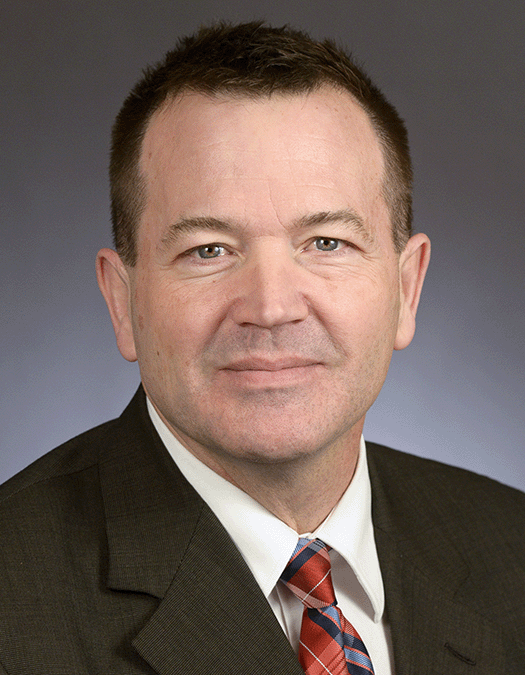
Rep. Leon Lillie
Sponsored bills
Maddy summaryHF 3092 appropriates $300,000 from Minnesota's arts and cultural heritage fund for the city of St. Paul to design and construct a mural and statue honoring Tou Ger Xiong at Lake Phalen's Tou Ger Xiong Island. The bill directly affects St. Paul by providing funding for this specific public artwork. It establishes a concrete funding mechanism through the arts and cultural heritage fund for the project. The legislation focuses on commemorating Tou Ger Xiong through public art, with no additional policy provisions beyond the funding allocation.
Maddy summaryThis bill appropriates $100,000 for fiscal year 2026 and $100,000 for fiscal year 2027 from the arts and cultural heritage fund to the Minnesota Governor's Council on Developmental Disabilities. The funding supports the Council's work to preserve and raise awareness about the history of Minnesotans with developmental disabilities. It will be used for activities like creating exhibits, videos, print materials, and traveling displays. The direct beneficiaries are Minnesotans with developmental disabilities and the Council's efforts to document their history. The bill makes no changes to eligibility or services, solely providing funding for historical preservation.
Maddy summaryHF 2942 requires Minnesota's Commissioner of Employment and Economic Development to disclose employer information to the Secure Choice Retirement Program within 30 days of a request. This affects businesses with 5+ employees that don’t already offer retirement plans, as they may be designated as "covered employers" needing to enroll staff. The bill creates a certification process allowing entities to formally claim they’re not covered employers (e.g., due to size, existing plans, or government status), with a 30-day review period by the program’s executive director. It also clarifies key terms like "enrollment window" for phased program implementation under Minnesota Statutes.
Maddy summaryHF 2387 amends Minnesota Statutes § 124D.118 to establish a program allowing schools to provide free half-pint milk to students who do not participate in the full school lunch program. This directly affects public and nonpublic schools in Minnesota, enabling students to receive milk without needing to take a complete lunch, thereby reducing food waste from uneaten meals. The bill authorizes state reimbursement of 20 cents per milk serving for kindergarten students and up to 50 cents (or USDA rate) for lunch milk, with funding appropriated for fiscal years 2026 and 2027. Schools must follow commissioner-established guidelines to participate, focusing on daily milk access as a nutritional supplement.
Maddy summaryHF 1005 adjusts payment rates for healthcare providers under Minnesota's medical assistance program. It increases reimbursement rates for certain residential services, sets a new statewide rate for behavioral health home services, and adjusts physician professional service rates. These changes directly affect hospitals, clinics, and care providers receiving state medical assistance payments for these specific services. The bill amends existing statutes to implement these rate adjustments while requiring budget neutrality for hospital payments. It does not create new programs but modifies existing payment structures for covered services.
Maddy summaryHF 2628 appropriates $1.5 million from the general fund for fiscal year 2026 and another $1.5 million for fiscal year 2027 to Catholic Charities of St. Paul and Minneapolis. The funding directly supports its homeless elders program, which assists homeless, isolated, and low-income older adults in transitioning to stable housing. This is a straightforward budget allocation with no new policy requirements or eligibility changes. The bill specifically targets funding for an existing program serving vulnerable seniors in the Twin Cities area.
Maddy summaryHF 2943 adds enforcement mechanisms to Minnesota's Secure Choice Retirement Program. It imposes escalating financial penalties on employers who fail to enroll eligible employees or distribute required information (starting at $100 per employee on the second anniversary of noncompliance, rising to $500 annually after the fourth year). The bill also creates a misdemeanor charge for employers who willfully fail to remit employee contributions withheld from paychecks within 10 days of a demand. Employers must pay withheld contributions plus interest for delays, and employees or the attorney general can pursue civil or criminal action for violations. This directly affects Minnesota employers participating in the Secure Choice program.
Maddy summaryHF 2349 creates the Ramsey County Economic Development Authority (RCEA), a new entity with powers to support local economic growth. It also expands the existing Ramsey County Housing and Redevelopment Authority (RCHRA) to include all the RCEA's development powers, effectively merging their functions under a unified structure. The bill allows Ramsey County's board to appoint commissioners for both authorities, using existing county governance procedures. This directly affects Ramsey County residents and businesses by streamlining economic development efforts through a single coordinated authority. The key change is consolidating and expanding development powers previously held separately under county and housing authorities.
Maddy summaryHF 2821 modifies Minnesota's public employee retirement system by changing when additional employer contributions end and increasing cost-of-living adjustments for retirees. It repeals the extra employer contribution once the retirement fund's assets reach 98% of liabilities (based on actuarial reports), effective after March 31 of the year following the valuation. The bill also raises the maximum annual cost-of-living adjustment for PERA retirees from 1.5% to 1.75%, but this higher rate drops to 1.5% if fund assets fall below 85% of liabilities. These changes directly affect current and future retirees in Minnesota's Public Employees Retirement Association (PERA) system and the state/local governments that fund the retirement plans.