

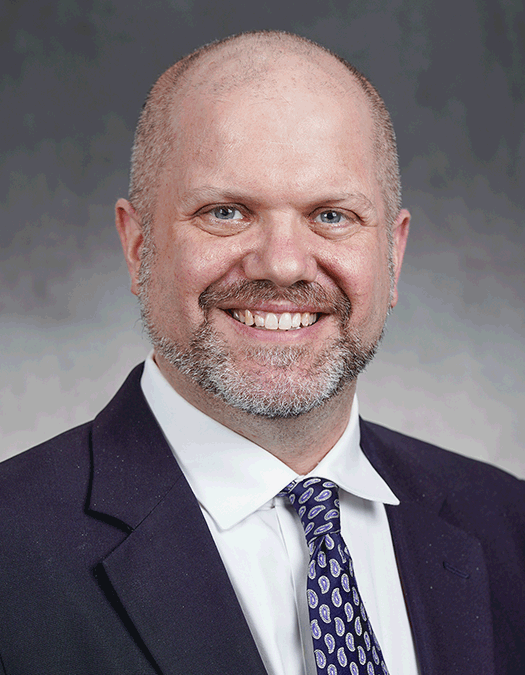
Photo of Mike Freiberg
D Minnesota House · District 43B

Rep. Mike Freiberg

Compare
Total votes
2,328
all sessions
Attendance
99%
31 missed
Near the chamber average
With party
99%
of cast votes
Higher than 87% of chamber peers
Bipartisan score
0%
crosses aisle rarely
Lower than 88% of chamber peers
Sponsored
1,342
bills & resolutions
Higher than 84% of chamber peers
Committees
3
assignments
1,342 bills and resolutions

Sponsored bills

Total
1,342
Primary
283
Co-sponsor
1,059
This page
1,342
matching current filters
Co-sponsor HF 4609
In committee · Minnesota House · Co-sponsor
Health plans required to cover infertility treatment and standard fertility preservation services, medical assistance and MinnesotaCare required to cover infertility treatment and standard fertility preservation services, and money appropriated.

Maddy summaryThis bill requires health plans in Minnesota that offer maternity benefits to cover infertility treatment and standard fertility preservation services for their enrollees. It defines infertility based on medical criteria and specifies that coverage must match the cost-sharing terms applied to maternity care, including limits on oocyte retrievals but unlimited embryo transfers. The legislation also mandates that health plans cannot impose additional restrictions, waiting periods, or benefit maximums on these services beyond what applies to maternity coverage. Additionally, the state will reimburse health plans for the costs of providing these new benefits, but only for services that would not have been covered without this law.

In committee Apr 9, 2026 1 co-sponsor
Co-sponsor HF 4477
In committee · Minnesota House · Co-sponsor
Minnesota business recovery loan program established, report required, and money appropriated.

Maddy summaryThis bill creates the Minnesota Business Recovery Loan Program to help businesses that have suffered financial losses due to increased immigration enforcement activities in the state. It appropriates $100 million in fiscal year 2026, with $18 million designated for zero-interest loans to businesses in greater Minnesota and $82 million for zero-interest loans to businesses in the seven-county metropolitan area through nonprofit lenders. To qualify, businesses must be located in Minnesota, owned by state residents, demonstrate a revenue loss of more than 30 percent between enactment and December 1, 2025, and show that losses resulted from staffing shortages, reduced customer access, or other immigration enforcement-related factors. The program provides loans ranging from $25,000 to $200,000 depending on business size and location, which must be used exclusively for business operations in Minnesota and cannot be used to repay prior debt or for real estate speculation.

In committee Apr 9, 2026 1 co-sponsor
Co-sponsor HF 4172
In committee · Minnesota House · Co-sponsor
Uses of legislative email, telephone numbers, and office space restricted.

Maddy summaryThis bill restricts how members, officers, and employees of the Minnesota Senate and House of Representatives can use legislative email addresses, telephone numbers, and office space. It prohibits giving out official legislative contact information to anyone who is not a legislator, staff member, or authorized employee, and limits member phone lines to exclusive use by the member and their assigned staff. The law also requires written notification to caucus leaders before allowing non-legislators to occupy assigned office space. Enforcement and penalties for violations are handled through rules adopted by the Senate and House, with courts barred from intervening in disputes over these provisions.

In committee Apr 9, 2026 1 co-sponsor
Co-sponsor HF 2901
In committee · Minnesota House · Co-sponsor
Allowable uses of funds in the Minnesota housing tax credit contribution account expanded to include funding supportive services in supportive housing.

Maddy summaryHF 2901 expands the allowable uses of funds in Minnesota's housing tax credit contribution account to include funding supportive services for residents in existing supportive housing. This bill directly affects housing providers operating supportive housing programs, which assist vulnerable populations like seniors or individuals with disabilities. The key change amends Minnesota Statutes § 462A.40 by adding "funding supportive services in supportive housing" to the list of permitted uses, alongside existing options like construction and rehabilitation. It does not create new funding but allows existing account funds to cover essential services like case management or healthcare coordination within current supportive housing developments.

In committee Apr 9, 2026 1 co-sponsor
Co-sponsor HF 1758
In committee · Minnesota House · Co-sponsor
Health plans required to cover infertility treatment and standard fertility preservation services, medical assistance and MinnesotaCare required to cover infertility treatment and standard fertility preservation services, and money appropriated.

Maddy summaryHF 1758 requires all health plans covering maternity benefits in Minnesota to provide comprehensive coverage for infertility diagnosis/treatment and standard fertility preservation services. It applies to private health plans, MinnesotaCare, and medical assistance programs, effective January 1, 2026. The law mandates no cost-sharing beyond what's required for maternity coverage (e.g., no extra deductibles), prohibits benefit limits specific to fertility care, and allows up to four completed oocyte retrievals per year. The state will reimburse health plans for coverage costs that wouldn’t have been provided without this law, using funds appropriated annually. This directly affects Minnesotans seeking infertility care through qualifying health insurance.

In committee Apr 9, 2026 1 co-sponsor
Co-sponsor HF 2742
In committee · Minnesota House · Co-sponsor
Minnesota clearance grant program provided, law enforcement agency solve rate of crimes involving nonfatal shootings increased, and money appropriated.

Maddy summaryHF 2742 establishes Minnesota's Clearance Grant Program to help law enforcement agencies improve their resolution rates for nonfatal shooting incidents. The program provides state funds for agencies to hire investigators, purchase forensic equipment, support victim services, and develop data-sharing systems across agencies. Recipients must submit biannual reports detailing investigations, staffing, clearance rates, and how grant funds were used. This directly affects local and state law enforcement agencies handling nonfatal shooting cases, with priority given to those with high unsolved case rates and plans for interagency collaboration. The bill requires agencies to track and report on specific metrics like victim/offender demographics and clearance rate improvements.

In committee Apr 9, 2026 1 co-sponsor
Co-sponsor HF 4839
In committee · Minnesota House · Co-sponsor
Commissioner of health directed to join World Health Organization Global Outbreak Alert and Response Network.

Maddy summaryThis bill directs the Minnesota Department of Health to join the World Health Organization's Global Outbreak Alert and Response Network. The commissioner must identify the necessary application process by September 1, 2026, and submit the application by December 1, 2026. This action aims to integrate the state's health response capabilities with a global system for monitoring and addressing disease outbreaks. The legislation does not alter existing funding or staffing but establishes a specific timeline for this international partnership.

In committee Apr 7, 2026 1 co-sponsor
Co-sponsor HF 4848
In committee · Minnesota House · Co-sponsor
Public nuisance cause of action for certain conduct related to the sale, marketing, importing, distribution, and manufacturing of firearms created.

Maddy summaryThis bill creates a new legal tool in Minnesota that allows the state Attorney General to sue firearm industry members for public nuisance if their conduct harms public safety. It directly affects companies involved in selling, manufacturing, distributing, or marketing firearms and related products like ammunition. To comply, these businesses must implement reasonable controls to prevent sales to prohibited individuals, stop thefts, and ensure adherence to existing laws. If a company violates these rules, the Attorney General can seek court orders to stop the behavior, force cleanup costs, demand financial restitution, and collect damages.

In committee Apr 7, 2026 1 co-sponsor
Co-sponsor HF 4244
In committee · Minnesota House · Co-sponsor
University of Minnesota School of Dentistry capital improvements funding provided, bonds issued, and money appropriated.

Maddy summaryThis bill authorizes the University of Minnesota to receive $100 million in state funding for capital improvements to its School of Dentistry on the Twin Cities campus. The funds will be used to design, renovate, and construct clinical, teaching, research, and administrative spaces, along with related infrastructure and hazardous materials cleanup. The state will issue bonds to finance the project, with the university covering approximately one-third of the total costs from its own sources. The legislation takes effect immediately upon final enactment.

In committee Apr 7, 2026 1 co-sponsor
Co-sponsor HF 4378
In committee · Minnesota House · Co-sponsor
Onetime emergency rental assistance aid for counties and Tribal governments established, claims administrator required to return unused funds, prior appropriation canceled, time period to correct delinquent rent temporarily extended, and money appropriated.

Maddy summaryThis bill creates a one-time emergency rental assistance fund for counties and Tribal governments in Minnesota to help low-income households facing financial hardship after August 31, 2025. The program would provide financial support for up to two months of prospective rent and utilities, as well as unpaid rent and utility bills and related fines, to households earning at or below 200 percent of the federal poverty guidelines who are at risk of eviction or homelessness. Counties and Tribal governments would receive funding based on population and geographic factors, with 95 percent of funds designated for direct assistance and 5 percent for fraud prevention and compliance monitoring. Local governments, cities, nonprofit organizations, or groups of jurisdictions could administer the assistance, and any unused funds must be returned to the state.

In committee Apr 7, 2026 1 co-sponsor
Showing 51 to 60 of 1,342 bills
Previous 1 5 6 7 135 Next