

Maddy summaryThis bill adjusts funding allocations for Minnesota's state colleges and universities, including a reduction in the Juvenile Detention Alternatives Initiative appropriation and the addition of new grants for restorative practices. It decreases the overall budget for the initiative by $500,000 while designating $500,000 as a one-time appropriation to support juvenile justice services and local alternatives to detention for counties and federally recognized Tribes. The legislation also establishes a new $500,000 grant program in fiscal year 2026 to fund restorative practices initiatives across the state. These changes affect the Minnesota State Colleges and Universities Board of Trustees, local government agencies, and juvenile justice service providers.
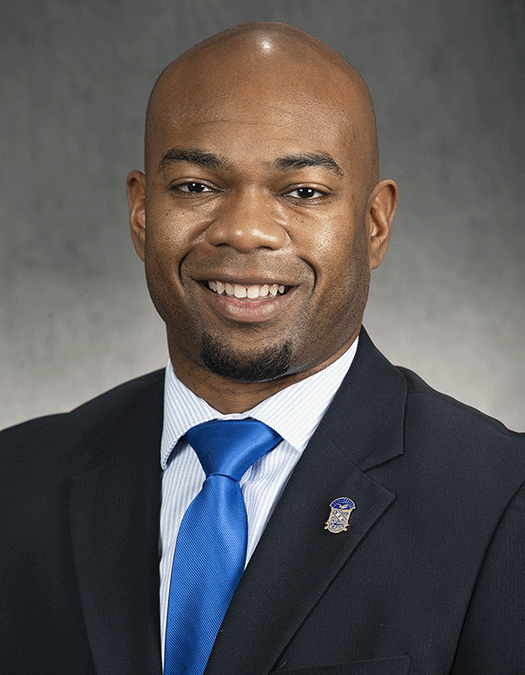
Sponsored bills
Maddy summaryThis bill legalizes and regulates mobile sports betting in Minnesota by establishing a licensing system for operators, platforms, and suppliers while prohibiting local governments from restricting the activity. The state commissioner would oversee the program, setting rules for fair play, responsible gaming measures, advertising restrictions, and financial reporting to ensure transparency and prevent problem gambling. The legislation also creates a tax on sports betting revenue, provides civil and criminal penalties for violations, and allocates funds for grants to support amateur sports programs.
Maddy summaryThis bill requires sellers of emotional support dogs to provide written notice to buyers stating that the dog is not a service animal and does not have the special training required for service dogs. The notice must be printed in bold 12-point type and included on the purchase receipt or a separate document, informing buyers that the dog is not entitled to the legal rights and privileges granted to service animals. Additionally, the bill increases criminal penalties for intentionally misrepresenting an emotional support dog as a service dog, raising the offense from a petty misdemeanor to a gross misdemeanor for repeat violations. These changes apply to all sales of emotional support dogs and take effect on August 1, 2026.
Maddy summaryThis bill allocates $1,602,000 from the state's general fund in fiscal year 2027 to the Office of the Attorney General. The funding is specifically designated to hire six additional attorneys to support the office's legal operations. The legislation does not change existing laws or procedures but provides financial resources for staffing expansion. It directly affects the Office of the Attorney General by increasing its budget for attorney positions.
Maddy summaryThis bill appropriates $1,000,000 from Minnesota's general fund in fiscal year 2027 for the Getting to Work Grant Program, which supports workforce development initiatives. The funds are allocated to the Commissioner of Employment and Economic Development to administer the program as outlined in Minnesota Statutes section 116J.545. Up to five percent of the appropriation is designated for administrative and monitoring purposes to ensure proper oversight of the grant program.
Maddy summaryHF 3483 modifies Minnesota's trespass law to require law enforcement to obtain a warrant signed by a judicial officer before entering property for civil immigration enforcement. It also prohibits local law enforcement from detaining individuals solely based on federal civil immigration detainers. The bill amends Minnesota Statutes § 609.605 to add a specific provision (subdivision 1, clause (6)) requiring a warrant with probable cause for immigration-related trespass entries. This directly affects local police and sheriff's departments by restricting their ability to act on federal immigration requests without judicial oversight. The law applies to all trespass offenses involving immigration enforcement activities on private property.
Maddy summaryHF 3174 allows the chief judge of the Office of Administrative Hearings to set aside certain permanent background disqualifications for individuals seeking employment in licensed programs, primarily affecting those in child foster care and substance use disorder treatment fields. The bill requires the chief judge to assess whether the individual poses no risk of harm, considering factors like the nature of the original offense, rehabilitation efforts, time elapsed, and for substance use workers, proof of treatment and one year of abstinence. It specifies strict criteria for substance use treatment roles, including documentation of successful treatment and no recent disqualifying conduct. The set-aside is limited to specific programs or agencies and does not remove the underlying disqualification.
Maddy summaryHF 3279 proposes a constitutional amendment to increase Minnesota's sales tax rate by 0.375% (three-eighths of one percent) starting July 1, 2027, through June 30, 2052. The revenue would fund three dedicated housing programs: 25% to a homeownership opportunity fund for owner-occupied housing, 25% to a community and household stability fund for homelessness prevention services, and 50% to a rental opportunity fund for rental assistance and housing development. All Minnesotans purchasing taxable goods would pay the slightly higher tax, with funds specifically targeting housing stability for vulnerable households. The amendment requires voter approval at the 2026 general election before taking effect.
Maddy summaryThis bill increases funding for Minnesota's Family Homeless Prevention and Assistance Program, raising the annual appropriation from $10.27 million to $45.27 million. The additional funds will be used to reduce homelessness risks and improve program effectiveness, with a portion designated for the housing development fund. The legislation also grants agencies flexibility in awarding grants to existing grantees and allows new grantees in certain areas to work with advisory committees or local care systems without meeting specific statutory requirements. These changes take effect immediately and establish a future funding base of $10.72 million starting in fiscal year 2028.
Maddy summaryThis bill creates a new grant program to provide social services and mental health support to victims of Operation Metro Surge, a federal immigration enforcement operation. The program will fund organizations that help affected individuals with basic needs like housing, food, and employment assistance, as well as mental health care. Eligible applicants include nonprofits, government agencies, tribal nations, and legal service providers, with priority given to areas most impacted by the operation. The bill appropriates unspecified funding from the state's general fund for one-time use through June 2029, requiring grantees to report on program participation and outcomes.