

Maddy summaryHF 1286 amends Minnesota's vehicle registration tax to provide reduced rates for disabled veterans. It requires the tax on a disabled veteran's vehicle to be lowered to a percentage matching their U.S. Department of Veterans Affairs disability rating, with only one vehicle per veteran eligible for the reduction. The bill also mandates that the state treasury transfer funds from the general fund to the highway user tax fund each July to cover the tax reductions provided under this provision. This change directly affects disabled veterans who own vehicles in Minnesota and alters how vehicle registration tax proceeds are handled for this specific group.
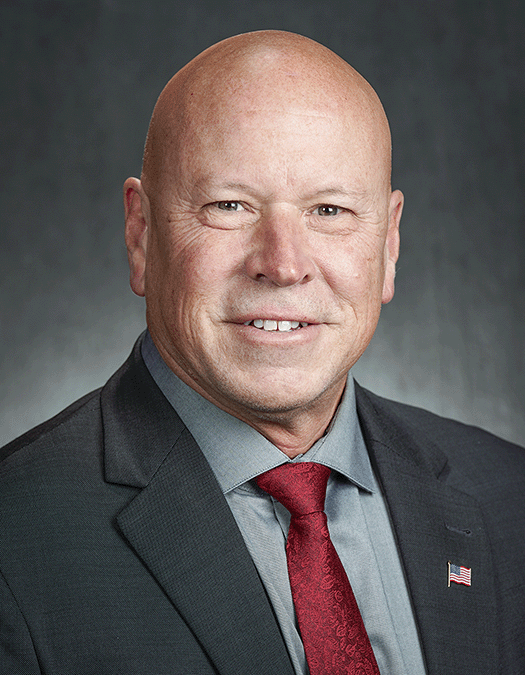
Rep. Wayne Johnson
Sponsored bills
Maddy summaryHF 3 requires Minnesota's legislative auditor to annually report to the legislature by February 1 on whether state agencies have implemented audit recommendations from the prior five years. The bill mandates that agencies' commissioners must also submit detailed reports by September 1 each year, specifically itemizing unaddressed recommendations and explaining why they weren't implemented. This directly affects all state agencies subject to legislative auditor reviews and their commissioners, who must now document progress on audit findings. The law creates a structured process for tracking accountability without altering agency funding or creating new programs.
Maddy summaryHF 1752 amends Minnesota's licensure requirements for dental hygienists under Statutes 150A.06. It establishes two pathways for applicants: (1) graduation from an accredited U.S. dental hygiene program requiring at least two years of education, or (2) a foreign dental degree comparable to a D.D.S. or D.M.D. All applicants must pass the National Board of Dental Hygiene exam, a clinical competency exam, and a test on Minnesota dental laws. The bill also specifies that applicants failing the clinical exam twice must complete additional training before retaking it, and imposes separate fees for reapplying. These changes directly affect individuals seeking to become licensed dental hygienists in Minnesota.
Maddy summaryHF 1221 exempts reported tip income from Minnesota's individual income tax and employer tax withholding requirements. The bill adds a new definition to state tax law specifying that "tips" include amounts workers report to employers under federal tax rules (IRC 6053(a)) or to the IRS as taxable wages (IRC 3121(q)). This means tipped workers, such as restaurant servers, will no longer have their reported tips counted toward their taxable income for Minnesota state taxes, and employers will not need to withhold state income tax on those amounts. The change takes effect for tax years beginning after December 31, 2024.
Maddy summaryThis bill appropriates $238,000 for fiscal year 2026 and $238,000 for fiscal year 2027 from the workforce development fund to support the Minnesota Helmets to Hardhats program. The funds will help Building Strong Communities connect National Guard members, military reservists, active duty personnel, and veterans to construction industry apprenticeships and career training through the Department of Labor and Industry. The program must not discriminate based on protected characteristics like race, religion, or gender. It directly affects military-connected individuals seeking careers in building and construction trades.
Maddy summaryHF 106 appropriates $750,000 from the general fund for fiscal year 2026 and another $750,000 for fiscal year 2027 to provide a grant to Neighbors, Inc. The bill directs these funds specifically for Neighbors, Inc. to deliver social services outreach, trainings, capacity building, support services, programming, and administrative support. This funding directly affects Neighbors, Inc. as the recipient organization and the communities they serve through these expanded services. The legislation creates a concrete, two-year financial commitment for these specific program activities.
Maddy summaryHF 924 amends Minnesota law to allow retired peace officers to possess firearms in the Capitol complex, directly affecting retired law enforcement personnel who previously may have faced restrictions. The bill updates Section 609.66 of Minnesota Statutes by adding retired peace officers to an existing exception (under federal law § 926C) for firearm possession in Capitol Area buildings, alongside active officers and others with specific permissions. This change applies to all state buildings within the Capitol Area described in Chapter 15B, excluding the National Guard Armory, and takes effect August 1, 2025. The policy modifies existing felony prohibitions without altering general firearm laws or creating new permit requirements.
Maddy summaryHF 1851 requires Minnesota's Commissioner of Employment and Economic Development to submit annual reports starting January 15, 2026, on organizations receiving workforce development grants. The reports must detail each grant's purpose, amount, the number of Minnesotans served and placed in living wage jobs, and cost-effectiveness metrics like how much grant money was used per job placement. If grants were used for non-Minnesotans, the report must explain why. These reports will be sent to relevant legislative committees, with exceptions for organizations without measurable outcomes.
Maddy summaryHF 1590 establishes mandatory minimum prison sentences for individuals who maliciously punish children, specifically targeting cases involving severe physical injury. It affects parents, legal guardians, or caretakers who cause substantial or great bodily harm to children, with penalties increasing based on the child's age (under 4) and the injury's severity. For example, causing head/neck injuries to a child under 4 mandates at least one year in prison, while causing great bodily harm requires a minimum two-year sentence. The bill amends Minnesota Statute 609.377 and takes effect August 1, 2025.
Maddy summaryHF 1778 requires Minnesota's Commissioner of Veterans Affairs to submit annual reports starting January 15, 2026, detailing grants provided to organizations serving veterans. The reports must include specific data for each recipient: grant purpose and amount, prior grants received, other state/federal funding, numbers of veterans and family members served, program completion rates, and charitable giving ratios. If grants served veterans outside Minnesota, the report must list those states and explain the rationale. This bill directly affects the Commissioner’s office and the organizations receiving veterans' grants by mandating transparent, standardized reporting to legislative committees.