

Maddy summaryThis bill removes the legal authority for federal agents from U.S. Customs and Border Protection and U.S. Citizenship and Immigration Services to make arrests under Minnesota state law. It directly affects these federal agencies by eliminating their ability to conduct warrantless arrests within the state, except when assisting local law enforcement. The change amends existing statutes to delete provisions that previously allowed these officers to arrest individuals for specific crimes like assault or felonies when on duty or with a warrant. This policy adjustment limits arrest powers to state-authorized peace officers and private citizens, while still permitting federal agents to aid in executing warrants when requested by local officers.
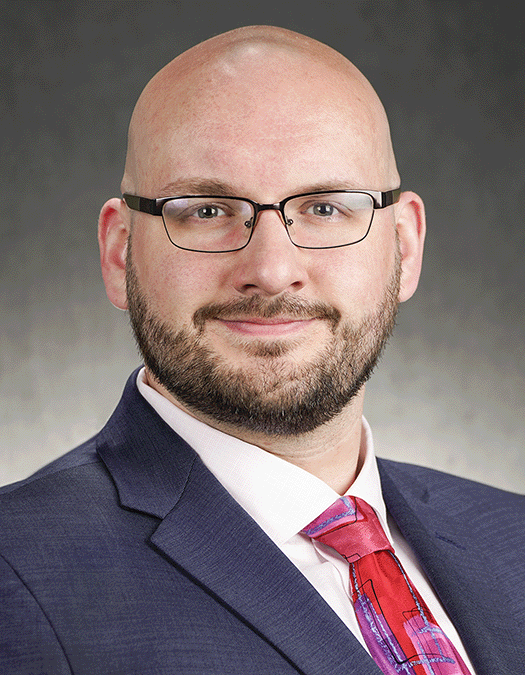
Rep. David Gottfried
Sponsored bills
Maddy summaryThis bill establishes a minimum wage requirement for workers employed at Minnesota's covered airports, including Minneapolis-St. Paul International Airport and other public airports under the Metropolitan Airports Commission. It applies to private companies and contractors that employ workers performing airport-related duties or preparing food for departing flights, excluding independent contractors and salaried professionals. The law mandates that employers pay a "quality service wage" starting in 2026, which combines the applicable minimum wage with supplemental benefits calculated according to federal Service Contract Act standards. The Minnesota Department of Labor and Industry will set the specific wage rate each year and has authority to issue compliance orders with penalties for violations.
Maddy summaryThis bill modifies Minnesota's law on concealing identity in public places. It adds "protection from smoke, gas, or other airborne toxin" as a valid exception for wearing masks or disguises, while clarifying that the law generally prohibits such concealment (except for religious, entertainment, weather, or medical reasons). The bill specifically creates two new exceptions for law enforcement: undercover officers may conceal identity when necessary for investigations or safety, and tactical team members may wear face masks to prevent facial disfigurement. The law would not apply to these officers while performing official duties under these specified circumstances. (Note: This is a proposed bill pending in committee as of February 2026.)
Maddy summaryHF 3635 establishes Minnesota's participation in an interstate compact to simplify teacher licensure across state lines. The bill creates a framework allowing teachers from member states to more easily obtain licensure in Minnesota, directly affecting educators seeking to relocate and military spouses needing to move with service members. Key provisions include sharing licensure and disciplinary information between states, removing barriers to employment, and maintaining state-specific licensing authority. This compact does not change Minnesota's current licensure rules but provides a standardized process for out-of-state teachers to gain authorization to teach in Minnesota public schools.
Maddy summaryHF 1816 establishes the Office of Animal Protection within Minnesota's Department of Public Safety to address animal cruelty more systematically. The office will coordinate investigations, prosecutions, forensic veterinary services, and public education on animal cruelty, while collecting statewide data on such cases. It also expands Minnesota's definition of "crime of violence" to include animal cruelty offenses. The bill appropriates funding for the office and requires an annual report on its operations to the legislature. This affects state agencies, law enforcement, and communities by creating a centralized approach to animal cruelty prevention and enforcement.
Maddy summaryHF 3638 modifies educator licensing rules by shifting authority for paraprofessional credential standards from the Professional Educator Licensing and Standards Board to the Commissioner of Education. It requires new data sharing agreements between the Board, the Department of Education, and school administrators to share non-educational staff data for program improvement and funding management. The bill also updates professional development requirements for mental health training and extends an existing appropriation for education programs. These changes directly impact school districts, educators, paraprofessionals, and state education agencies in Minnesota.
Maddy summaryHF 3662 amends Minnesota's individual income tax code to require taxpayers to include certain employer-reimbursed travel expenses as taxable income. Specifically, it adds an "addition" for travel costs (like fares, meals, and lodging) paid by or reimbursed by an employer while traveling within Minnesota for immigration enforcement activities or supporting such activities. This provision applies only to expenses incurred in Minnesota and takes effect for tax years starting after December 31, 2025. The bill directly affects Minnesota taxpayers whose employers cover travel related to immigration enforcement within the state.
Maddy summaryHF 3659 requires individuals who earned income in Minnesota while participating in immigration enforcement activities or providing material support to such activities to file a Minnesota income tax return. This requirement applies even if the individual's income would normally be too low to trigger a filing obligation under standard tax rules. The bill amends Minnesota Statutes to add this specific filing requirement, which takes effect for tax years beginning after December 31, 2025.
Maddy summaryHF 3668 establishes an Office of Gun Violence Prevention within Minnesota's Department of Health. The office will coordinate prevention efforts, collect and report statewide data on gun incidents/deaths, conduct research, create public health campaigns, and support victims - working with agencies like Public Safety. It requires an annual report to legislative committees by February 15 each year. The bill appropriates unspecified funding from the general fund for the office's operations in fiscal years 2026 and 2027.
Maddy summaryHF 2491 creates a School Health Advisory Committee to advise Minnesota's governor and legislature on school health policies. The committee reviews policies affecting student health, identifies essential health data to collect, and establishes models for supporting students with chronic conditions like asthma or diabetes. It must report annually by January 15 on health needs and recommend improvements to school health services and funding streams. This bill directly affects Minnesota public schools, students (especially those with health conditions), and school health staff through new advisory and reporting requirements.