

Maddy summaryHF 1724 establishes legal definitions and regulatory exemptions for direct primary care service agreements in Minnesota. The bill clarifies that these agreements - where patients pay a direct fee for primary care services (like check-ups and chronic disease management) instead of using insurance - are not considered insurance or health plans under Minnesota law. This means primary care providers (such as physicians or nurse practitioners) offering these agreements do not need insurance licenses or comply with insurance regulations (chapters 60A, 62A, 62C, 62D, or 62N). The bill directly affects primary care providers seeking to offer subscription-based care and patients choosing this alternative to traditional insurance.
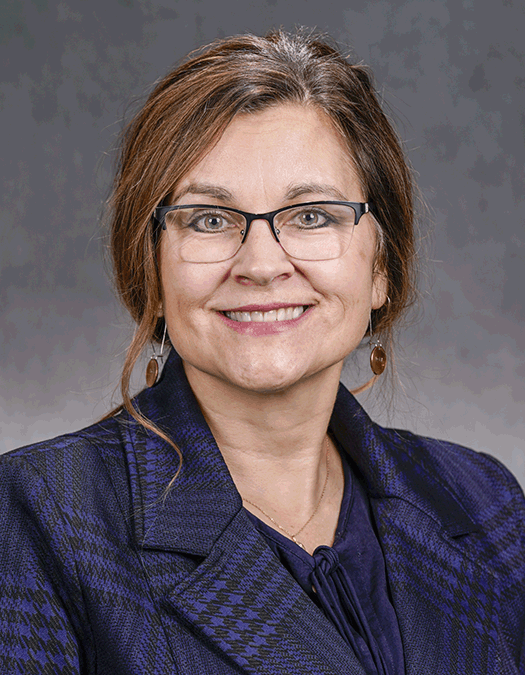
Rep. Natalie Zeleznikar
Sponsored bills
Maddy summaryThis bill directs state funds to conduct a study on building nuclear power plants in Minnesota, focusing on factors like technology, regulations, and community impact. The study will examine small modular reactors, waste management, economic benefits, and safety concerns, and must be completed by June 2027. The results will be shared with state lawmakers to inform future energy policy decisions.
Maddy summaryThis bill temporarily suspends the state motor fuels tax in Minnesota for a specific period in 2026, directly affecting drivers, fuel retailers, and businesses that purchase gasoline and diesel. Under the legislation, the tax rate is set to zero cents per gallon or per thousand cubic feet for all fuel types during the designated timeframe, which begins shortly after the bill is enacted and ends in early September 2026. To offset the lost revenue from this suspension, the state will transfer money from its general fund to the Department of Transportation to cover the costs that would have been collected from fuel taxes. The bill also allocates a one-time appropriation to the Department of Revenue to cover the administrative expenses required to implement this temporary tax pause.
Maddy summaryThis bill expands Minnesota's fourth-degree assault laws to increase penalties for physically attacking specific first responders and healthcare workers. It makes assaulting firefighters, emergency medical personnel, or hospital emergency department staff a gross misdemeanor, but raises the charge to a felony with up to three years of imprisonment if the assault causes demonstrable bodily harm. The changes apply to crimes committed on or after August 1, 2026, and affect anyone who commits these acts against the listed individuals.
Maddy summaryHF 3727 increases property tax relief for Minnesota veterans with service-connected disabilities by raising the market value exclusion amounts. Veterans with a 70% or higher disability rating now qualify for a $200,000 exclusion (up from $150,000), while those with a total and permanent 100% disability qualify for $400,000 (up from $300,000). The bill applies to veterans owning their primary residence ("homestead") in Minnesota, requiring certification of disability by the U.S. Department of Veterans Affairs and honorable military discharge. Surviving spouses of qualifying veterans may also inherit this tax benefit under specific conditions. This change directly reduces taxable value for eligible veterans’ primary homes, lowering their property tax burden.
Maddy summaryThis bill appropriates $4 million from the state airports fund to the Duluth Airport Authority for construction projects at the Duluth International Airport. The funding is specifically designated to design and build a new air traffic control tower and base building, including site preparation and utility installations. The legislation mandates that a portion of the funds serve as a match for federal contributions and restricts spending to exclude administrative costs. This one-time appropriation remains available for use until June 30, 2028.
Maddy summaryHF 3586 establishes a $10 million annual grant program for regional food banks and Minnesota Tribal governments in Minnesota, funded through the general fund for fiscal years 2027-2029. The program distributes funds based on poverty and unemployment data in each area, requiring grantees to use money for purchasing, transporting, and distributing food and hygiene products (like diapers) at no cost to recipients. Funds cannot cover staff salaries or other ineligible expenses, and grantees must report spending and maintain records for oversight. This bill directly supports food banks serving low-income individuals and families by expanding access to essential food and hygiene supplies.
Maddy summarySF 3868 prohibits the placement or operation of virtual currency kiosks (physical machines for buying/selling cryptocurrency) within Minnesota. It directly affects businesses that operate such kiosks by banning their activity statewide. The bill creates a new legal provision (Minnesota Statutes § 53B.691) explicitly stating this prohibition and repeals all existing statutes (53B.69-53B.75) that previously defined virtual currency kiosk operations and related terms. This represents a complete ban on physical cryptocurrency kiosks in Minnesota, replacing the prior regulatory framework.
Maddy summaryHF 1270 updates Minnesota's licensing rules for acupuncture and herbal medicine practitioners. The bill adds specific definitions clarifying that acupuncture includes techniques like dry needling and herbal medicine involves using herbs as part of a patient's treatment plan. It also sets new standards for continuing education, requiring courses to directly relate to acupuncture practice, have qualified instructors, last at least one hour, and maintain attendance records for four years - while excluding practice management courses. Additionally, the bill establishes an advisory council for the licensing board with defined membership criteria, including licensed practitioners and public members.
Maddy summaryHF 4949 establishes a new state program to provide financial reimbursement for hosting major sports and events in Minnesota. The bill defines eligible events to include high-profile competitions such as the Super Bowl, NCAA championships, World Cup matches, and various All-Star games. Funding is intended for local organizing committees that successfully attract these events to the state, with money drawn from a newly created account in the state treasury. The legislation also requires the commissioner of revenue to submit reports regarding the program's operations.