

Maddy summaryHF 1878 requires Minnesota's human services commissioner to seek a federal waiver by October 1, 2025, to cover traditional health care practices under the state's medical assistance program. It would allow coverage for these services when received from qualified providers at Indian Health Service facilities, tribal clinics under the Indian Self-Determination Act, or urban Indian organizations. Reimbursement would follow existing Indian Health Service outpatient rates, limited to one visit per day per enrollee. The coverage would begin on January 1, 2026, or after federal approval, whichever is later. This bill directly affects medical assistance enrollees seeking traditional health care through these specific tribal or urban Indian health providers.
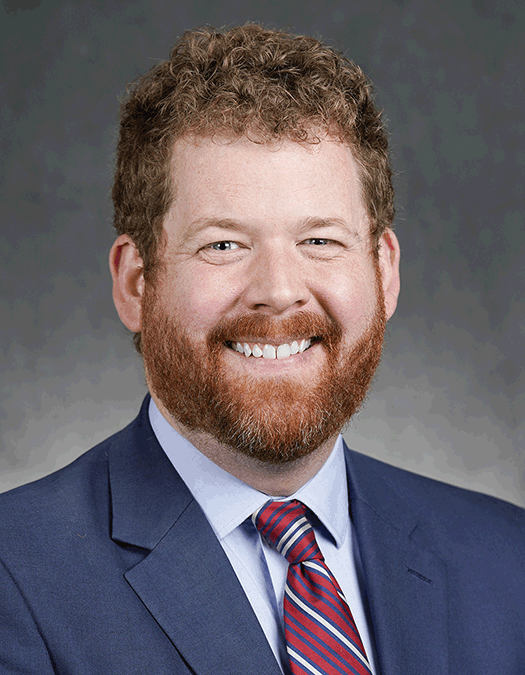
Rep. Zack Stephenson
Sponsored bills
Maddy summaryHF 2474 modifies Minnesota's absentee voting rules to clarify administrative responsibilities and enhance ballot processing procedures. It requires city or town clerks to obtain county auditor approval or provide written notice before administering absentee voting, and mandates they have technical capacity to access the statewide voter registration system after receiving state-approved training. The bill also adds specific counting checks during ballot processing: election workers must verify envelope and ballot counts at multiple stages and document discrepancies in an incident log. These changes directly affect local election officials (city clerks and county auditors) and apply to absentee voting procedures for all Minnesota elections held 85 days after the bill's effective date.
Maddy summaryHF 1587 appropriates $250,000 for the state to legally acquire specific parcels of land in Cass County through condemnation proceedings. After acquisition, the Minnesota Department of Natural Resources may transfer the land - described as surplus land bordering public waters - to a federally recognized Indian Tribe with no payment required. The bill states the state determined this land is not needed for natural resource purposes and that returning it to Tribal ownership best serves state land management interests. This bill directly affects the specified Tribal entity and the Cass County landowners involved in the condemnation process.
Maddy summaryHF 1029 requires Minnesota's health commissioner to add metachromatic leukodystrophy (MLD) testing to the official list of required medical tests for detecting heritable or congenital disorders. The bill mandates periodic updates to this test list to reflect medical advancements, new testing methods, and factors like test accuracy, treatability of conditions, and disorder severity. This directly affects healthcare providers and patients in Minnesota who rely on these screenings for early detection. The commissioner must follow specific criteria when revising the list, including input from an advisory committee, but revisions are exempt from standard rulemaking procedures.
Maddy summaryHF 683 allows Minnesota cities and counties to adopt ranked choice voting (RCV) for local elections, such as mayoral or city council races. It establishes rules for how RCV would work, including counting votes by voter preferences and reallocating votes when candidates are eliminated. The bill permits local jurisdictions to use electronic voting systems that automatically handle vote reallocation, and it appropriates funds for implementation. This bill directly affects local governments choosing to implement RCV and voters in those jurisdictions participating in local elections. It does not change state or federal election rules.
Maddy summaryHF 2745 clarifies when licensed brewers of fermented malt beverages (beer) in Minnesota must file monthly tax returns. The bill amends tax law to require brewers to submit returns by the 18th of each month, but exempts "qualified brewers" from filing if no tax is owed. This change directly affects licensed brewers who sell beer, streamlining reporting for those with no tax liability. The updated rule applies to returns due on or after July 18, 2025.
Maddy summaryHF 2710 establishes a free test and professional licensure preparation program in Minnesota, directly affecting public college students and dislocated workers (as defined in Minn. Stat. § 116L.17). The bill requires the commissioner to contract with vendors to provide free test prep services for exams like the MCAT, LSAT, GRE, GMAT, and professional licenses (e.g., nursing, real estate, securities). It appropriates $5 million for fiscal years 2026 and 2027 from the workforce development fund to administer the program. The commissioner must annually report on program effectiveness, participant numbers, and spending to legislative committees by February 15.
Maddy summaryHF 2419 requires that life jackets worn by children under 10 years old on Minnesota watercraft must include at least 31 square inches of reflective material on the front, back, and both sides (if reversible), with the material positioned near the shoulder area. This applies to all non-commercial watercraft operators transporting children under 10, excluding commercial vessels and anchored vessels for swimming. The requirement takes effect January 1, 2027, with a grace period until May 1, 2028, during which first violations would only receive safety warnings. The bill amends Minnesota Statutes section 86B.501 to add this reflective material standard to existing child life jacket rules.
Maddy summaryHF 1756 increases property tax exclusions for Minnesota veterans with service-connected disabilities and modifies benefits for surviving spouses. Veterans with a 70% or higher disability rating receive a $150,000 exclusion (doubling to $300,000 for 100% disability), with the base amount adjusted annually for inflation using a federal economic index. Surviving spouses of qualifying veterans or service members who died in active duty can continue the full $300,000 exclusion until they remarry or sell the home. The bill directly affects veterans, their spouses, and primary family caregivers who qualify under the existing program.
Maddy summaryHF 2782 exempts certain brewers from Minnesota's requirement to register their brand labels for alcoholic beverages. Currently, most brands must be registered with the state (with an initial fee of $40 and renewal fee of $30), unless sold exclusively on the brewer's premises or for off-sale under section 340A.29. This bill adds a new exemption category, removing the registration obligation for eligible brewers without specifying their exact criteria. The change simplifies administrative requirements for these brewers but does not alter existing fees or exceptions for other brands.