

Maddy summaryHF 492 appropriates $250,000 for fiscal year 2026 and $250,000 for fiscal year 2027 from the general fund to fund mental health services and outdoor recreational activities for currently serving military personnel and veterans in Minnesota. The funds are directed to Hometown Hero Outdoors, a Stillwater-based nonprofit, to support programs promoting mental wellness, community interaction with professionals, and quality of life through outdoor engagement. This bill specifically provides dedicated funding for an existing nonprofit's established services rather than creating new state programs. It directly affects military members and veterans by expanding access to mental health support and outdoor activities through this designated organization. The appropriation is limited to these specific fiscal years and services as outlined in the bill.
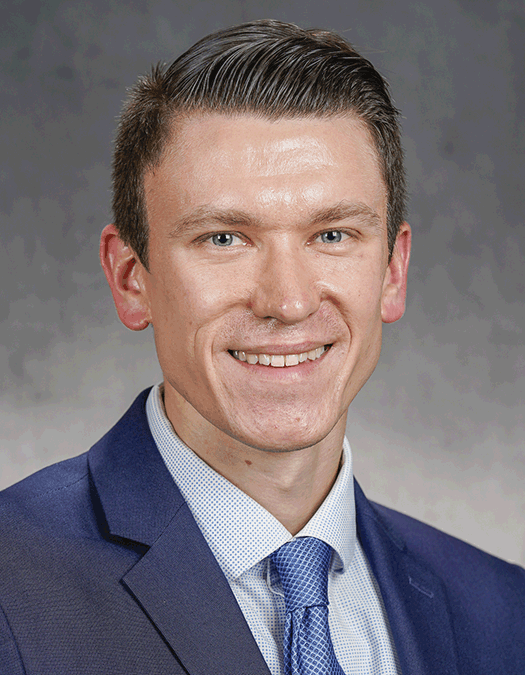
Rep. Matt Norris
Sponsored bills
Maddy summaryHF 2454 establishes a Minnesota law enforcement grant program to help recruit and retain officers by covering tuition and fees at public colleges for eligible individuals. It directly affects current Minnesota law enforcement officers, their dependent children, and dependent children of officers who suffered a total and permanent duty disability while serving. The grant covers 100% of tuition and fees after other aid is deducted, renewable each semester if eligibility continues (e.g., maintaining enrollment in criminal justice programs and meeting academic standards). Funds are appropriated by the state to administer the program through the Office of Higher Education.
Maddy summaryHF 1989 increases funding for Minnesota school districts by raising the "local optional revenue" allowances used to calculate state aid. It sets the first-tier allowance at $550 for fiscal year 2027 (up from $300) and maintains the second-tier allowance at $424 through 2027, with future increases tied to the general education funding formula. School districts receive more state aid when they levy less than the maximum allowed under these new formulas, which include specific "equalizing factors" for different fiscal years (e.g., $626,450 for second-tier in 2025). The bill appropriates funds to cover this increased aid, effective for fiscal year 2027 and later.
Maddy summaryHF 2302 amends Minnesota's tax code to allow 18-year-old children to qualify for the state child credit, expanding eligibility beyond the previous age limit. The bill removes the exclusion for individuals who turned 18 during the tax year by revising definitions in Minnesota Statutes sections 290.0661 and 290.0671. It directly affects 18-year-olds who meet other eligibility criteria for the credit, such as income and residency requirements. The change takes effect for tax years beginning after December 31, 2024.
Maddy summaryHF 2447 establishes a dedicated account for financial assurance funds collected from gas development permits. It requires the commissioner of natural resources to deposit these funds into an account managed by the State Board of Investment, with earnings credited back to the account. The funds can only be used for financial assurance purposes related to specific gas permits under chapters 93 and 103I of Minnesota Statutes. This bill directly affects gas development permit applicants and the commissioner's office, creating a new mechanism for handling and investing these required funds.
Maddy summaryThis bill requires legislators serving on public safety policy or finance committees to complete at least 12 hours of ride-alongs with law enforcement or fire departments every two years. It directly affects members of these specific legislative committees in both the House and Senate. The bill also mandates that both chambers adopt rules to implement this requirement. The provisions aim to provide committee members with direct exposure to public safety operations through structured on-the-job observation.
Maddy summaryHF 2315 expands property tax refunds for Minnesota homeowners whose taxes increased significantly. It directly affects homeowners whose property taxes rose more than 12% (with a $100 minimum increase) compared to the previous year, allowing a refund of 60% of the excess over 12% or $100. The bill raises the maximum refund from $1,000 to $2,500 and requires homeowners to submit prior-year tax statements. Counties must provide contact lists of eligible homeowners to help them apply, without charge, for the refund. The changes apply to refunds based on taxes payable after December 31, 2025.
Maddy summaryHF 1100 requires Minnesota's human services commissioner to establish a $4.50 per prescription payment to eligible community pharmacies in rural or underserved areas. This payment, added to existing fees, must be paid by managed care plans, county health programs, and pharmacy benefit managers to qualifying pharmacies that serve medically underserved populations or share ownership with 12 or fewer Minnesota pharmacies. The bill appropriates funds for this program in fiscal years 2026 and 2027, with the payment ending if federal approval isn't obtained. It explicitly states this payment cannot replace or reduce other fees paid to pharmacies.
Maddy summaryHF 1485 requires Minnesota health insurers and medical assistance programs to cover over-the-counter (OTC) contraceptive drugs, devices, and products without cost-sharing (like co-pays or deductibles). It applies directly to health plans and enrollees, mandating coverage of all FDA-approved OTC contraceptives at the point of sale without prescription requirements or quantity limits. The bill also requires health plans to list covered contraceptive services accessibly and cover provider-recommended methods based on medical necessity. This law takes effect January 1, 2026, for health plans offered, issued, or renewed after that date.
Maddy summaryHF 278 increases fees for all-terrain vehicle (ATV) registrations and nonresident trail passes in Minnesota. It adds a $45 surcharge to all ATV registration fees (raising public-use fees from $6 to $20 annually) and increases the nonresident trail pass fee from $30 to $45 per year. The surcharge and higher pass fees fund grant-in-aid programs under Minnesota Statutes 84.927, specifically for constructing and maintaining ATV trails and use areas in counties and municipalities. This directly affects ATV owners (residents and nonresidents) who must pay these updated fees to operate on state or grant-in-aid trails.