

Maddy summaryHF 641 expands Minnesota's fourth-degree assault law to specifically protect healthcare workers. It makes it a felony to physically assault a nurse, physician, or other healthcare provider in a hospital emergency department, causing physical injury. The penalty includes up to two years in prison, a $4,000 fine, or both. This law applies to crimes committed on or after August 1, 2025, and directly affects healthcare workers providing emergency care. The bill adds this protection alongside existing safeguards for firefighters and emergency medical personnel.
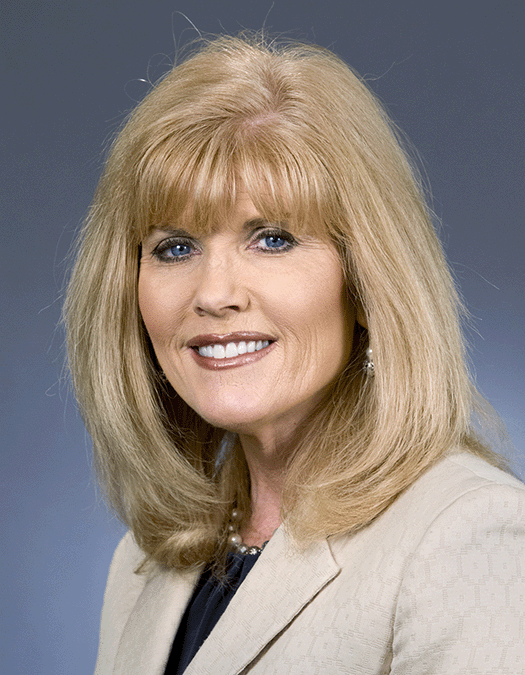
Rep. Peggy Scott
Sponsored bills
Maddy summaryThis bill aligns Minnesota's state tax law with the federal tax treatment of tip income. It adds a provision allowing Minnesota taxpayers to deduct qualified tips under the federal Internal Revenue Code (section 224) as a subtraction from taxable income. The deduction applies to taxable years beginning after December 31, 2028, but is effective retroactively for years starting after December 31, 2024. This directly affects Minnesota residents who earn tip income and file individual income tax returns, potentially reducing their state tax liability.
Maddy summaryHF 3524 would allow Minnesota taxpayers to deduct qualified overtime pay from their state taxable income, aligning Minnesota's tax code with a federal deduction for overtime compensation. This bill directly affects Minnesota residents who earn overtime pay and file state income taxes. The key provision adopts the federal definition of "qualified overtime compensation" under Internal Revenue Code section 225, permitting this deduction for taxable years beginning after December 31, 2028, though it applies retroactively to years starting after December 31, 2024. The bill amends Minnesota Statutes 2024, section 290.0132, to add this deduction as a subtraction from taxable income.
Maddy summaryHF 3436 requires drivers approaching a stopped school bus displaying flashing red lights to stop at least 20 feet away. The bill amends Minnesota Statutes section 169.444 to mandate this stop until the bus retracts its stop arm and turns off the red lights. It also adds a new provision requiring drivers to prepare to stop within 20 feet when a bus shows prewarning amber lights, signaling red lights are about to activate. This law directly affects all drivers operating vehicles near school buses in Minnesota, aiming to improve safety for children boarding or exiting buses. The bill takes effect the day after final enactment.
Maddy summaryHF 391 requires courts to automatically prohibit abusive parties from possessing firearms when issuing certain domestic abuse protection orders. Specifically, if a court order restrains harassment/stalking and finds the abuser poses a credible threat to a child's safety, it must bar firearm possession for the order's duration. The bill mandates that abusive parties transfer all firearms within three business days to a licensed dealer, law enforcement, or a legally permitted third party. This applies to orders issued after a hearing where the abuser received notice and had a chance to participate. The law aims to enforce existing court orders by creating a clear, time-bound process for firearm removal.
Maddy summaryHF 2062 modifies Minnesota's sales tax payment rules for retailers. It requires large retailers (with $250,000+ annual tax liability) to pay 84.5% of estimated June tax by June 30 and the remainder by August 20, while smaller retailers pay monthly. The bill also creates a "vendor allowance," allowing retailers to retain a portion of collected sales tax (at least $10 or 1% of eligible taxes) to offset collection costs, provided taxes are reported and paid on time. This directly affects most Minnesota retailers, particularly construction material sellers (defined in the bill), and takes effect for sales after June 30, 2025.
Maddy summaryThis bill clarifies notification requirements for public authorities in family law cases involving children, requiring parents receiving public assistance to provide specific personal information to ensure child support obligations are established. It also extends the expiration date of the Supreme Court Council on Child Protection from January 2026 to June 2027 and adjusts the final report deadline from January 2026 to December 2026. The legislation allocates $1,000,000 in fiscal year 2025 for the council's establishment and administration, with funds available until June 30, 2027. These changes directly affect families undergoing dissolution or custody proceedings and the Minnesota Supreme Court Council on Child Protection.
Maddy summaryThis bill establishes a new felony crime in Minnesota for providing material support or resources to designated foreign terrorist organizations or those engaged in terrorist activity. It directly affects individuals who might offer money, training, weapons, shelter, or other assistance to such groups, while explicitly excluding medical and religious materials from the definition. The law sets tiered penalties based on harm caused, ranging from up to ten years in prison for basic violations to up to forty years if the support results in death. The legislation will take effect on August 1, 2026, and applies only to crimes committed on or after that date.
Maddy summaryThis bill stops annual payments from the Monticello nuclear plant to a state renewable energy fund and modifies how distributed solar energy standards are handled. It extends a sales tax exemption on residential natural gas and electricity to apply year-round instead of seasonally. Additionally, the bill exempts electric and natural gas facilities from paying the state commercial-industrial property tax. These changes directly affect the Monticello nuclear plant operator, solar energy developers, residential energy consumers, and utility companies operating gas and electric infrastructure.
Maddy summaryHF 2962 modifies Minnesota's paid leave program by clarifying who qualifies as an employee and employer under the law. It excludes seasonal hospitality workers (defined as those employed ≤150 days/year in hospitality with specific revenue patterns), self-employed individuals, and small employers unless they elect coverage. The bill also expands the definition of "family member" to include grandparents, grandchildren, in-laws, and up to one annually designated non-family individual with a close personal relationship. These changes directly affect workers and employers covered by Minnesota's paid leave law, particularly in hospitality and small businesses.