

Maddy summaryHF 2632 creates a new criminal offense in Minnesota for intentionally altering a digital photo or video of another person without their consent, with the intent to deceive others into believing the subject authorized the content (e.g., via email, text, or social media), and with the purpose of harming, defrauding, or maliciously misrepresenting the person, an event they attended, or their property. This law directly affects individuals who create or share manipulated media meeting all three criteria: lack of consent, intent to deceive, and malicious harm. Violating this law is classified as a gross misdemeanor, effective August 1, 2025. The bill specifically targets intentional deception using digital media, not accidental edits or non-malicious alterations.
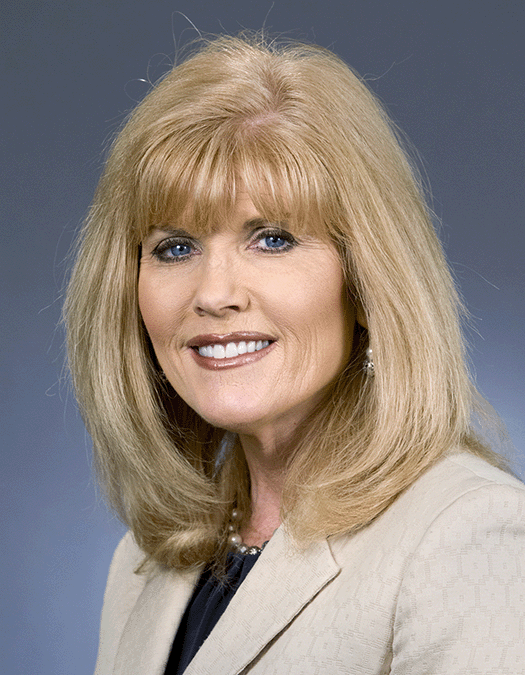
Rep. Peggy Scott
Sponsored bills
Maddy summaryHF 2637 appropriates $6.8 million from state bonds to fund a new water treatment facility and trunk water main improvements in Ramsey, Minnesota. The funds will specifically remove manganese and iron from Ramsey's water supply. The state will issue bonds up to $6.8 million under existing bond authority to provide this grant to the city. This bill directly affects Ramsey's public water system and its residents by financing infrastructure upgrades to improve water quality.
Maddy summaryHF 2630 expands Minnesota's unauthorized computer access law to include accessing an unsecured computer containing personal data, even without bypassing security systems. This change directly affects individuals who access computers holding personal information without authorization, such as through open or unsecured devices. The bill amends Minnesota Statutes section 609.891 by adding a new subsection (3) to define this activity as a violation. The law maintains existing penalty tiers (misdemeanor, gross misdemeanor, or felony) based on the severity of the access and potential harm, but broadens the scope of what constitutes unauthorized access.
Maddy summaryHF 2638 extends a sales and use tax exemption for construction materials used in specific water infrastructure projects in Ramsey, Minnesota. It modifies an existing law to allow tax-free purchases of materials for new water treatment plants and trunk water main improvements, covering purchases made after December 31, 2022, and before July 1, 2027. The bill also specifies that refunds for eligible purchases must be issued after June 30, 2023, and before July 1, 2027, with the exemption applying retroactively to qualifying purchases. This directly affects construction companies buying materials for these projects and the city of Ramsey's water infrastructure development.
Maddy summaryHF 2631 proposes amending the Minnesota Constitution to explicitly protect citizens' electronic communications and data from unreasonable searches and seizures, similar to existing protections for physical items like papers and homes. If approved by voters in 2026, the amendment would require law enforcement to obtain warrants based on probable cause to access digital information such as emails, text messages, or location data. This change directly affects all Minnesotans by establishing a constitutional right to privacy for digital communications. The bill is a constitutional amendment, not a law, and must be voted on by the public in the 2026 general election.
Maddy summaryHF 1580 amends Minnesota law to require medical personnel to provide immediate care to infants born alive during abortion procedures. The bill mandates that such infants be recognized as human persons under the law and that all reasonable medical measures, consistent with standard practice, be taken to preserve their life and health, including proper medical documentation. This directly affects healthcare providers performing abortions in Minnesota who encounter infants born alive. The law takes effect the day after final enactment. It focuses solely on medical care protocols for surviving infants, not on changing abortion access or legality.
Maddy summaryHF 1960 appropriates $350,000 for fiscal year 2026 and $350,000 for fiscal year 2027 from the workforce development fund to support displaced homemaker programs in Minnesota. The funds will be distributed by the commissioner of employment and economic development to existing nonprofit and state-run displaced homemaker programs through the adult career pathways program. This is a one-time funding measure specifically for programs assisting individuals (typically women) who have been displaced from the workforce due to life changes like caregiving or divorce. The bill directly affects these programs and their participants, providing targeted financial support without altering eligibility or program structure.
Maddy summaryHF 2241 requires North Star Promise scholarship recipients in Minnesota to live and work in the state for three years after completing their degree or credential program, beginning within six months of graduation. If they fail to meet this requirement, their scholarship converts to a repayable student loan with interest. Exceptions include deferrals for graduate study, Peace Corps/AmeriCorps service, or extreme hardship, and waivers if they didn’t complete their program. The rule applies to scholarships awarded starting fall 2026.
Maddy summaryThis bill recognizes Minnesota's historic state flag (described as a blue flag with a central emblem featuring 19 stars, the word "MINNESOTA," and scenes from the Great Seal) and grants all Minnesotans the right to display it. It requires the lieutenant governor to set standards for its display on state property, mandating it be shown during specified holidays and on Capitol grounds during legislative sessions. The bill also allows the historic flag to be displayed on other public property for ceremonial purposes, while requiring it to be placed beneath the official state flag when both are displayed together. It directly affects all Minnesotans who display the flag and government entities managing public property.
Maddy summaryHF 1021 increases funding for the Minnesota Family Resiliency Partnership by reallocating more court and marriage license fees. It raises the amount from dissolution court fees (currently $30) to $60 per fee, and increases the marriage license fee contribution from $25 to $55 per license. These additional funds are directed to the Partnership’s special revenue fund under section 116L.96. The bill directly affects the Partnership’s budget, providing increased resources for its programs without changing eligibility or service delivery.