

Maddy summaryThis bill modifies how Minnesota calculates registration taxes for passenger cars and hearses by lowering the tax rate based on the vehicle's manufacturer's suggested retail price. It changes the tax calculation for new vehicles registered on or after November 16, 2020, and reduces the percentage of the vehicle's value taxed for each subsequent year of ownership. The legislation also establishes a process to transfer money from the state's general fund to the highway user tax distribution fund to cover any revenue shortfall caused by these tax reductions.
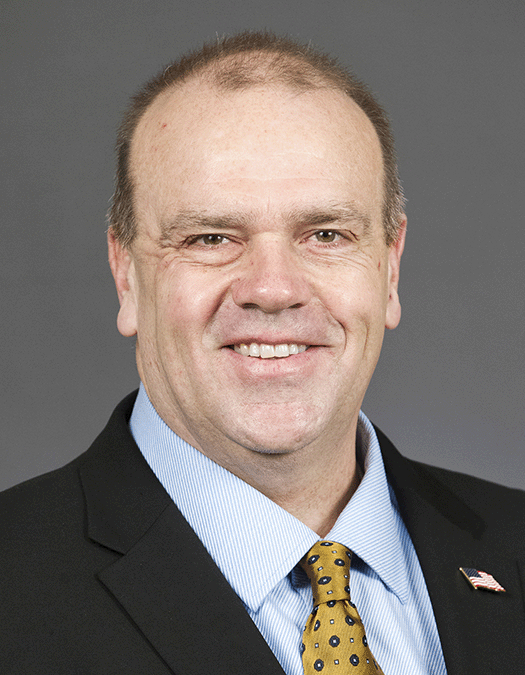
Rep. Matt Bliss
Sponsored bills
Maddy summaryThis bill updates Minnesota's definition of an all-terrain vehicle by increasing the maximum weight limit from 2,000 to 3,500 pounds. It also raises the annual fee for nonresidents to operate an all-terrain vehicle on state trails from $30 to $50. The collected fees will continue to fund grants for local governments to build and maintain all-terrain vehicle trails. These changes affect vehicle owners, operators, and the state's natural resources management system.
Maddy summaryThis bill establishes a regulated therapeutic use program for psilocybin in Minnesota, allowing adults aged 21 and older with qualifying medical conditions to access the substance under medical supervision. The program requires patients to work with licensed health care practitioners and registered facilitators who oversee preparation, administration, and integration sessions. Key provisions include creating an advisory committee to guide program oversight, setting up registration requirements for patients, suppliers, and facilitators, and establishing civil penalties for violations. The legislation also appropriates funds for program implementation and creates a framework for data collection and public health monitoring.
Maddy summaryHF 530 proposes adding a constitutional amendment requiring a three-fifths vote in both legislative chambers to approve any law conveying state land exceeding 640 acres for less than its market value. This would directly affect state land transactions, requiring broader legislative consensus for such sales. The bill mandates that if adopted, the amendment must be submitted to voters in the 2026 general election with a specific "yes/no" question. The key provision changes the standard for approving below-market-value land conveyances from a simple majority to a supermajority vote. The amendment would apply only to land sales exceeding 640 acres, not smaller transactions.
Maddy summaryThis bill allocates $5,000,000 from the state's general fund to support the construction and equipping of a community center on the White Earth Reservation. The funding is designated for the White Earth Band of Ojibwe and will cover costs such as design, site preparation, construction, and furnishing. The new facility is intended to offer space for health, wellness, and community gatherings for both Tribal and non-Tribal residents. This one-time appropriation becomes effective immediately upon the bill's final passage.
Maddy summaryThis bill establishes a temporary sales tax holiday for the entire month of July 2026 to commemorate the 250th anniversary of the United States. It directly affects Minnesota retailers and consumers by exempting the sale of most tangible personal property from state sales tax during this period. The exemption applies to all retail sales from July 1 through July 31, 2026, but excludes alcohol, taxable cannabis products, and motor vehicles. The bill takes effect the day after it is finalized and signed into law.
Maddy summaryThis bill, known as Harvey's Law, requires licensed child care centers in Minnesota to install video security cameras in public and shared areas under specific conditions. Centers must have cameras if they are required to post a maltreatment investigation memorandum, with compliance needed within six months and maintained for four years. Additionally, starting in 2027, centers receiving certain state child care funding must also install and maintain these cameras. The law applies to facilities with public access areas and aims to enhance safety oversight through video monitoring requirements.
Maddy summaryThis bill removes the standard four-year statute of limitations for medical malpractice claims related to gender-affirming care received by minors in Minnesota. It defines gender-affirming care as medical or surgical interventions such as hormone therapy, puberty blockers, or gender reassignment surgery intended to affirm an individual's perceived gender identity that differs from their biological sex. The change allows patients or former patients to file lawsuits against healthcare providers for alleged errors or failures in such care without being restricted by the usual time limit. The amendment applies specifically to cases involving minor children and does not alter the statute of limitations for other types of medical malpractice claims.
Maddy summaryThis bill designates the Quality Learning Center in Hennepin County as a historic place under Minnesota state law. It achieves this by amending Minnesota Statutes section 138.664 to add a new subdivision specifically naming the facility. The change is administrative and does not alter the center's operations or funding, but it formally recognizes the building's historical significance within the state's historic preservation framework.
Maddy summaryThis bill establishes a new taxpayer refund account in Minnesota to hold undesignated money returned to the state through restitution, fraud recovery, overpayment recovery, administrative fines, or other reimbursements. State agencies must transfer these recovered funds to the commissioner of management and budget within 60 days of receipt, and the funds must be used exclusively for issuing refunds to individual taxpayers who filed Minnesota income tax returns. The commissioner will distribute the accumulated funds as direct payments to eligible taxpayers once the account balance exceeds $300 million, with refunds issued within 120 days after the legislative session ends. The bill also requires the commissioner to create rules for administering the account and determining the refund distribution formula, with provisions taking effect on July 1, 2026.