

Maddy summaryHF 20 clarified which data maintained by Minnesota's Attorney General's Office must be treated as "private data" under state law. It specifically designated five categories as private: disciplinary records (excluding public hearings), non-final administrative communications, consumer complaint data (excluding confidential data), inactive investigative files, and detailed home protection hotline information (like mortgage details and income). This change directly affects the Attorney General's Office by requiring them to handle these specific data types with privacy protections. The bill was introduced in 2025 but was not passed by the legislature and was laid on the table.
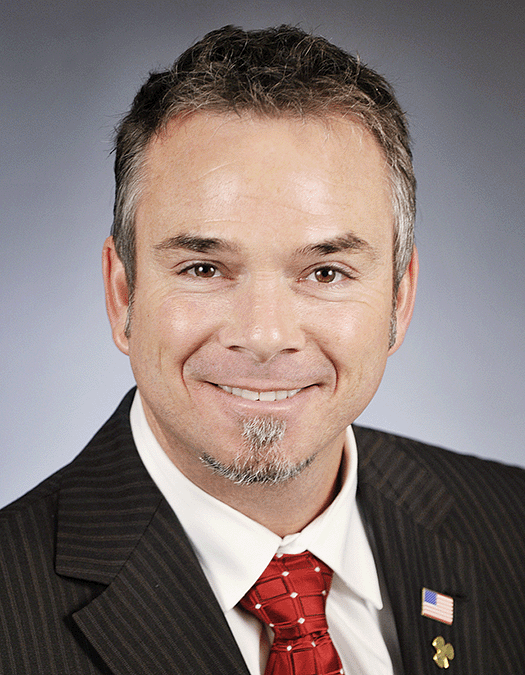
Rep. Joe McDonald
Sponsored bills
Maddy summaryHF 2147 exempts hot tubs or whirlpools on houseboats and single-unit rental properties from most public pool safety requirements in Minnesota. It requires property owners to ensure water temperature stays below 106°F, test chlorine/bromine, pH, and alkalinity before each rental, and provide renters with a specific notice about the exemption. The bill mandates a posted warning: "NOTICE: This spa is exempt from certain state and local sanitary requirements... USE AT YOUR OWN RISK." It directly affects rental property owners, resorts, and renters of these properties, while prohibiting local governments from adding extra requirements for qualifying hot water pools.
Maddy summaryHF 3158 proposes a constitutional amendment requiring a two-thirds vote in both the Minnesota House and Senate to authorize public funding for the design, construction, or renovation of a professional sports facility. Currently, a simple majority vote suffices for such funding. The amendment must be submitted to voters in the 2026 general election, where they will decide whether to adopt the two-thirds requirement. If approved by voters, this change would become part of the Minnesota Constitution, affecting future legislative decisions on sports facility funding.
Maddy summaryHF 8 streamlines Minnesota's environmental permitting process to improve efficiency and transparency. It sets specific timeframes (90 days for simpler permits, 150 days for complex ones), requires the Pollution Control Agency to issue separate construction and operation permits for certain facilities, and mandates that petitioners for environmental assessments must live in affected or neighboring counties. The bill also eliminates preliminary environmental assessment steps for projects requiring full environmental impact statements and requires the agency to publish annual reports tracking permitting progress. These changes directly affect developers, landowners, and the Pollution Control Agency in processing environmental permits.
Maddy summaryHF 1740 appropriates $X from Minnesota's arts and cultural heritage fund for fiscal year 2026 to support community cable television programming. The funds will be distributed through the Minnesota Association of Community Telecommunications Administrators to public, educational, and governmental cable channels across the state. This grant program specifically aims to fund local programming that promotes community and civic engagement. The bill directly affects community cable providers by providing dedicated funding for locally produced content, with no changes to existing regulatory frameworks.
Maddy summaryHF 3110 amends Minnesota's student privacy law to allow educational institutions to disclose private student contact information to legislators and photographers for "specified purposes." This change modifies existing restrictions under Minnesota Statutes §13.32, creating a new exception to the general rule that protects student data. The bill directly affects students and schools by altering when personal contact details (like phone numbers or addresses) can be shared with these groups. It does not define the specific "specified purposes," so the exact scope of this disclosure remains unclear from the provided text.
Maddy summaryHF 1679 allocates $5 million for fiscal year 2026 and $5 million for fiscal year 2027 from the state's arts and cultural heritage fund to support public television. The funding is specifically designated for the Minnesota Public Television Association (MPTA) to provide production and acquisition grants for public television programming. This bill directly affects MPTA's ability to fund local and national content for Minnesota viewers through existing state law. The funding mechanism provides stable, multi-year support for public broadcasting services.
Maddy summaryHF 1309 prohibits Minnesota local governments (cities and counties) from requiring minimum parking spaces for new residential, commercial, or industrial buildings. The bill directly affects developers and property owners by removing a common zoning requirement that previously mandated a set number of parking spots. Key provisions state that political subdivisions cannot impose these minimums, though they may still require ADA-compliant disability parking or make non-binding parking space recommendations. This change aims to increase flexibility for development projects, potentially allowing more housing or commercial space without dedicated parking.
Maddy summaryHF 19 establishes education savings accounts (ESAs) for Minnesota students from low-income households, defined as families earning no more than four times the income threshold for free school meals. The bill allows parents to use state funds to pay for qualifying education expenses - including tuition at eligible nonpublic schools, tutoring, approved curriculum, and school supplies - at participating schools or providers. Participation is capped at 5% of public school enrollment in the first year, increasing by 3% annually, with priority given to kindergarten students and those who attended public school full-time the prior year. The program directly affects eligible students (ages 18 and under) and their families, with funds restricted to approved educational services and materials.
Maddy summaryThis bill appropriates $100,000 for fiscal year 2026 and $100,000 for fiscal year 2027 from the arts and cultural heritage fund to the Minnesota Governor's Council on Developmental Disabilities. The funding supports the Council's work to preserve and raise awareness about the history of Minnesotans with developmental disabilities. It will be used for activities like creating exhibits, videos, print materials, and traveling displays. The direct beneficiaries are Minnesotans with developmental disabilities and the Council's efforts to document their history. The bill makes no changes to eligibility or services, solely providing funding for historical preservation.