

Maddy summaryThis bill modifies the licensing fees for scrap metal copper dealers in Minnesota, reducing the application and renewal fees from $250 to $100. It requires individuals to obtain a license from the commissioner of commerce to sell scrap metal copper starting January 1, 2025, with the new fee structure taking effect July 1, 2026. The legislation outlines application requirements, including personal information and proof of lawful copper acquisition, while also specifying conditions for license denial, suspension, or revocation. Additionally, the bill allows licensed professionals in related trades to sell scrap metal copper without a separate license if they hold existing certifications.
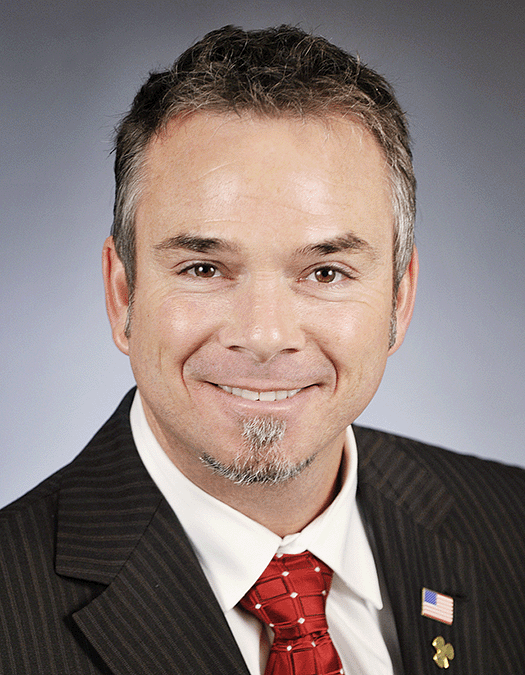
Rep. Joe McDonald
Sponsored bills
Maddy summaryHF 16 prohibits Minnesota cities, counties, or local governments from passing laws that block law enforcement from sharing immigration status information with federal authorities. It requires county attorneys to notify federal immigration agencies when someone without legal status is arrested for a violent crime. The bill overrides any local "noncooperation" policies that would restrict this information sharing or federal immigration enforcement. It applies to all local law enforcement and government entities in Minnesota, ensuring consistent cooperation with federal immigration enforcement on specific matters.
Maddy summaryHF 13 would amend Minnesota Statutes section 609.06 to eliminate the requirement that individuals must attempt to retreat before using reasonable force in self-defense or defense of others. The bill specifically removes the "duty to retreat" provision, allowing people to use force without first trying to avoid confrontation if they reasonably believe it is necessary. This change would directly affect Minnesotans using force to defend themselves or others in situations where they perceive an immediate threat. The bill was introduced but not passed, as it was laid on the table during the 2025 legislative session.
Maddy summaryThis bill establishes hiring requirements for the executive director of Minnesota's Lessard-Sams Outdoor Heritage Council, a 12-member advisory body focused on wetlands, prairies, forests, and wildlife habitat. The legislation creates an interview panel that must include equal representation from the two largest political parties to recommend candidates to the full council, which retains final approval authority. It also clarifies that the Legislative Coordinating Commission can hire nonpartisan staff and consultants to support the council's operations. The bill amends existing statutes to formalize these hiring procedures while maintaining the council's current structure and member appointment processes.
Maddy summaryHF 2937 regulates how parenting consultants can be used in Minnesota family court cases involving custody and parenting time disputes. The bill requires consultants to meet specific qualifications (similar to parenting time expeditors or marriage and family therapists) and clarifies they cannot modify court orders or change parenting time percentages. Crucially, it states that parenting consultants' recommendations and decisions are not binding on parents or courts, and their evidence cannot be used in family court proceedings. This directly affects parents, family courts, and consultants by setting clear boundaries for their role in resolving disputes without altering legal custody arrangements.
Maddy summaryThis bill creates a new crime called disruption of worship services in Minnesota, targeting individuals who enter religious buildings with the intent to disrupt scheduled services by committing a crime. The law defines a religious establishment as a building used for worship that is clearly marked with a sign or other identifier. First-time offenders face gross misdemeanor charges, while repeat offenders could be charged with a felony punishable by up to five years in prison or a fine of $10,000 or both. The provisions take effect on August 1, 2026, and apply only to crimes committed on or after that date.
Maddy summaryThis bill modifies income and asset requirements for households receiving SNAP benefits in Minnesota. It requires SNAP households to demonstrate that their gross income does not exceed 200 percent of the federal poverty guidelines, while net income must still meet federal SNAP requirements. The legislation also changes how vehicles are counted toward asset limits, specifically requiring that vehicles with a trade-in value of $100,000 or more be included in personal property calculations rather than being excluded. These changes directly affect Minnesota residents applying for or receiving SNAP assistance by adjusting eligibility criteria for income and vehicle assets.
Maddy summaryThis bill requires Minnesota's Secretary of State to share voter and election data with federal agencies upon request. It applies to all individuals in the statewide voter registration system, including those who attempted to register but were not approved, had outdated registrations, or registered but never voted. The Secretary of State must provide the requested data within 180 days of the request or by 90 days before the next scheduled election, whichever comes first. The law takes effect immediately after final passage and covers requests made on or after that date.
Maddy summaryHF 7 modifies multiple public safety laws in Minnesota. It requires law enforcement agencies to make bail/bond information public and mandates county attorneys to publicly report reasons for dismissing charges. The bill establishes mandatory minimum sentences for certain sex trafficking offenses and requires individuals subject to stays in sexual conduct cases to register as predatory offenders. It also increases penalties for assaulting police officers, obstructing highway/airport traffic, and expands law enforcement's use of tracking devices on fleeing vehicles. These changes apply directly to law enforcement agencies, prosecutors, and individuals involved in criminal cases.
Maddy summaryThis bill modifies Minnesota's "Read Act" to require literacy instruction based on "science of reading" research, emphasizing evidence-based methods like phonics and decoding while explicitly excluding the three-cueing system. It establishes a new Office of Achievement and Innovation within the Department of Education to support literacy implementation and creates a statewide school performance reporting system. The bill also allows school boards to opt out of complying with certain recently enacted state education laws or rules and authorizes fund transfers for education programs through fiscal year 2029. These changes directly affect all Minnesota public school districts, educators, and students by reshaping literacy instruction requirements and school accountability systems.