

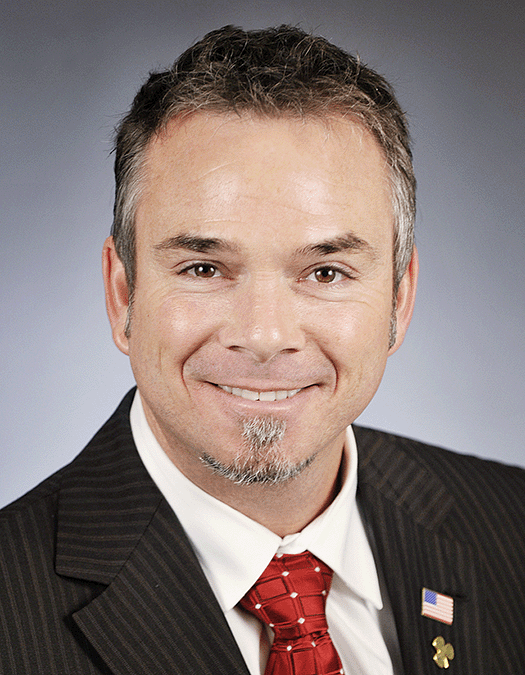
Photo of Joe McDonald
R Minnesota House · District 29A On the 2026 ballot

Rep. Joe McDonald

Compare
Total votes
1,926
all sessions
Attendance
82%
428 missed
Lower than 89% of chamber peers
With party
97%
of cast votes
Near the chamber average
Bipartisan score
1%
crosses aisle rarely
Near the chamber average
Sponsored
581
bills & resolutions
Near the chamber average
Committees
3
assignments
581 bills and resolutions

Sponsored bills

Total
581
Primary
165
Co-sponsor
416
This page
581
matching current filters
Co-sponsor HF 3564
In committee · Minnesota House · Co-sponsor
Greater Minnesota Regional Parks and Trails Commission provisions modified, and availability of previous grants extended.

Maddy summaryHF 3564 extends deadlines for specific parks and trails grants awarded under Minnesota's parks and trails fund. It extends funding availability for five projects: the Mesabi Trail (St. Louis/Lake Counties), Oxbow Park (Olmsted County), Kraemer Lake/Wildwood County Park (Stearns County), Plum Creek Park (Redwood County), and Robinson Quarry Park (Sandstone) through June 30, 2027 or 2028. The bill also modifies the Greater Minnesota Regional Parks and Trails Commission's structure, including changing how its chair is elected from annual to biennial and updating reporting requirements. These changes ensure existing grant projects can continue using allocated funds beyond their original deadlines.

In committee Apr 9, 2026 1 co-sponsor
Co-sponsor HF 3571
died · Minnesota House · Co-sponsor
Watershed districts allowed to self-insure for certain employee health benefits, and technical changes made.

Maddy summaryHF 3571 allows watershed districts in Minnesota to cover their own employee health insurance costs (excluding life insurance) instead of purchasing group policies, a change previously limited to cities, counties, and school districts. The bill requires these self-insurance plans to meet state certification standards, provide all legally required benefits, and involve consultation with employee representatives before implementation or dissolution. It also permits multiple watershed districts to jointly self-insure under shared rules and clarifies that employees represented by unions may opt into the district’s plan at their own expense. The legislation updates existing statutes to include watershed districts in these health benefit options while maintaining key safeguards for employees.

died Apr 9, 2026 1 co-sponsor
Co-sponsor HF 5
In committee · Minnesota House · Co-sponsor
Imposition and allocation of certain taxes modified, tax analysis required, transportation funding impacts analysis required, retail delivery fee repealed, unlimited Social Security subtraction provided, previous appropriation and transfer modified, reports required, money transferred, and money appropriated.

Maddy summaryHF 5 modifies Minnesota's tax structure by repealing the retail delivery fee and establishing an "unlimited Social Security subtraction," allowing taxpayers to subtract all their Social Security benefits from state taxable income. It redirects transportation funding by creating a "transportation advancement account" and requires specific distribution percentages: 36% to metropolitan counties, 28% to county highway funds, 23% to larger cities, 34% to small cities, 15% to town roads, and 1% to food delivery support. The bill also mandates tax analysis and reporting requirements for transportation funding impacts and modifies several tax statutes, including those governing Social Security benefit subtractions. These changes directly affect Minnesota taxpayers, local governments, and transportation agencies, effective July 1, 2025.

In committee Apr 9, 2026 1 co-sponsor
Co-sponsor HF 1426
In committee · Minnesota House · Co-sponsor
Stewardship program for circuit boards, batteries, and electrical products established; mercury in batteries prohibited; rulemaking authorized; and money appropriated.

Maddy summaryHF 1426 establishes a statewide program requiring manufacturers of electronic products (like circuit boards and batteries) to fund collection and recycling of covered items through a reimbursement board. It directly affects electronics manufacturers by mandating their financial responsibility for end-of-life products and consumers by creating designated collection sites. The bill prohibits mercury in batteries and defines specific categories of "covered products," including circuit boards and batteries (excluding lead-acid types), while exempting medical devices and vehicles. It also appropriates funds to implement the program and replaces outdated battery management rules.

In committee Apr 9, 2026 1 co-sponsor
Primary HF 4858
In committee · Minnesota House · Lead sponsor
Sellers required to accept United States currency for purchases.

Maddy summaryThis bill requires sellers in Minnesota to accept United States currency, including Federal Reserve notes, as payment for goods and services. The law applies specifically to in-person transactions and allows businesses with multiple sales points to comply by accepting cash at just one location. Several exceptions exist, such as for banks and credit unions, as well as for situations involving security deposits or cash-to-card conversions that meet specific conditions like having no fees and no expiration dates. Violations of this requirement could result in a civil penalty of up to $250 for each transaction where cash is refused. The provisions would take effect on January 1, 2026.

In committee Apr 7, 2026 0 co-sponsors
Co-sponsor HF 4794
In committee · Minnesota House · Co-sponsor
Farmed Cervidae fencing requirements modified.

Maddy summaryThis bill updates Minnesota's fencing rules for farmed deer and elk to better prevent them from escaping or interacting with wild animals. It mandates that all perimeter fences be at least 96 inches tall and made of high-tensile material, while requiring two redundant gates at every entry point. Owners must immediately fix any fence defects that allow animals to enter or exit, with other repairs due within 14 days, and facilities found with violations face additional reinspection fees. The legislation also gives animal health officials the power to revoke a farm's registration and order the removal or destruction of animals if the facility has multiple escape incidents or fails to correct identified safety issues.

In committee Apr 7, 2026 1 co-sponsor
Primary HF 4295
In committee · Minnesota House · Lead sponsor
County authorized to approve up to 24 chickens on any lot by ordinance.

Maddy summaryThis bill amends Minnesota law to allow counties to adopt local ordinances permitting residents to keep up to 24 chickens on their property. The change adds a new provision to existing feedlot zoning regulations, giving local governments authority to approve small-scale backyard chicken keeping through their own ordinances. The bill does not require counties to allow chickens but enables those that choose to do so by updating state statutes. This policy change affects rural and suburban residents who may wish to raise chickens for personal use or small-scale production.

In committee Apr 7, 2026 0 co-sponsors
Co-sponsor HF 4277
In committee · Minnesota House · Co-sponsor
Child care centers video security cameras use requirements modified.

Maddy summaryThis bill, known as Harvey's Law, requires licensed child care centers in Minnesota to install video security cameras in public and shared areas under specific conditions. Centers must have cameras if they are required to post a maltreatment investigation memorandum, with compliance needed within six months and maintained for four years. Additionally, starting in 2027, centers receiving certain state child care funding must also install and maintain these cameras. The law applies to facilities with public access areas and aims to enhance safety oversight through video monitoring requirements.

In committee Apr 7, 2026 1 co-sponsor
Co-sponsor HF 12
Failed · Minnesota House · Co-sponsor
Female sports team participation restricted to the female sex.

Maddy summaryHF 12 restricts participation on female-designated sports teams in Minnesota K-12 schools to students identified as female at birth, based on specific medical criteria. It requires students in disputes about sex to provide a physician's statement confirming their sex using three factors: reproductive anatomy, natural testosterone levels, and chromosome analysis. The bill directly affects public and private schools offering girls' sports teams and students seeking to join them. It amends Minnesota education law to take effect July 1, 2025.

Failed Apr 7, 2026 1 co-sponsor
Primary HF 4665
In committee · Minnesota House · Lead sponsor
Number of proof of residence oaths a person can sign on any election day reduced from eight to two.

Maddy summaryThis bill reduces the maximum number of election day registration oaths a single person can sign from eight to two, applying to voters who vouch for others' residency at polling places. It directly affects individuals who help register new voters on election day by verifying their residence, limiting how many people one person can vouch for during a single election. The law requires election judges to track these oaths on a standardized form and does not change the existing methods for proving residence through identification documents or vouching by registered voters and facility employees.

In committee Mar 26, 2026 0 co-sponsors
Showing 21 to 30 of 581 bills
Previous 1 2 3 4 59 Next