

Maddy summaryHF 2310 reenacts Minnesota's existing prohibition on weather modification within state boundaries, directly affecting individuals or entities attempting activities like cloud seeding. The bill defines "weather modification" as intentionally altering weather through chemical or apparatus dispersal in the atmosphere, and prohibits such actions within Minnesota's borders or airspace above them. Violations are classified as misdemeanors, with each day of continued violation considered a separate offense. This law aims to protect public safety, health, and the environment by preventing unauthorized weather-altering activities.
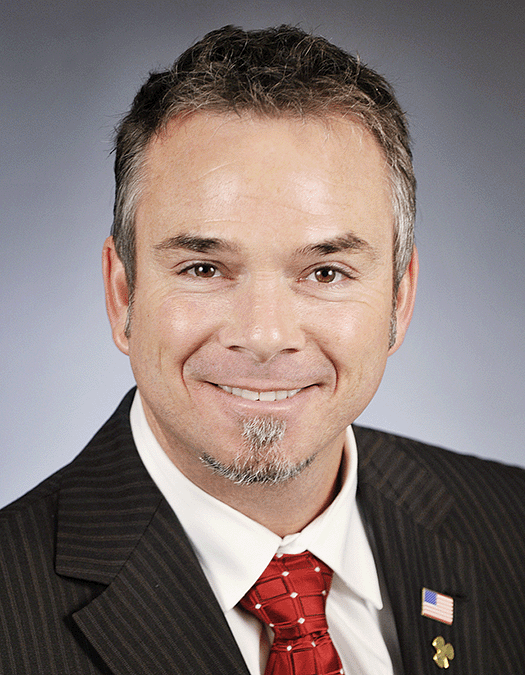
Rep. Joe McDonald
Sponsored bills
Maddy summaryHF 2254 adds a $400 "baby bonus" to Minnesota's existing child credit for each qualifying child born during the tax year. This directly affects Minnesota taxpayers with newborn children, increasing their state income tax credit. The bill modifies the child credit calculation by adding the $400 per newborn (without reducing the minimum credit amount) and allows for potential advance payments. It takes effect for tax years beginning after December 31, 2024.
Maddy summaryHF 741 establishes a $10,000 income tax subtraction for individual volunteer fire and rescue workers in Minnesota, increasing to $20,000 for married couples where both spouses qualify. It directly affects volunteers who perform at least 40 hours of qualified work (such as firefighting, ambulance services, or search/rescue) during the year without working full-time (1,600+ hours). The bill defines "qualified rescue work" to include roles like volunteer firefighters, emergency medical responders, and search/rescue team members. This tax benefit applies to taxable years beginning after December 31, 2024.
Maddy summaryHF 1582 modifies Minnesota's Teachers Retirement Association (TRA) benefits for educators. It allows teachers with 30 years of service to retire at age 60 without reduced annuity payments (previously requiring 35 years), adjusts early retirement penalties, and increases postretirement cost-of-living adjustments. The bill also raises employer contribution rates for school districts (from 13.3% to 17.3% for basic members) and increases pension adjustment revenue rates for school districts starting in 2026. These changes directly affect current and future TRA members, school districts funding retirement costs, and the state's retirement system budget.
Maddy summaryHF 1253 modifies Minnesota's absentee ballot procedures for certain voters. It shortens the timeline for mailing absentee ballots from 46 days to 28 days before elections (Minnesota Statutes 2024, § 203B.06, subd. 3) and moves the deadline for returning ballots from 8:00 p.m. to 3:00 p.m. on election day (§ 203B.08, subd. 1). The bill also prohibits correctional facilities from receiving absentee ballots, requiring county auditors to reject applications with correctional facility addresses (§ 203B.06, subd. 2). These changes directly affect absentee voters, election officials managing ballot distribution, and correctional facilities.
Maddy summaryHF 11 delays the implementation of Minnesota's Paid Leave Law from 2026 to 2027, affecting employers, employees, and state agencies responsible for administering the program. The bill amends multiple statute sections to adjust key dates, including the start of employer premium payments (now January 1, 2027) and administrative requirements like public outreach and annual reporting. This one-year delay provides additional time for businesses to prepare for the new paid leave program without changing the law's core requirements. The law's substance - such as premium rates and fund management - remains unchanged, only the rollout timeline is extended.
Maddy summaryHF 2026 extends the deadline for several Minnesota counties and cities to use existing parks and trails grant funds. The bill specifically allows Goodhue County (Cannon Valley Trail), Stearns County (Beaver Island Trail), Winona (Bluffs Traverse Trail), Austin (Jay C. Hormel Nature Center), and Duluth (Spirit Mountain Recreation Area and Waabizheshikana/Marten Trail) to access previously allocated funds through June 30, 2027. This provision does not create new funding but extends the timeframe for utilizing fiscal year 2023 and 2024 appropriations. The key mechanism is a straightforward deadline extension for six specific trail and park projects. This affects local governments and community projects that rely on these designated grants.
Maddy summaryHF 1250 appropriates $168.5 million from Minnesota's Outdoor Heritage Fund for fiscal year 2026 (with $775,000 for 2027) to fund specific conservation projects. It directs funding toward acquiring land and restoring habitat for prairies, wetlands, and wildlife management areas across Minnesota, including projects in Martin County, the southern Red River Valley, and riparian buffer programs. Key provisions include $3.69 million for prairie chicken habitat partnerships, $4.97 million for wildlife management area acquisitions, and $4.09 million to expand habitat protection on private lands through conservation easements. These funds directly support state agencies and conservation partners working to protect native prairie ecosystems and wildlife habitats. The bill specifies that funds must be used for land acquisition, restoration, and habitat enhancement under existing conservation programs.
Maddy summaryHF 2129 establishes a program connecting Minnesota students needing specialized equipment training for specific careers (like those listed in state workforce statutes) with private businesses that own such equipment. Businesses participating in the program receive a tax credit equal to the cost of renting the equipment on the private market, up to a specified limit. The program requires the state workforce commissioner to identify training gaps in educational institutions, recruit businesses, and submit annual reports detailing student participation, participating courses, businesses, and tax credit amounts. The bill appropriates funds to cover refunds for excess tax credits and mandates the first report by December 2027.
Maddy summaryHF 3 requires Minnesota's legislative auditor to annually report to the legislature by February 1 on whether state agencies have implemented audit recommendations from the prior five years. The bill mandates that agencies' commissioners must also submit detailed reports by September 1 each year, specifically itemizing unaddressed recommendations and explaining why they weren't implemented. This directly affects all state agencies subject to legislative auditor reviews and their commissioners, who must now document progress on audit findings. The law creates a structured process for tracking accountability without altering agency funding or creating new programs.