

Maddy summaryHF 704 requires mortgage lenders and servicers in Minnesota to provide a "satisfaction of mortgage" document to borrowers within 45 days after full loan payment or receipt of a payoff statement. The bill adds rules for when lenders must send corrected payoff statements if an initial amount was too low, protecting borrowers who relied on the incorrect figure. It also specifies that lenders who fail to provide the satisfaction document within 45 days after payment are liable for actual damages suffered by borrowers. This directly affects homeowners who pay off mortgages and the lenders handling those transactions.
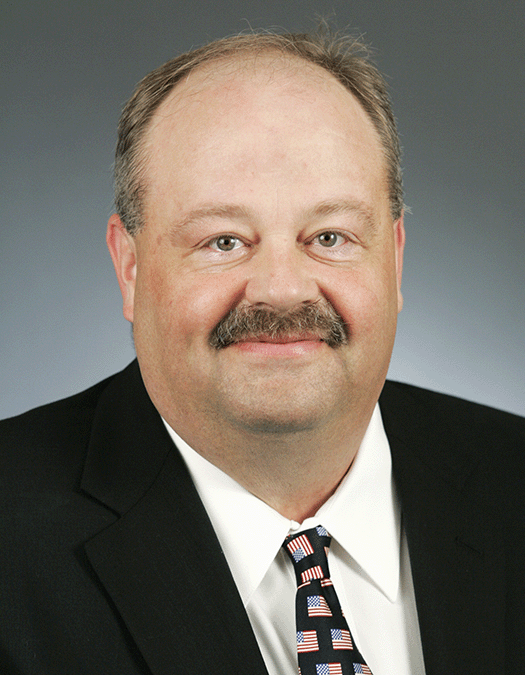
Rep. Greg Davids
Sponsored bills
Maddy summaryThis bill would allow Minnesota residents to subtract certain capital gains from the sale of their main home from their state income tax. It creates a new provision that mirrors the federal tax exclusion limits, letting homeowners exclude up to $250,000 or $500,000 in gains depending on their filing status. The change would apply to taxable years starting after December 31, 2025, and only affects properties that qualify for the federal principal residence exclusion.
Maddy summaryThis bill authorizes the city of Lanesboro to impose a local sales and use tax of up to 0.5 percent, subject to approval by city voters. The tax revenue must be used to fund specific projects, including $500,000 for improvements to Sylvan Park and $2,000,000 for road improvements on Trunk Highway 250. The legislation also allows the city to issue up to $2.5 million in bonds to finance these projects, with the tax revenue securing the bond payments. The tax would expire after 30 years or once the projects are fully funded, whichever comes first.
Maddy summaryHF 3697 modifies Minnesota's tax refund filing deadline, shortening the standard window from 3.5 years to 2 years for most taxpayers. The bill requires claims for overpaid state taxes to be filed within two years of when the tax, penalties, or interest was paid, instead of the previous 3.5-year period. This change directly affects individual and business taxpayers seeking refunds for overpaid Minnesota state taxes, limiting the refund amount to taxes paid within the two-year period preceding the claim. The amendment applies to all refund claims filed on or after the bill's effective date.
Maddy summaryThis bill modifies how Minnesota authorities handle excess tax increments in tax increment financing districts, requiring them to return any surplus funds to the county auditor and potentially decertify the district if no qualifying debt exists. The law mandates that authorities must annually calculate excess increments by comparing total collected funds against authorized costs, with a new requirement to return these funds within nine months of year-end. Authorities may defer decertification if they approve a plan modification that increases authorized costs by more than the excess amount, but this deferral expires if no further qualifying modifications occur and no outstanding debt remains. The changes apply to all tax increment financing districts starting with excess increment determinations for calendar year 2026 and later.
Maddy summaryThis bill authorizes the Cloquet Area Fire District in Minnesota to collect a local sales tax of up to 0.5% in the cities of Cloquet and Scanlon, with voter approval required before implementation. The tax revenue would be used to fund the construction of a new ambulance and fire station, with up to $31 million available for the project and related bond debt service. The tax would expire after 20 years or once the project is fully funded, whichever comes first, and any remaining funds would go to the district's general fund.
Maddy summaryThis bill authorizes the Minnesota Department of Health to create and manage a stockpile of essential prescription and over-the-counter medications to prepare for drug shortages and public health emergencies. The Department of Health will work with medical experts, pharmaceutical companies, and healthcare facilities to determine what medications to stockpile and may hire third-party vendors to handle storage, tracking, and distribution. During emergencies, the department can establish equitable distribution limits to ensure fair access to medications, while also coordinating with local health authorities and emergency responders. The bill requires an annual report to legislative committees detailing the stockpile's inventory, usage, and management updates, and it appropriates funding from the state's general fund to support these efforts.
Maddy summaryThis bill (HF 3754) is procedural, amending Minnesota Statutes to align the state's tax code with a specific federal tax exclusion. It adds a reference to section 70204 of federal law (Public Law 119-21), which excludes employer contributions to "Trump accounts" from gross income for federal tax purposes. The change ensures Minnesota's tax code matches this federal provision, directly affecting employers making contributions to such accounts. The amendment is effective retroactively to when the federal change took effect.
Maddy summaryHF 3604 modifies Minnesota's exemption rules for bulk deliveries of nonoxygenated gasoline. It requires that such deliveries (500 gallons or less) must be made directly into either: (1) the attached fuel tank of a vehicle listed as exempt under existing rules, or (2) a bulk tank on the premises. This bill affects fuel suppliers delivering nonoxygenated gasoline to exempt vehicles, such as classic cars or certain machinery. The key change clarifies where the fuel must be delivered, replacing previous ambiguous language with specific requirements. The bill is currently in committee for review.
Maddy summaryHF 400 requires Minnesota's Commissioner of Commerce to pay health insurance companies to offset costs when new state-mandated health benefits increase premiums for consumers. This applies to health plans sold in individual, small group, and large group markets. The Commissioner must make these payments within 60 days of receiving a cost statement from the company, using the federal process for cost calculation to ensure accurate measurements. The bill takes effect January 1, 2026, for all new mandated health benefit proposals enacted after that date.