

Maddy summaryHF 290 exempts specific health-related purchases made by public and private health plans from Minnesota's sales and use tax. It creates two new exemptions: (1) single-use medical items prescribed by a physician (like bandages or syringes), and (2) other items purchased under private health plans not already covered by existing exemptions. These changes apply to purchases made after June 30, 2025, and directly affect health plans purchasing these items. The bill modifies Minnesota Statutes 297A.67 to clarify which health care materials qualify for tax exemption.
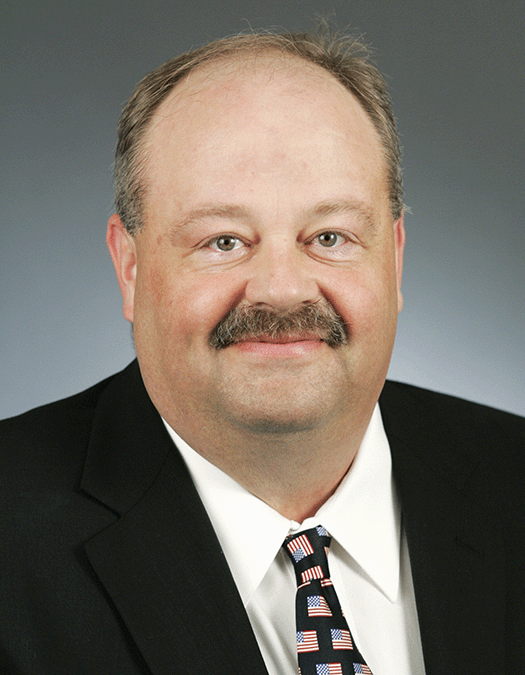
Rep. Greg Davids
Sponsored bills
Maddy summaryHF 2049 creates tax credits for Minnesota businesses and industrial projects in specific locations. It allows eligible entities (Minnesota-based businesses with qualifying projects in industrial parks, economic zones, or near railroads in counties under 250,000 population) to claim a 10% credit on qualified economic development costs (up to $8 million per project) and a 50% credit on qualified rail infrastructure costs (up to $4 million per project), with a total cap of $10 million per project. Applicants must submit detailed project plans, cost breakdowns, and job creation projections to the commissioner, who will verify eligibility and allocate credits subject to an annual $50 million statewide limit. Unused credits can be carried forward for up to five years.
Maddy summaryThis bill extends time limits for tax increment financing (TIF) in Moorhead's District No. 31. It changes Minnesota law to allow the city a 10-year period (instead of 5) to use tax increment revenue for redevelopment projects, and extends the subsequent period for using that revenue to 11 years. The change directly affects Moorhead's city government and developers working within TIF District No. 31. This adjustment provides more time for the city to fund redevelopment projects using future tax growth within the designated district.
Maddy summaryHF 1065 extends timeframes for Minnetonka's Opus Tax Increment Financing (TIF) district. It extends the initial five-year period for using TIF funds to ten years and the period for using tax increments after that to eleven years, instead of the standard five and five years. The bill specifically applies to the Opus TIF district established in 2021 by Minnetonka's economic development authority and exempts it from certain standard TIF rules under Minnesota Statutes section 469.176, subdivision 4j. This change allows the district more time to use tax increment funds for its designated development projects.
Maddy summaryHF 2046 provides $1,993,000 to Fillmore County for the rehabilitation of the historic Forestville bridge. The bill authorizes the state to issue bonds to fund this project, with the money coming from the bond proceeds fund. The funds will be used to design, engineer, and construct the bridge's rehabilitation. This directly affects Fillmore County and the preservation of a specific historic structure in that area. The project is funded through state bond sales under Minnesota's capital investment laws.
Maddy summaryHF 2142 modifies Minnesota's historic structure rehabilitation tax credit program to allow a second assignment of credit certificates. Previously, credit certificates could only be assigned once to another taxpayer; this bill permits the initial recipient or first assignee to transfer the credit to a second assignee. The bill requires any assignment (including the second) to be reported to the state commissioner within 30 days. This change directly affects developers and taxpayers involved in historic rehabilitation projects who use the credit for financing, making it easier to secure project funding through multiple credit transfers.
Maddy summaryHF 2044 appropriates $3 million from state bond proceeds to fund the rehabilitation of the historic Forestville bridge in Fillmore County. The bill authorizes the state to issue up to $3 million in bonds under Minnesota law to provide this funding. The money will be administered by the commissioner of natural resources as a grant to Fillmore County for the bridge's design, engineering, and construction. This legislation directly affects Fillmore County by providing dedicated funding for preserving a specific historic structure.
Maddy summaryHF 2047 requires health insurance plans (health carriers) to pass all rebates and discounts they receive from drug manufacturers or pharmacies directly to enrollees at the point of prescription purchase. This means enrollees’ out-of-pocket costs (like co-pays) for covered drugs will be reduced by 100% of any rebates the health carrier received, calculated at the pharmacy counter. The bill mandates that health carriers adjust these costs immediately during checkout, while protecting rebate details as confidential trade secrets to prevent public disclosure. Non-compliance could result in civil penalties or license suspension for health carriers.
Maddy summaryHF 2048 corrects errors in attributing retirement contributions to the wrong tax year for Minnesota individual income tax purposes. It requires annuity providers to treat eligible contributions made by the IRS deadline as belonging to the *previous* tax year if the individual notifies them within three years of the original tax return due date. This applies only to notifications received for contributions made in 2023, with retroactive effect for that year. The bill directly affects individuals making retirement contributions and the annuity providers handling those contributions.
Maddy summaryHF 2054 provides a refundable sales tax exemption for construction materials purchased specifically for the Moorhead City Hall renovation project. It allows Moorhead City to pay sales tax on eligible materials upfront and then receive a refund, covering purchases made between March 1, 2025, and June 1, 2027. The exemption applies only to materials used in the City Hall renovation, not general city projects, and refunds must be processed after June 30, 2025. The bill retroactively covers purchases made after February 28, 2025, with funding coming from the state general fund.