

Maddy summaryHF 412 requires members of Minnesota's education policy and finance legislative committees to observe a teacher or administrator for at least 12 hours over a two-year period. Committee members must submit detailed reports - including date, school, and grade levels observed - to legislative leadership, with all reports published online by the Legislative Reference Library. The House and Senate are also required to adopt rules to implement these requirements. The bill takes effect on July 1, 2025.
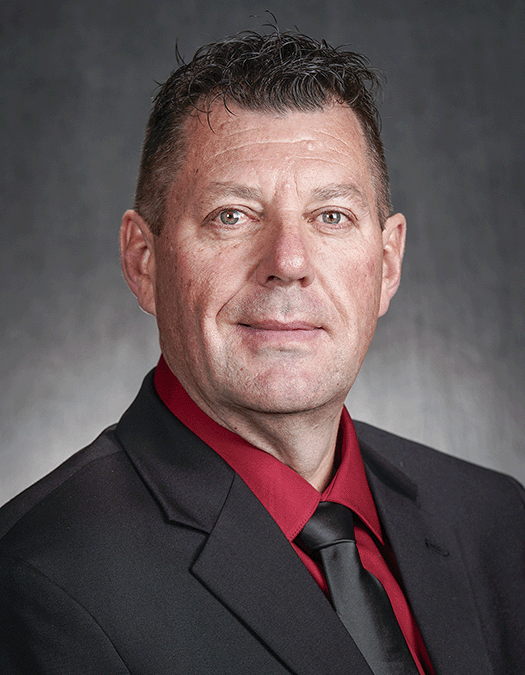
Rep. Ripper Repinski
Sponsored bills
Maddy summaryHF 5 modifies Minnesota's tax structure by repealing the retail delivery fee and establishing an "unlimited Social Security subtraction," allowing taxpayers to subtract all their Social Security benefits from state taxable income. It redirects transportation funding by creating a "transportation advancement account" and requires specific distribution percentages: 36% to metropolitan counties, 28% to county highway funds, 23% to larger cities, 34% to small cities, 15% to town roads, and 1% to food delivery support. The bill also mandates tax analysis and reporting requirements for transportation funding impacts and modifies several tax statutes, including those governing Social Security benefit subtractions. These changes directly affect Minnesota taxpayers, local governments, and transportation agencies, effective July 1, 2025.
Maddy summaryHF 3691 adds "emergency managers" to the statutory definition of "essential employees" in Minnesota law. This means emergency managers - professionals who coordinate responses to crises like natural disasters or public safety incidents - will now be officially classified as essential employees, alongside firefighters, police dispatchers, and correctional guards. The bill amends Minnesota Statutes § 179A.03, specifically adding "emergency managers" to the list of roles considered essential during emergencies. This change ensures emergency managers receive the same legal protections and operational status as other designated essential workers during critical events.
Maddy summaryHF 3687 modifies Minnesota's medical assistance and MinnesotaCare coverage for chiropractic services. The bill removes the previous age restriction (limiting coverage to those under 21) and establishes new rules: chiropractic care for spinal pain, chronic conditions, and related services is covered for all ages, but limited to 24 visits per year without prior authorization. It also restricts x-ray coverage to specific spine examinations necessary for diagnosing subluxation. This affects all MinnesotaCare and medical assistance recipients seeking chiropractic care, changing coverage from age-limited to broadly applicable with visit and x-ray restrictions. The changes take effect January 1, 2027, or after federal approval.
Maddy summaryHF 2002 abolishes a prohibition that prevented the Minnesota Public Utilities Commission from issuing a certificate of need for new nuclear power plants. This change would allow the commission to approve applications for new nuclear plant construction, which was previously blocked by law. The bill amends Minnesota Statutes 2024, section 216B.243, subdivision 3b, by removing the language stating the commission "may not issue a certificate of need" for new nuclear facilities. The policy change directly affects nuclear energy developers seeking to build new plants in Minnesota and the commission's approval process.
Maddy summaryHF 3127 modifies Minnesota's pass-through entity tax election process, allowing certain businesses (like partnerships and S corporations) to file a single tax return instead of requiring each owner to file individually. It specifies that qualifying entities must meet ownership thresholds (over 50% of qualifying owners) to elect this tax, and the election is irrevocable for the tax year. The bill clarifies that the tax amount equals each qualifying owner's income multiplied by Minnesota's highest individual tax rate, without allowing standard deductions. This directly affects pass-through business owners and entities filing under Minnesota Statutes 289A.08 and 290.06. The changes streamline tax filing for these entities while maintaining the tax calculation method.
Maddy summaryHF 2113 exempts small Minnesota employers with 50 or fewer employees from the state's paid leave requirement. This bill amends Minnesota Statutes 2024, section 268B.01, to explicitly exclude such employers from the paid leave mandate. Small businesses that currently meet the 50-employee threshold will no longer be required to provide paid leave under this law. Employers with 50 or fewer employees may still choose to opt into the paid leave program if they wish. The bill directly affects small business owners and their employees in Minnesota.
Maddy summaryThis bill requires drivers to stop at least 20 feet away from a school bus displaying flashing red lights while children are boarding or exiting. It directly affects all drivers approaching school buses on Minnesota roads, mandating they remain stopped until the red lights cease flashing. The bill also adds a new provision warning drivers that amber lights indicate red lights will soon activate, requiring them to prepare to stop. These changes aim to improve safety for children near school bus stops. The bill is currently pending passage after committee approval.
Maddy summaryThis bill appropriates $10 million for Minnesota's supportive housing program, with $9 million specifically targeting U.S. Department of Housing and Urban Development (HUD) Continuum of Care grantees facing funding gaps before December 2026. It allows noncompetitive grants to existing HUD recipients to fill these gaps, covering permanent supportive housing, rapid rehousing, and related services. Grantees must report every 90 days on fund usage and people served, with compiled reports shared with lawmakers and the Legislative Reference Library. The funding is a one-time appropriation under Minnesota Statutes §462A.42.
Maddy summaryThis bill creates a new grant program to fund early childhood mental health consultations for children five years old and younger, primarily benefiting child care professionals, mental health clinics, and community service providers. The grants will support activities such as diagnosing mental health conditions, training clinicians in evidence-based practices, and providing specialized care to young children with significant mental health needs. Eligible recipients include certified mental health clinics, community mental health centers, Indian health facilities, and therapeutic service providers who help children remain in their families and communities. The legislation also modifies existing requirements for home and community-based services, day treatment programs, and intensive rehabilitative mental health services while mandating additional reporting.