

Maddy summaryHF 3784 requires all high school and middle school athletic coaches and assistant coaches in Minnesota school districts or charter schools to complete cardiopulmonary resuscitation (CPR) and automated external defibrillator (AED) training starting with the 2027-2028 school year. Coaches must maintain current training annually and complete refresher courses every two years, following nationally recognized emergency cardiovascular care guidelines. The bill also provides legal protection, shielding coaches from civil liability for good-faith CPR or AED use during athletic activities, except in cases of gross negligence or willful misconduct. This law directly affects school coaches and aims to improve emergency response for student athletes experiencing cardiac incidents.
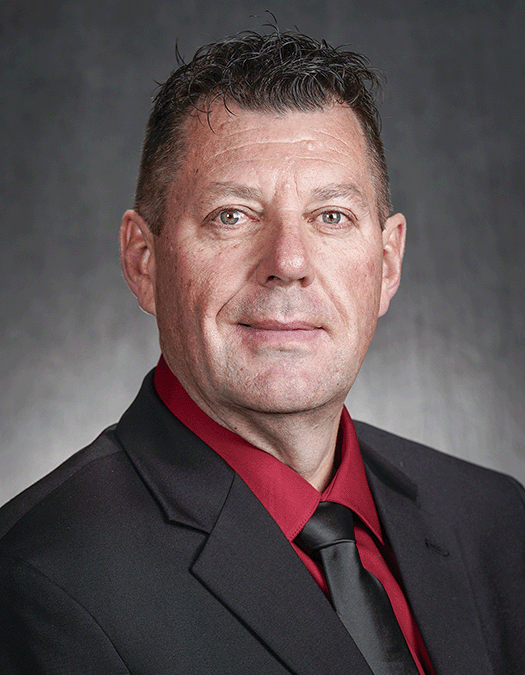
Rep. Ripper Repinski
Sponsored bills
Maddy summaryHF 3513 defines key terms for autonomous vehicles in Minnesota Statutes, establishing a regulatory foundation for future rules. It adds definitions for terms like "automated driving system" (level 4/5 vehicles), "dynamic driving task," "minimal risk condition," and "on-demand autonomous vehicle network" to clarify operational standards. The bill does not impose new restrictions or requirements but creates the terminology needed for future legislation governing autonomous vehicle safety and operation. This procedural update prepares Minnesota’s legal framework for regulating self-driving technology as it develops.
Maddy summaryHF 168 creates an advance homestead credit for qualifying seniors in Minnesota, allowing them to receive 50% of their prior year's homestead tax refund upfront. Seniors who already qualified for the standard homestead credit can apply for this advance, which is applied directly to their first-half property tax payment each year. The state reimburses counties and school districts for the tax reductions by October 31 (for non-school districts) or through the Department of Education (for school districts). This policy, effective for 2027 property taxes, aims to ease annual tax burdens for eligible seniors by providing earlier access to their refund amount.
Maddy summaryHF 2027 modifies Minnesota's liquor laws to allow 17-year-olds to serve alcoholic beverages in on-sale establishments (like restaurants), while maintaining the 18+ requirement for off-sale licenses (like liquor stores). It also establishes a new license for food trucks selling alcohol, updates requirements for the University of Minnesota's liquor licenses, and changes rules for transferring wine between licensed businesses. The bill directly affects minors working in alcohol service, food truck operators, and university beverage operations. These changes take effect the day after the bill is enacted.
Maddy summaryThis bill modifies a previous funding allocation to provide $5 million to the city of Winona for completing a specific segment of the Mississippi Riverfront Trail. The funds are designated for final design, engineering, and construction of a trail connection between Levee Park and Lions Park. Any remaining money after this project is finished can be used to extend the trail further within the city. The changes take effect immediately upon the bill's final passage.
Maddy summaryThis bill allows parents in Minnesota to request one free certified birth record for each of their children, starting on July 1, 2027. The change would remove the current fee for that first official copy while any additional certified records would still require payment. It applies to parents listed on a child's birth certificate and affects the state registrar and local offices that issue these documents. The legislation amends existing Minnesota statutes to specify this fee waiver without altering other birth record requirements.
Maddy summaryThis bill allows homeowners to use their private residential swimming pools for certified swimming lessons when they are paid by a guest. It permits these classes only if the homeowner is a certified swimming instructor teaching one-on-one and no more than four people are in the pool at once. The law clarifies definitions for public pools, certified swimming classes, and certified swimming instructors to ensure compliance with national safety standards. This change affects homeowners who wish to conduct swimming lessons in their private pools and the organizations that offer certified swimming instruction.
Maddy summaryHF 3395, the "Fraud Isn't Free Act," requires Minnesota state agencies administering public programs (like healthcare or education funding) to take specific actions when fraud occurs. If fraud is suspected, agencies must submit a corrective plan to lawmakers within 30 days, including steps to prevent future fraud, recover stolen funds, and fire employees directly responsible for the fraud. The bill also mandates suspending new enrollments in affected programs, reducing agency budgets, and reporting fraud totals to the budget office and legislative auditors. These provisions apply to all state programs using public funds, with definitions covering intentional deception like false claims or theft.
Maddy summaryHF 3753 establishes a pilot program to enhance school safety through threat assessment. The Minnesota Department of Public Safety will contract with a vendor to provide real-time monitoring, threat alerts, and door-locking capabilities using predictive analytics, with services integrating into existing school security systems. One school district per congressional district (including both large and small districts) will participate, excluding those already using similar systems. The program requires a report by January 2027 evaluating effectiveness, gathering feedback from schools, and recommending statewide implementation, funded by a $4 million appropriation from the general fund for fiscal year 2027.
Maddy summaryThis bill modifies how Minnesota calculates registration taxes for passenger cars and hearses by lowering the tax rate based on the vehicle's manufacturer's suggested retail price. It changes the tax calculation for new vehicles registered on or after November 16, 2020, and reduces the percentage of the vehicle's value taxed for each subsequent year of ownership. The legislation also establishes a process to transfer money from the state's general fund to the highway user tax distribution fund to cover any revenue shortfall caused by these tax reductions.