

Maddy summaryHF 2169 modifies Minnesota's unintentional murder in the second degree statute to include cases where someone causes death while violating a protective order issued by a court in another U.S. state, the District of Columbia, Tribal Lands, U.S. territories, Canada, or a Canadian province. This change directly affects individuals who violate protective orders from these additional jurisdictions and cause a death, expanding the circumstances under which this offense applies. The bill amends Minnesota Statutes section 609.19, subdivision 2, to explicitly include such out-of-state orders as part of the definition. The amendment takes effect August 1, 2025, for crimes committed on or after that date.
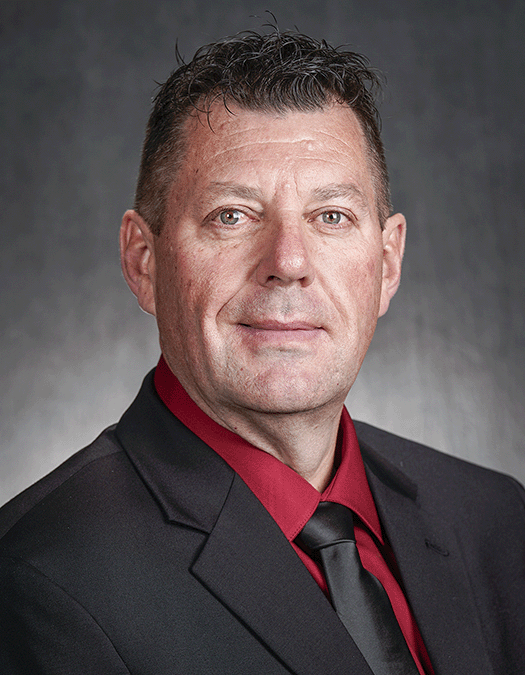
Rep. Ripper Repinski
Sponsored bills
Maddy summaryThis bill requires providers, vendors, and individuals applying for public funds to submit proof of recent operational history and financial records as part of their eligibility process. Applicants must demonstrate they have performed similar services over the past three years, provide audited financial statements or nonprofit tax forms from that period, and show good standing with the secretary of state if they are business or nonprofit entities. The law adds new requirements to Minnesota statutes governing financial screening for programs administered by state commissioners. These measures aim to establish clearer standards for verifying the legitimacy and financial stability of entities seeking government money.
Maddy summaryThis bill modifies the legal definitions for adult foster care licensing in Minnesota to clarify the services and responsibilities required. It updates the definition of "foster care for adults" to specify that programs must provide household management services alongside food, lodging, protection, supervision, and care according to individual service plans. The bill also revises the definition of a "family adult foster care home" to require that the license holder lives in the home and serves as the primary caregiver providing the listed services. These changes directly affect adult foster care providers and licensing requirements administered by the Minnesota Department of Human Services. The adjustments aim to ensure clearer standards for how adult foster care homes operate and deliver care to functionally impaired adults.
Maddy summaryHF 3465 amends Minnesota Statutes to increase penalties for theft when the victim is a vulnerable adult, as defined in section 609.232, subdivision 11. It specifically enhances penalties: misdemeanor theft becomes a gross misdemeanor, gross misdemeanor theft becomes a felony (up to 2 years imprisonment or $5,000 fine), and felony theft sentences increase by 25%. This directly affects vulnerable adults in Minnesota who are victims of theft, aiming to hold offenders accountable for targeting those at heightened risk. The bill takes effect August 1, 2026, for crimes committed on or after that date.
Maddy summaryHF 194 increases property tax relief for Minnesota veterans with service-connected disabilities by raising the exclusion amount for their homesteads. It raises the exclusion from $150,000 to $200,000 for veterans with a 70%+ disability rating, and from $300,000 to $400,000 for veterans with a total (100%) permanent disability. Surviving spouses of qualifying veterans who died while serving or with a total disability also gain eligibility for the higher $400,000 exclusion if they continue living in the home. This directly affects veterans with VA-certified disabilities and their eligible spouses, reducing their property tax burden on their primary residence. The bill amends Minnesota Statutes section 273.13, subdivision 34.
Maddy summaryHF 100 would amend Minnesota tax law to allow taxpayers to subtract the full amount of their Social Security benefits from their state taxable income, removing previous limits. Currently, Minnesota caps this subtraction at $5,840 for joint filers, $4,560 for singles, and lower amounts for separate filers. The bill eliminates these maximums, meaning eligible taxpayers could deduct all their Social Security benefits without reduction. It directly affects Minnesota residents receiving Social Security income who file state tax returns. The change takes effect for taxable years beginning after December 31, 2024.
Maddy summaryThis bill creates a new crime called disruption of worship services in Minnesota, targeting individuals who enter religious buildings with the intent to disrupt scheduled services by committing a crime. The law defines a religious establishment as a building used for worship that is clearly marked with a sign or other identifier. First-time offenders face gross misdemeanor charges, while repeat offenders could be charged with a felony punishable by up to five years in prison or a fine of $10,000 or both. The provisions take effect on August 1, 2026, and apply only to crimes committed on or after that date.
Maddy summaryThis bill allocates $400,000 from the state's general fund to repair the historic Pickwick Mill Dam in Winona County. The money will be given as a one-time grant to Pickwick Mill Inc. through the commissioner of natural resources for improvements and repairs to the dam structure. The funds are available until the project is finished or abandoned, following state financial regulations. The legislation takes effect the day after it is passed by the legislature.
Maddy summaryHF 3562 modifies Minnesota's motor vehicle registration tax for passenger cars and hearses. It reduces the tax rate from 1.54-1.575% to 1.25-1.285% of a vehicle's manufacturer's suggested retail price (MSRP), depending on whether the vehicle was first registered in Minnesota before or on/after November 16, 2020. The tax amount decreases each year based on the vehicle's age (e.g., 100% of MSRP in year one, dropping to 10% in year ten), then becomes a flat $20 annually after the 10th year. This bill directly affects Minnesota vehicle owners paying registration fees for passenger cars and hearses, effective for registrations starting January 1, 2027.
Maddy summaryThis bill updates Minnesota's paid family and medical leave insurance program to explicitly include foreign-licensed physicians as eligible health care providers. It also establishes stricter rules for certifying these providers by requiring the state to suspend certification processing when there are credible allegations of fraud, such as verified complaints or audit findings. Additionally, the legislation disqualifies foreign-licensed physicians from certification if they have been convicted of specific fraud-related offenses listed in Minnesota statutes or equivalent laws in other jurisdictions. These changes aim to strengthen fraud prevention measures while expanding the pool of eligible providers for the state's insurance program.