

Maddy summaryHF 661 appropriates $750,000 for fiscal year 2026 and $750,000 for fiscal year 2027 from Minnesota's workforce development fund to provide grants to Bridges to Healthcare. The funding supports career training and job skills programs in high-demand healthcare fields for low-income parents, non-native English speakers, and other hard-to-train individuals. Grant funds cover program expenses like instructor salaries, facility rentals, and essential support services including childcare, transportation, and housing assistance to help participants complete training. This directly addresses workforce shortages in healthcare while helping participants build stable careers and improve economic security.
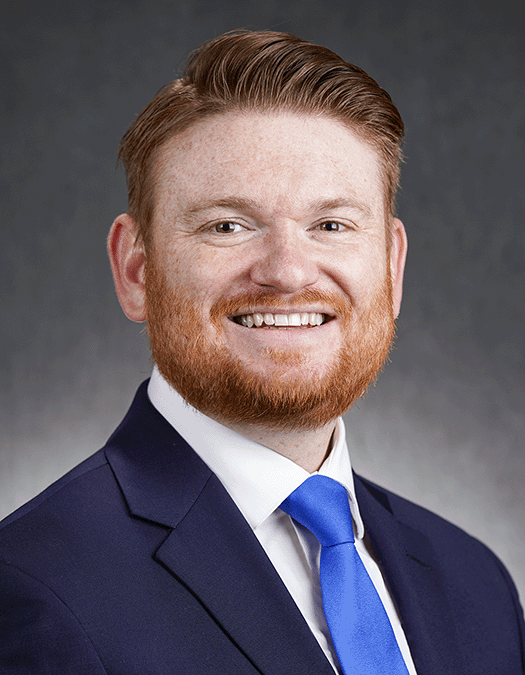
Rep. Andy Smith
Sponsored bills
Maddy summaryHF 1414 appropriates $600,000 from the general fund for a one-time grant to Accessible Space, Inc. to make capital improvements to two low-income accessible housing properties in Rochester (1680 Eastwood Road SE and 3461 Kenosha Drive). The funding supports physical upgrades to existing housing units, not new construction or ongoing operations. This bill directly affects low-income residents living in these specific Rochester housing units by potentially improving their living conditions through the renovations. The appropriation is available until the project is completed or abandoned, per state statute.
Maddy summaryHF 1356 allows cities with over 100,000 residents (outside specific jurisdictions) to extend their zoning and subdivision regulations to unincorporated land within two miles of their boundaries, even in areas where counties or towns already have their own zoning rules. This directly affects large cities seeking to control development in surrounding rural areas and the unincorporated communities they would regulate. The bill amends existing law to remove restrictions preventing these cities from applying their rules to adjacent unincorporated territory, provided the area isn't already covered by county or town zoning. The key change enables larger municipalities to more uniformly manage growth and development patterns in their immediate vicinity.
Maddy summaryHF 1041 imposes an additional tax on Minnesota corporations with high executive-to-median-worker pay ratios, ranging from 0.2% to 1.5% based on the ratio tier (e.g., 0.2% for 50:1 to 100:1 ratios). It directly affects corporations meeting specific pay ratio thresholds, using the federal disclosure standard (17 CFR § 229.402(u)(1)(iii)) to calculate the ratio. The bill also disqualifies these corporations from receiving state grants or subsidies, as specified in amended Minnesota Statutes sections 16B.981 and 290.06. The tax applies to taxable years beginning after December 31, 2025, with disqualification effective January 1, 2026.
Maddy summaryHF 1189 appropriates $250,000 from Minnesota's general fund for the Rochester Area Foundation's Pamoja Women program during fiscal year 2026. The funding supports two specific services: women's health education and parent education programming. This is a one-time appropriation available until June 30, 2027, and directly affects the Rochester Area Foundation's program operations. The bill does not change existing laws but provides dedicated funding for these community services.
Maddy summaryHF 351 establishes a minimum aid amount for cities in Minnesota with unmet needs, specifically requiring that cities located in counties containing a first-class city receive aid of at least $150 multiplied by their population (if their unmet need exceeds zero). The bill amends Minnesota Statutes to set total annual aid distributions at $644 million for 2024-2025 and $722 million for 2026 onward. It modifies how city aid is calculated when certified aid exceeds unmet needs, ensuring no city receives less than its prior year's certified amount minus a small adjustment. The changes take effect for aid payments starting in 2026. This directly affects cities relying on state-local aid programs under Minnesota’s tax system.
Maddy summaryHF 350 establishes guaranteed minimum aid amounts for Minnesota cities receiving state aid. It requires that cities receive at least their previous year's certified aid amount (adjusted for population or levy limits) or their current unmet need, whichever is greater. For first-class cities, it sets a minimum of $150 multiplied by the city's population. The bill also specifies annual aid funding levels, increasing to $657,681,729 for aid payable in 2026 and later. This applies to all cities receiving state local government aid under Minnesota Statutes.
Maddy summaryHF 30 requires Minnesota's Commissioner of Revenue to create a free, electronic system allowing residents to file individual income tax returns directly online without cost. The system must be hosted on the Department of Revenue website, and any contracted software vendor cannot offer paid tax preparation services through it. By tax years starting after December 31, 2025, the system must support at least 70% of resident individual tax returns, and the state must coordinate it with federal filing systems where possible. This directly affects Minnesota taxpayers who currently file individual income taxes, providing a free filing option instead of relying on paid services.
Maddy summaryHF 265, also known as "Brent's Law," requires Minnesota 911 call centers to identify mental health crisis calls and prioritize mental health crisis teams as primary responders when available. It mandates that 911 telecommunicators receive specific training or mental health staff screen calls to recognize crises, and establishes protocols for public safety answering points to comply. The bill also creates a civil lawsuit option for individuals or families harmed by violations, allowing claims for damages, attorney fees, and up to $15,000 in punitive damages for willful violations. This directly affects all Minnesota public safety answering points and the government entities operating them.
Maddy summaryThis bill increases the maximum refund amount for political contributions claimed on Minnesota state income taxes. For individuals, the maximum refund rises from $75 to $100 per year, and for married couples filing jointly, it increases from $150 to $200 per year. It directly affects Minnesota taxpayers who contribute to candidates or political parties and claim these refunds on their state tax returns. The amendment updates Minnesota Statutes section 290.06, effective for tax years beginning after December 31, 2024. The bill does not change eligibility requirements or documentation rules for claiming the refund.