

Maddy summaryHF 3294 is a non-binding resolution passed by the Minnesota House of Representatives. It urges the President and Congress to fully fund Medicaid and oppose federal funding cuts, directly affecting Minnesota's 1.2 million Medicaid beneficiaries - including children (41% covered), seniors, people with disabilities, and communities of color (covering 80-90% of Black and American Indian births). The resolution has no new funding mechanisms or state policy changes; it solely requests federal action. It does not impose new requirements or alter existing Medicaid programs.
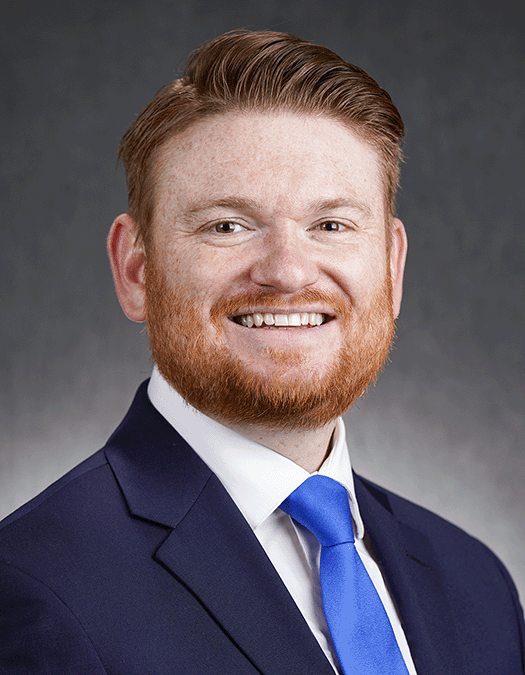
Rep. Andy Smith
Sponsored bills
Maddy summaryHF 1278 establishes a one-time $30 million reproductive health equity grant fund to support abortion care access in Minnesota. The bill provides funding to abortion providers, government agencies, and nonprofits whose primary work involves abortion care, with grants designed to increase access, cover uncompensated care for low-income patients, secure facility infrastructure, and fund staff training in trauma-informed care. Eligible organizations must apply through the commissioner of health, who will prioritize applications based on local need, health equity impact, and applicant need. The fund becomes effective July 1, 2025, with grants to begin by January 1, 2026, and includes strict privacy protections requiring confidentiality of patient information.
Maddy summaryHF 2289 requires Minnesota hospitals to maintain registered nurse staffing levels consistent with nationally accepted standards, ensuring adequate care for patients. Hospitals must create and implement staffing plans specifying maximum patient-to-nurse ratios for each unit, developed with input from direct-care registered nurses, and report these levels to the state. The bill prohibits retaliation against nurses who raise staffing concerns and imposes civil penalties for noncompliance. It directly affects all licensed Minnesota hospitals, their nursing staff, and patients by mandating safer staffing practices. The law appropriates funding to support implementation of these requirements.
Maddy summaryHF 3259 reauthorizes Minnesota's existing farmer-lender mediation program, extending its operational deadline from June 30, 2027, to June 30, 2032. This program directly helps farmers and lenders resolve financial disputes through voluntary mediation instead of court proceedings. The bill updates Minnesota Statutes section 583.215 to reflect this extended expiration date, ensuring continued access to mediation services for agricultural debt conflicts.
Maddy summaryHF 1314 appropriates $10 million from bond proceeds to fund the acquisition of private lands within existing Minnesota state parks and recreation areas. This money, raised by issuing up to $10 million in state bonds, is specifically for creating new parks or expanding current ones. The bill directly affects the Commissioner of Natural Resources (who administers the funds) and private landowners willing to sell property within designated park boundaries. It establishes a dedicated funding mechanism through bonds instead of general state funds for park land expansion.
Maddy summaryHF 2339 increases Minnesota's income threshold for the child tax credit, allowing more families to qualify for the full benefit before credits begin phasing out. The bill raises the phaseout threshold from $35,000 to $45,490 for married couples filing jointly and from $29,500 to $38,340 for other filers. This change directly affects Minnesota taxpayers with children who file individual income tax returns, as it prevents the credit from decreasing at lower income levels. The bill also requires future annual inflation adjustments to these thresholds starting in 2026.
Maddy summaryHF 1913 creates a new limited medical license for graduates of foreign medical schools who meet specific criteria, including 60 months of practice outside the U.S. in the past decade, working in a collaborative agreement within a rural or underserved area, and providing evidence of a job offer. It requires employers of these limited license holders to carry medical malpractice insurance and pay at least the equivalent of a medical resident's salary, while prohibiting retaliation for reporting violations. Limited license holders must submit periodic certification to the medical board confirming their employment and good standing every six months. The bill also establishes a pathway to full licensure after two years of practice (1,692 hours annually), passing all USMLE/COMLEX-USA steps, and obtaining a recommendation letter.
Maddy summaryThis bill appropriates $20 million ($10 million for each of fiscal years 2026 and 2027) to create regional food bank grants. It directs the commissioner of Children, Youth, and Families to distribute funds to regional food banks and federally recognized Minnesota tribes to purchase, transport, and distribute food through federal programs, with optional use for hygiene products like diapers. Recipients must comply with federal food assistance guidelines and report spending to the commissioner. The program aims to increase food availability for individuals and families in need across Minnesota.
Maddy summaryHF 3156 restricts local governments from blocking affordable housing developments by religious organizations on their own land. It requires cities to permit such projects as a "permitted use" in specific zones: up to three units on most residential lots, up to eight units outside single-family districts, and up to 12 units in mixed-use or commercial areas. The bill defines "affordable housing" as developments where 20-40% of units are for households earning ≤50-60% of area median income, and sets minimum density requirements (e.g., 1.25x existing density). This directly affects religious organizations seeking to build housing, cities with zoning codes that previously restricted such projects, and low-income residents in communities where these developments may be constructed.
Maddy summaryHF 2761 updates Minnesota's pesticide regulations to include pesticides from treated seeds in the commissioner's management plans and monitoring. It requires new coordination between state agencies, local governments, and public health agencies for pesticide management, and adds monitoring for pesticides from treated seeds and their breakdown products in groundwater, surface water, and air. The bill establishes new labeling requirements for certain pesticide-treated seeds and defines "systemic pesticides" (like neonicotinoids) for a new regulatory program. These changes primarily affect farmers using treated seeds, state environmental agencies, and local communities managing water and air quality.