

Maddy summaryHF 2166 requires the Minnesota Department of Agriculture to relocate its main offices to either Blue Earth County or Nicollet County by June 1, 2028. This procedural bill amends Minnesota Statutes section 17.01, changing the location requirement for the department's principal offices. The bill directly affects the Department of Agriculture's operational headquarters and does not create new programs or funding. It is a straightforward location mandate with no additional policy provisions.
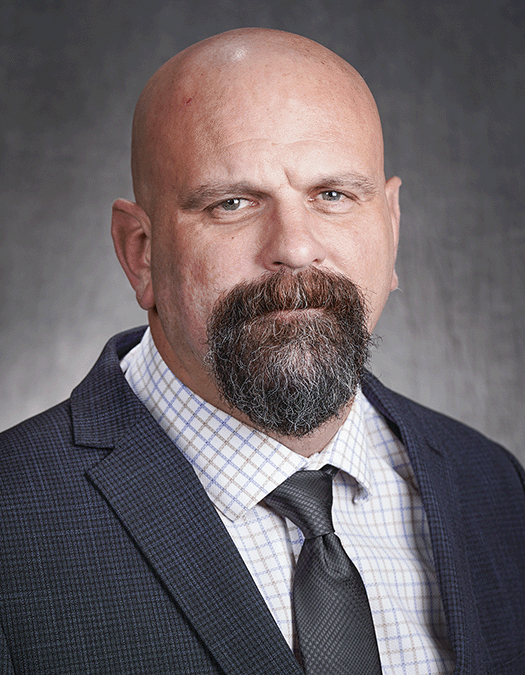
Rep. Terry Stier
Sponsored bills
Maddy summaryHF 2167 requires Minnesota judges to state publicly the reasons for releasing or detaining individuals arrested for domestic violence, stalking, or violating protection orders. Judges must document findings on whether the person poses a safety threat to victims or family members, or is likely to skip court. This applies to all pretrial release decisions for these offenses starting August 1, 2025. The bill focuses on transparency in judicial decisions without altering existing release conditions.
Maddy summaryHF 2220 prohibits Minnesota state agencies from charging parking fees to state employees at facilities owned or operated by the state. It directly affects all state employees who park on state property, whether working or with manager approval for personal use. The bill amends Minnesota Statutes (sections 16B.04 and 16B.58) to require free parking, removing all fees, fines, or penalties for eligible employees. This change applies to all state parking lots managed under the Department of Administration, ensuring employees receive a free parking permit.
Maddy summaryHF 2135 requires Minnesota's child welfare system to undergo a detailed fiscal analysis and comprehensive program evaluation. It mandates a third-party consultant to examine federal funding sources (like Title IV-E and IV-B reimbursements), budgeting processes, and system integration, while also engaging tribal nations, community advocates, and those with lived experience. The analysis must identify ways to maximize federal funding, address inequities, and recommend state investment or legislative changes by June 2027. The resulting report will guide improvements to child welfare services for children and families in Minnesota’s system.
Maddy summaryHF 1261 increases penalties for tampering with motor vehicles and establishes a new offense for passengers who knowingly ride in a vehicle they reasonably should have known was taken without permission. The bill directly affects drivers who tamper with vehicles (e.g., breaking in or damaging them) and passengers who are aware a vehicle was stolen. Its key provision creates a separate crime for passengers who should have known a vehicle was taken, expanding accountability beyond just the driver. The bill amends Minnesota Statutes 609.546, effective August 1, 2025.
Maddy summaryHF 1241 repeals Minnesota's Paid Leave Law, which previously provided state-funded family and medical leave benefits. The bill transfers any unspent funds from the family medical leave account to the general state fund, effective July 1, 2025. It specifically repeals all provisions of Minnesota Statutes 2024, sections 268B.001 through 268B.30, which governed the paid leave program. This action eliminates the state's paid leave law and redirects unused program funds to the general state budget.
Maddy summaryHF 1260 authorizes special license plates for Minnesota firefighters who are also certified emergency medical technicians (EMTs), advanced EMTs, or paramedics. To qualify, applicants must provide proof of state certification from the Office of Emergency Medical Services, a letter from their fire chief confirming active membership, and own a passenger car, one-ton pickup, or motorcycle. The special plates require an additional fee, must display a distinct emblem, and become invalid if the holder loses either fire department membership or EMT certification. The bill also allows limited plate transfers between qualifying vehicles for a $5 fee and takes effect January 1, 2026.
Maddy summaryHF 541 establishes a $2.5 million reimbursement program to cover training costs for peace officers on use of force, including deadly force. Certified postsecondary schools providing approved in-service training must meet specific requirements, including scenario-based drills with nonlethal ammunition, stress management instruction, and de-escalation techniques. Schools receive $450 per officer completing the free training, which must be offered at no cost to officers or their law enforcement agencies. The program is administered by the Office of Higher Education using funds from the state general fund.
Maddy summaryHF 893 clarifies and strengthens Minnesota's self-defense laws by eliminating the requirement to retreat before using force when defending one's home or person. It expands the definition of "dwelling" to include occupied vehicles, porches, decks, and adjacent structures, and creates a legal presumption that someone entering a dwelling by stealth or force poses an imminent threat. The bill allows individuals to use deadly force without retreating in certain situations, such as when preventing a forcible felony or imminent harm to themselves or others. This directly affects Minnesotans using self-defense, particularly in home or vehicle defense scenarios.
Maddy summaryHF 898 withdraws Minnesota from the National Popular Vote Interstate Compact, a multi-state agreement that would have awarded the state's presidential electors based on the national popular vote. The bill amends Minnesota election law to revert to the state's existing method for selecting presidential electors: candidates are nominated by party conventions and elected based on congressional district and statewide vote totals, rather than the national popular vote. This change directly affects how Minnesota's 10 presidential electors are chosen in future elections. The bill repeals Minnesota Statutes sections 208.051 and 208.052, which had implemented the compact.