

Maddy summaryHF 2936 requires Minnesota's Commissioner of Corrections to seek legislative approval before implementing certain new or amended rules that would cost over $25,000 annually for any jail, lockup, or workhouse to comply with. If the commissioner determines compliance costs exceed this threshold, or if an administrative law judge disapproves that determination, the affected facility can request a temporary exemption until the legislature approves the rule. The bill amends Minnesota Statutes to add this requirement for legislative review prior to implementation of high-cost correctional rules. This directly affects local correctional facilities by delaying rule implementation until legislative approval is obtained.
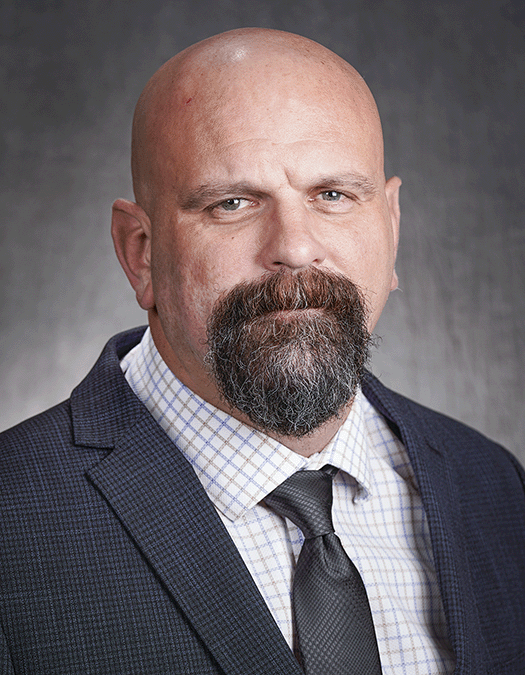
Rep. Terry Stier
Sponsored bills
Maddy summaryHF 2406 allows people receiving certain disability waiver services in Minnesota to have remote reassessments (via video or phone) instead of in-person meetings under specific conditions. It directly affects individuals enrolled in developmental disabilities, community access, brain injury, or elderly waiver programs. The bill permits remote reassessments to replace up to two consecutive in-person meetings for some programs (followed by an in-person meeting), or one for others, but requires informed consent from the person or their legal representative and verifies ongoing needs, care level, and service plan details. All remote reassessments must follow the same requirements as in-person meetings, including updates to support plans. The changes take effect January 1, 2026, or after federal approval.
Maddy summaryHF 1039 requires the State Board of Civil Legal Aid to submit an annual report to legislative committees by January 15 in odd-numbered years. The report must include data on cases and individuals served by each legal aid organization receiving state funds, broken down by organization and geographic region where possible. The bill mandates that this data be provided in aggregate form to protect the privacy of clients. This affects the State Board and all legal aid grant recipients funded under Minnesota Statutes section 480.242.
Maddy summaryHF 2812 requires Minnesota's Commissioner of Corrections to charge fees for incarcerated people's communication services (like phone calls, video, or messaging), but only up to the actual cost of providing those services. It mandates that voice calls remain free for both the incarcerated person and the recipient, prohibits state agencies from profiting from these services (except for pre-2023 contracts), and requires facilities to maintain in-person visitation programs unless an emergency exists. The bill also adds reporting requirements for the Department of Corrections to track fees, spending, and usage of communication services. This directly affects incarcerated individuals, their families, and correctional facilities in Minnesota.
Maddy summaryHF 2818 creates a program to reimburse Minnesota law enforcement agencies for specific costs incurred while responding to protests or demonstrations at the State Capitol complex or the governor's residence. Eligible costs include overtime pay, equipment damage, backfill staffing, and necessary supplies. Agencies must submit detailed requests within 60 days of a protest, with the Public Safety Commissioner reviewing applications and making payments within 30 days. The law requires an annual report starting in 2027 detailing all reimbursements, and appropriates funding for fiscal years 2026 and 2027.
Maddy summaryHF 2648 prohibits certain sex offenders convicted of crimes against minors under 18 from accessing social media platforms where users under 18 can interact. It requires these individuals on parole or probation to disclose all social media account details (including usernames and passwords) to their supervising agent and bans access to platforms allowing minor users. The law defines "social media platform" narrowly to exclude email, search engines, and business communication tools. The commissioner must annually publish a list of compliant platforms for probation agents to enforce these restrictions. This directly affects sex offenders sentenced under Minnesota statutes 609.342-609.3458 for offenses involving minors under 18.
Maddy summaryHF 128 increases criminal penalties for individuals engaging in prostitution with minors in Minnesota. The bill raises maximum sentences and fines based on the minor's age: up to 30 years or $40,000 for victims under 14, 20 years or $40,000 for those aged 14-15, 15 years or $30,000 for those aged 14-15 (for the act itself), and 10 years or $20,000 for victims aged 16-17. It also increases penalties for hiring minors for sexual acts across all age groups. The bill applies to crimes committed on or after its effective date of August 1, 2025.
Maddy summaryHF 2629 amends Minnesota's tax code to clarify definitions for regional sales taxes. It updates terms like "metropolitan area" (specifically naming Anoka, Carver, Dakota, Hennepin, Ramsey, Scott, and Washington counties) and "metropolitan sales tax" in statutes 297A.9915 and 297A.9925. The bill specifies that the Metropolitan Council must impose a 0.25% sales tax on retail sales within these seven counties, effective after June 30, 2025. This change directly affects businesses and consumers in those counties by clarifying the tax's scope and administration. The bill focuses solely on defining existing tax terms, not altering tax rates or policies.
Maddy summaryThis bill appropriates $3.5 million from the general fund for fiscal year 2026 to the commissioner of public safety. The funds will be provided as grants to the Fencing Consortium, which will distribute them to local government facilities in Minnesota that are members of the consortium. The money is specifically for purchasing anti-scale fencing, pedestrian doors, and vehicle gates to improve safety at these facilities. This is a one-time funding allocation with no new regulations or requirements.
Maddy summaryHF 340 modifies Minnesota's law on fleeing police in vehicles by adding two new offenses. It creates a felony for fleeing while driving recklessly (subdivision 3a), risking death or serious harm, punishable by up to 4 years in prison or a $8,000 fine. It also establishes a separate felony for fleeing while violating specific traffic laws like ignoring road signs or lane markings (subdivision 3b), with penalties of up to 5 years or $10,000. The bill increases license revocation periods for these offenses and allows police to use tracking devices on fleeing vehicles. These changes directly affect drivers who flee law enforcement while engaging in reckless or traffic-law-violating behavior.