

Maddy summaryThis bill creates a new income tax subtraction for Minnesota residents who receive medals or prize money from the United States Olympic Committee for competing in the Olympic or Paralympic Games. The provision allows athletes to exclude the value of these awards from their state taxable income, beginning for tax years starting after December 31, 2025. The legislation amends existing Minnesota tax statutes to add this specific subtraction to the list of allowable deductions when calculating individual income tax liability.
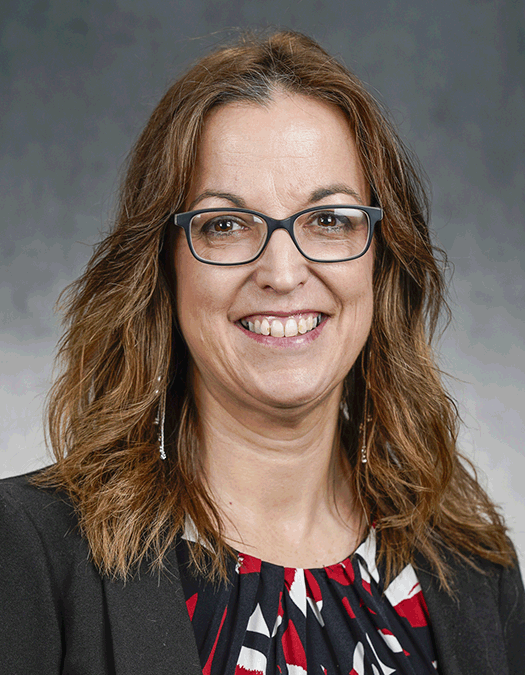
Rep. Marj Fogelman
Sponsored bills
Maddy summaryThis bill modifies Minnesota's escort requirements for oversized loads, specifically addressing manufactured and modular homes. It clarifies that when a licensed peace officer requires an escort beyond standard rules, that officer cannot personally provide the escort or be paid for it. Instead, the state commissioner of public safety must cover the escort costs from existing department funds and create a process to do so. The legislation also clarifies that briefly crossing the centerline during transport does not count as extending beyond the left side for escort determination purposes. These changes directly affect transportation companies moving large homes and the state public safety department.
Maddy summaryHF 3507 cancels unused funds from the Blue Line light rail extension project and redirects them to fund a bus rapid transit line in the same corridor. The bill reallocates unspent money from a 2023-2024 transit appropriation to the Metropolitan Council for developing an arterial bus rapid transit line, with funds available until June 2029. This one-time reallocation affects the Metropolitan Council (which manages regional transit) and residents in the corridor where the canceled rail project was planned. The policy change shifts existing transit funding from rail to bus improvements without creating new taxes or spending.
Maddy summaryThis bill requires election judges in Minnesota to transfer printed election result records to central locations using physical methods like disk or tape, rather than relying solely on electronic transmission. It also mandates that postelection reviews separately count absentee and early voted ballots from ballots cast on election day within the same precinct. These changes apply to county canvassing boards and election judges who conduct manual reviews of voting systems. The bill establishes separate performance standards for electronic voting systems used for different types of ballots, ensuring each system is evaluated based on its own tabulated votes.
Maddy summaryThis bill authorizes the state to issue up to $2 million in bonds to fund wastewater infrastructure improvements in Nobles County. The funds will be provided as a grant to the Public Facilities Authority for Nobles County to acquire land, hire engineers, and build wastewater collection, conveyance, and treatment systems for the Reading Subordinate Sewer District. The appropriation does not require Nobles County to contribute matching funds from other sources. The bill takes effect immediately upon final passage by the legislature.
Maddy summaryThis bill authorizes the city of Windom to impose a one percent local sales and use tax if approved by voters in a special election. The tax revenue must be used to cover collection costs and fund specific projects, including $7.5 million for a swimming pool and $1.5 million for flood mitigation measures. The city may issue up to $9 million in bonds to help finance these projects, with the tax serving as a repayment source. The tax would expire after 18 years or once the city determines sufficient funds have been collected, whichever comes first.
Maddy summaryThis bill prohibits individuals receiving Minnesota public assistance programs from using licensed money transmitters to send money to foreign countries. It directly affects recipients of programs such as SNAP, medical assistance, child care assistance, and housing support. The law requires money transmitters to report every six months to state agencies any individuals who send money abroad, and state officials must then check if those individuals are enrolled in public assistance programs. If a recipient is found to have sent money to a foreign country while receiving aid, they will lose eligibility for all public assistance programs they were participating in.
Maddy summaryThis bill requires Minnesota's social studies standards to include information about the dangers and perils of communism and socialism, specifically during the 2030-2031 review and revision of state academic standards. The legislation mandates that the state commissioner incorporate details about estimated lives lost and negative outcomes associated with these ideologies into the updated curriculum. It directly affects Minnesota public school systems by setting a specific requirement for future social studies education content. The bill takes effect on July 1, 2026, and does not change current curriculum requirements but establishes a mandate for future revisions.
Maddy summaryThis bill directs Minnesota's Department of Health to integrate specific reproductive health education into existing public health programs like family planning and maternal and child health services. It requires updating health education materials to include information on restorative reproductive medicine, fertility awareness-based methods, and body literacy education. The legislation mandates that Title X-funded facilities incorporate these services within 12 months and provides for provider training and patient education materials. The bill also establishes definitions for terms such as infertility, reproductive health conditions, and restorative reproductive health to guide implementation.
Maddy summaryHF 3573 requires individuals to have valid work authorization to qualify for benefits under Minnesota's Paid Leave Law. It amends the law to explicitly exclude people without proper work permits from receiving paid leave benefits. The bill affects workers applying for benefits who lack authorized work status, adding this as a new eligibility requirement. Key changes include updating definitions of "covered individual" and "employee" to exclude those without valid work authorization, and adding work authorization as a mandatory requirement for benefit accounts.