

Maddy summaryHF 3107 modifies Minnesota's sales and use tax exemption for businesses building large-scale agriculture processing facilities. The bill sets a $100 million capital investment threshold for eligibility, exempting building materials and supplies used in facilities processing agricultural crops (excluding livestock, poultry, or wood products). Tax must be collected at standard rates and then refunded per existing procedures. This change affects businesses planning major processing facility investments exceeding $100 million, effective after June 30, 2025.
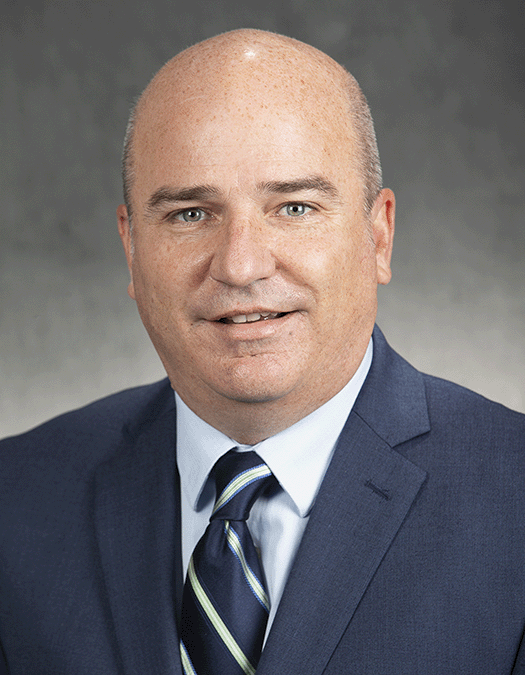
Rep. John Burkel
Sponsored bills
Maddy summaryHF 3144 appropriates $1 million for fiscal year 2026 and $1 million for fiscal year 2027 to support medical supply delivery to rural Minnesota communities using small drones. The bill directly affects rural residents who may face challenges accessing medical supplies, as well as state agencies implementing drone delivery systems. Key provisions include funding infrastructure for drone operations beyond visual line of sight, assisting with federal regulatory approvals, testing delivery systems, and public education on drone use. The commissioner of transportation must coordinate with the commissioner of health and the Board of Pharmacy on how these funds are used.
Maddy summaryHF 3257 appropriates $45,000 for fiscal year 2026 and $45,000 for fiscal year 2027 from the general fund to provide grants for wolf-livestock conflict prevention. The funds, administered by the commissioner of agriculture, directly support livestock producers facing wolf encounters by covering nonlethal prevention methods. Key provisions include using the money for grants under Minnesota Statutes §3.737 and allowing partial funding for nonlethal work done by federal wildlife services. This bill creates a dedicated funding stream for proactive measures to reduce livestock losses without lethal wolf management.
Maddy summaryHF 733 removes restrictions on handheld electronic devices used for bingo and pull-tab games in Minnesota. The bill amends state law to allow these devices, which must meet specific requirements like a $0.25 minimum ticket price, a limit of 36 bingo faces per game, and no slot machine-style features (e.g., spinning reels or bonus screens). It also requires devices to support visually impaired players and maintain transaction records. This change directly affects bingo and pull-tab operators by enabling new electronic gameplay options while maintaining key safeguards.
Maddy summaryHF 3151 prohibits health care providers in Minnesota from offering gender-affirming medical care (like hormone therapy or puberty blockers) or certain counseling to minors under 18. It directly affects minors seeking such care, their health care providers, and public health programs that could fund this care. Exceptions include treatment for precocious puberty or intersex conditions when medically necessary, and mental health counseling that doesn't affirm a gender identity differing from biological sex. Violations carry severe penalties, including $500,000 fines per violation, license revocation, up to 10 years in prison, and civil lawsuits by guardians. The bill takes effect July 1, 2025.
Maddy summaryHF 601 appropriates $125,000 for livestock depredation compensation and $125,000 for crop damage compensation under Minnesota law, directly affecting farmers who suffer wildlife-related losses. The livestock funding covers compensation for destroyed or crippled livestock and allows up to $5,000 for university educators to assess fair market values. The crop funding supports compensation for damaged crops, includes $10,000 for claim investigations, and allocates $40,000 for grants to protect stored crops from elk. Both funds are one-time appropriations available until June 30, 2026.
Maddy summaryHF 2230 requires all Minnesota pharmacies to offer ivermectin and hydroxychloroquine tablets for human use without a prescription. This bill directly affects every registered pharmacy in Minnesota by mandating the availability of these specific medications as over-the-counter drugs. The key provision amends Minnesota law to add a new requirement (Section 151.411) overriding existing restrictions, making it unlawful for pharmacies to refuse to sell these drugs without a prescription. The bill defines "over-the-counter drug" to include these medications, changing current pharmacy practice standards. This is a direct policy change to alter prescription requirements for two specific drugs.
Maddy summaryHF 2613 allows irrigators with water-use permits to transfer unused water gallons to other permit holders using the same water source, with the commissioner verifying compliance. It permits using "excess water" (unused gallons from the prior year) during declared drought conditions (D3/D4 on the U.S. Drought Monitor), provided use remains sustainable. The bill also adds 27,154 gallons per acre for irrigation of cover crops when needed, subject to sustainability checks by the commissioner. These provisions directly affect Minnesota irrigators managing groundwater or surface water permits.
Maddy summaryHF 3212 appropriates $34.59 million from bond proceeds and $15.72 million from the general fund to support a nine-county regional waste management system in northwest Minnesota. The bill directly funds specific projects for Beltrami, Cass, Clearwater, Hubbard, Mahnomen, Marshall, Norman, Polk, and Red Lake counties, including constructing a new debris landfill in Hubbard County and upgrading 12 existing processing facilities. Key mechanisms include grants for building construction, site improvements, and capital equipment (like compactors and sorting systems) to coordinate waste handling across the region. This funding enables counties to design, build, and equip facilities for managing trash and recyclables, with no new regulations or policies created.
Maddy summaryThis bill lowers the age threshold for early retirement reductions in Minnesota's Teachers Retirement Association from 62 to 60. It directly affects teachers who retire before normal retirement age but want to avoid reduced benefits. Specifically, members retiring before age 60 will now face the early retirement reduction, whereas previously the reduction applied only for retirement before age 62. The bill also clarifies procedures for delaying postretirement adjustments, though the exact mechanism isn't detailed in the provided text.