

Maddy summaryThis bill establishes a task force within Minnesota's Department of Veterans Affairs to address mental health service access for veterans living in rural areas. The task force will be responsible for identifying challenges and developing recommendations to improve how these veterans receive mental health care. Funding is allocated from the state's general fund to support the task force's operations over three fiscal years, starting in 2027. The legislation directly affects the Department of Veterans Affairs and rural veterans who may face barriers to accessing mental health services.
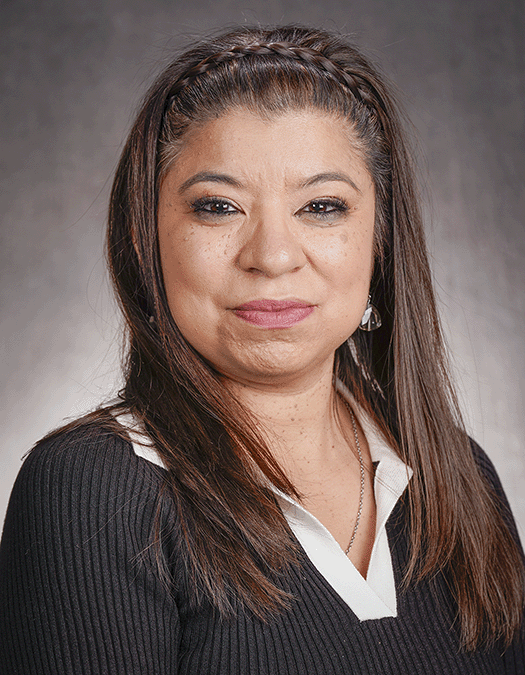
Rep. Erica Schwartz
Sponsored bills
Maddy summaryThis bill allocates $1.75 million from the state's general fund in fiscal year 2027 to help develop and implement a unified 911 center awareness platform. The money will be given to the Metropolitan Emergency Services Board to create a system that enables 911 centers to communicate and coordinate emergency responses across different jurisdictional boundaries in real time. The grant also covers two years of maintenance costs for the platform. This legislation directly affects public safety officials and emergency response centers by providing funding for improved communication infrastructure.
Maddy summaryHF 168 creates an advance homestead credit for qualifying seniors in Minnesota, allowing them to receive 50% of their prior year's homestead tax refund upfront. Seniors who already qualified for the standard homestead credit can apply for this advance, which is applied directly to their first-half property tax payment each year. The state reimburses counties and school districts for the tax reductions by October 31 (for non-school districts) or through the Department of Education (for school districts). This policy, effective for 2027 property taxes, aims to ease annual tax burdens for eligible seniors by providing earlier access to their refund amount.
Maddy summaryThis bill creates a new tax in Minnesota that targets individuals and organizations convicted of fraud or those identified by the state revenue commissioner as having obtained money through deceitful means. The tax requires anyone who has successfully defrauded state programs to pay back 100 percent of the stolen amount, regardless of any existing fines or restitution already ordered by courts. The state revenue commissioner is tasked with investigating suspected fraud, setting up a system to collect these payments, and ensuring the recovered funds are used specifically for income and property tax relief. The law applies retroactively to fraud cases determined after December 31, 2019, and also covers people who were paid to help commit the fraud.
Maddy summaryThis bill requires individuals seeking Minnesota medical assistance to demonstrate community engagement through work, education, or community service to maintain eligibility. Applicants must show compliance with these requirements over the two months before applying or renewing, or qualify for specific exceptions. Eligible individuals can meet the requirement by working 80 hours, completing 80 hours of community service, attending school half-time, earning at least the federal minimum wage for 80 hours, or combining these activities. The law includes exceptions for parents of young children, veterans with total disabilities, SNAP recipients, people in addiction treatment, inmates, and those with serious medical conditions or disabilities.
Maddy summaryHF 3753 establishes a pilot program to enhance school safety through threat assessment. The Minnesota Department of Public Safety will contract with a vendor to provide real-time monitoring, threat alerts, and door-locking capabilities using predictive analytics, with services integrating into existing school security systems. One school district per congressional district (including both large and small districts) will participate, excluding those already using similar systems. The program requires a report by January 2027 evaluating effectiveness, gathering feedback from schools, and recommending statewide implementation, funded by a $4 million appropriation from the general fund for fiscal year 2027.
Maddy summaryThis bill requires employees and officers of the state, the University of Minnesota, and certain other organizations to immediately report in writing to the legislative auditor if they discover theft, embezzlement, or unauthorized use of public funds. The law includes an exception for situations where reporting would knowingly hinder an active criminal investigation. Failure to comply with this reporting requirement when necessary is classified as a gross misdemeanor. The new penalties will take effect on August 1, 2026, and apply to crimes committed on or after that date.
Maddy summaryThis bill modifies how Minnesota calculates registration taxes for passenger cars and hearses by lowering the tax rate based on the vehicle's manufacturer's suggested retail price. It changes the tax calculation for new vehicles registered on or after November 16, 2020, and reduces the percentage of the vehicle's value taxed for each subsequent year of ownership. The legislation also establishes a process to transfer money from the state's general fund to the highway user tax distribution fund to cover any revenue shortfall caused by these tax reductions.
Maddy summaryThis bill updates Minnesota's definition of an all-terrain vehicle by increasing the maximum weight limit from 2,000 to 3,500 pounds. It also raises the annual fee for nonresidents to operate an all-terrain vehicle on state trails from $30 to $50. The collected fees will continue to fund grants for local governments to build and maintain all-terrain vehicle trails. These changes affect vehicle owners, operators, and the state's natural resources management system.
Maddy summaryThis bill allocates $1,000,000 from the state's general fund to hire eight additional school safety specialists at the Minnesota School Safety Center for fiscal years 2026 and 2027. The funding is designated as a one-time appropriation that can be used until fully spent, with no restrictions on how the money is distributed among the new positions. This legislation directly affects the Minnesota School Safety Center and the public safety system by increasing the number of available safety personnel. The bill takes effect immediately upon final passage by the legislature.