

Maddy summaryHF 1260 authorizes special license plates for Minnesota firefighters who are also certified emergency medical technicians (EMTs), advanced EMTs, or paramedics. To qualify, applicants must provide proof of state certification from the Office of Emergency Medical Services, a letter from their fire chief confirming active membership, and own a passenger car, one-ton pickup, or motorcycle. The special plates require an additional fee, must display a distinct emblem, and become invalid if the holder loses either fire department membership or EMT certification. The bill also allows limited plate transfers between qualifying vehicles for a $5 fee and takes effect January 1, 2026.
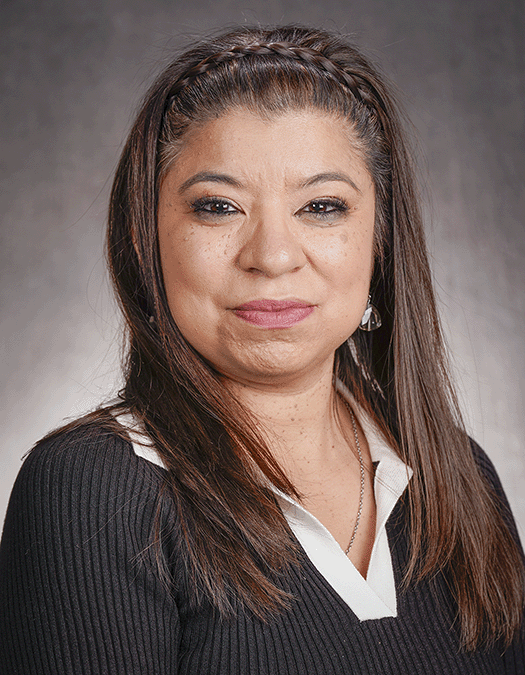
Rep. Erica Schwartz
Sponsored bills
Maddy summaryHF 72 prohibits entities or organizations receiving state funding from making campaign expenditures or spending money on political activities. It directly affects nonprofits and other groups that receive state funds through direct appropriations, competitive grants, or other legislatively named funding programs. The law bans using any state-funded money for political purposes, including supporting candidates or ballot measures, effective July 1, 2025. This policy change aims to separate public funds from political campaign activities.
Maddy summaryHF 1590 establishes mandatory minimum prison sentences for individuals who maliciously punish children, specifically targeting cases involving severe physical injury. It affects parents, legal guardians, or caretakers who cause substantial or great bodily harm to children, with penalties increasing based on the child's age (under 4) and the injury's severity. For example, causing head/neck injuries to a child under 4 mandates at least one year in prison, while causing great bodily harm requires a minimum two-year sentence. The bill amends Minnesota Statute 609.377 and takes effect August 1, 2025.
Maddy summaryHF 1726 appropriates $3.45 million from state bond proceeds to fund Blue Earth County's design, construction, and equipment for a dedicated recycling, reuse, and waste recovery customer service facility at its mixed municipal solid waste landfill. The bill authorizes the state to issue bonds to cover this cost, following Minnesota's bond procedures. This funding directly affects Blue Earth County residents by enhancing local waste management services at the landfill site. The legislation provides concrete financial support for facility development under Minnesota Statutes, section 115A.54.
Maddy summaryHF 1725 appropriates $68,684,000 from state bond proceeds to fund the construction, furnishing, and equipping of a new Bureau of Criminal Apprehension (BCA) regional office and laboratory facility in Mankato. The bill authorizes the state to sell bonds up to this amount to cover the costs, following standard bond procedures under Minnesota law. This funding directly supports the BCA's operations by creating a new regional facility in Mankato, which will serve the southern Minnesota community and improve forensic and investigative capabilities. The bill establishes concrete infrastructure funding without altering existing laws or creating new regulations.
Maddy summaryHF 1616 appropriates $12.75 million from state bond proceeds to fund the predesign, construction, and equipment of an indoor recreational facility at North Mankato's Caswell Regional Sporting Complex. The bill authorizes the state to issue bonds up to $12.75 million to cover this cost, as specified under Minnesota bonding laws. This funding directly supports the city of North Mankato in developing a new public recreational facility for community use. The bill becomes effective upon final enactment.
Maddy summaryHF 1359 increases funding for solid waste management by changing how fees collected from waste management are allocated. Starting in 2026, 7% of these fees will go to a resource management account (rising to 20% in 2027 and 30% after 2028), instead of the general fund. The funds must be distributed to counties for waste management programs under state law. This directly affects counties receiving these allocations and changes the percentage of fees dedicated to environmental resource management over time. The bill takes effect July 1, 2025.
Maddy summaryHF 1623 appropriates $1.525 million annually for fiscal years 2026 and 2027 from Minnesota’s arts fund to provide grants for interactive exhibits and outreach programs at 12 specific children’s museums across the state. The bill allocates exact annual amounts to each museum, including $175,000 each year for The Works (Bloomington) and the Children’s Museum of Southern Minnesota (Mankato), among others. Eligible museums must meet IRS criteria for children’s museums under code A52. This funding directly supports hands-on learning experiences focused on arts and cultural heritage for young visitors at these facilities.
Maddy summaryHF 1457 prohibits the construction of new public and charter schools within one-quarter mile of specific contaminated sites, including closed landfills listed by Minnesota's Pollution Control Agency or identified dump sites from historical records. The bill directly affects school districts and developers planning new educational facilities by requiring them to avoid these locations. Key provisions define "closed landfill" as sites on the Pollution Control Agency's contamination list and "dump site" as unpermitted waste disposal areas documented in a 2001 study or identified by county officials. The law takes effect July 1, 2025, aiming to prevent new schools from being built on potentially hazardous land.
Maddy summaryHF 1498 appropriates $1.09 million annually from the state general fund for grants to specific museums and education centers in Minnesota for fiscal years 2026 and 2027. The bill directly funds 12 designated institutions, including The Works in Bloomington ($125,000/year), WonderTrek Children's Museum in Brainerd ($82,500/year), and Duluth Children's Museum ($75,000/year), with remaining funds available for future years. It provides a fixed annual appropriation without altering eligibility rules or creating new programs. The bill’s sole policy change is directing state funds to these specific organizations for their operations.