

Maddy summaryHF 1311 modifies Minnesota's rules for how public utilities recover costs for electric generation and transmission assets. It requires utilities to submit detailed assessments showing how new assets contribute to system reliability during peak demand, including seasonal load calculations, before adding them to customer bills. For retiring assets, utilities must prove the action won't impair reliability, with the Public Utilities Commission required to explain impacts in its decisions. The bill directly affects Minnesota's electric utilities (like Xcel Energy) and the commission that reviews their rate requests. These changes apply to new filings after enactment, focusing on ensuring reliability while determining which costs can be passed to ratepayers.
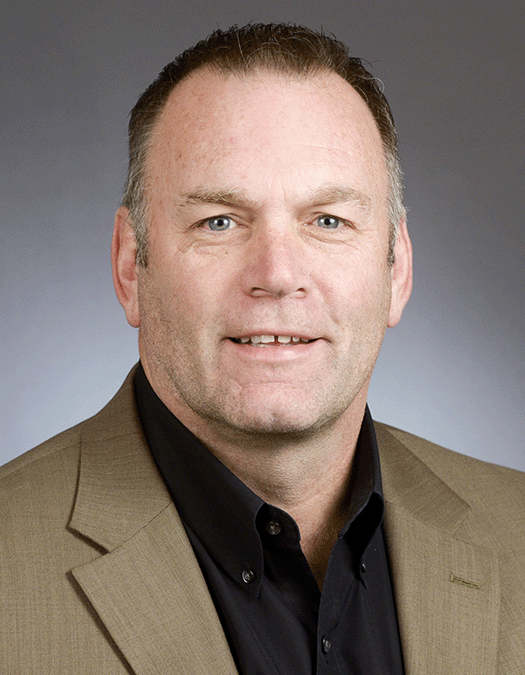
Rep. Dave Baker
Sponsored bills
Maddy summaryHF 981 appropriates $500,000 for fiscal year 2026 and $500,000 for fiscal year 2027 from the general fund to the Minnesota Commissioner of Health. This funding is directed to the nonprofit organization "Change the Outcome" to implement opioid prevention and education programs. The bill requires these programs to provide data-driven school and community education on opioid dangers, prevention strategies, overdose recognition, emerging drug trends (like fentanyl and xylazine), and access to substance use disorder support resources. The primary beneficiaries are Minnesota middle and high school students, communities, and individuals struggling with substance use disorders.
Maddy summaryHF 753 allows licensed veterans organizations in Minnesota to use gross profits from lawful gambling for repairing, maintaining, or improving their buildings. Specifically, it amends Minnesota law to permit these organizations to cover costs like water, fuel, electricity, and sewer expenses for their primary headquarters buildings. This change directly affects veterans groups operating legal gambling activities under state licensing. The policy expands their allowable uses of gambling revenue beyond previous restrictions, focusing on facility upkeep rather than other community programs.
Maddy summaryHF 98 modifies supervision and training rules for mental health professionals in Minnesota. It requires case managers with less experience to complete 40 hours of approved training and receive 38 hours of annual supervision (including monthly clinical sessions), while case management associates must meet specific education or experience criteria and complete 40 hours of preservice training. The bill also exempts intensive residential mental health treatment providers from certain client rights requirements and updates critical incident reporting timelines for residential programs. These changes directly affect mental health service providers, case managers, behavioral aides, and residential treatment facilities.
Maddy summaryHF 514 amends Minnesota Statutes section 121A.425 to modify dismissal limitations for kindergarten through grade 3 students. The current law prohibits disciplinary dismissals for these students, with exceptions for short-term dismissals (less than one school day) for students receiving special education services and for expulsions only after exhausting other resources in cases of serious safety threats. This bill adjusts those limitations, but the specific policy changes are not detailed in the provided bill text. The amendment directly affects public school students in grades K-3 and their schools, altering how disciplinary actions may be applied.
Maddy summaryHF 946 allows approved third-party programs (such as driving schools) to conduct the behind-the-wheel road test for class D driver's licenses (standard driver's licenses) in Minnesota. It establishes requirements for these programs and testers, mandates regular audits of third-party programs, and permits applicants to appeal decisions made by the Commissioner of Public Safety. The bill also updates website rules to show real-time appointment availability, display next available dates/times by location, and allow address-based searches without requiring personal information. This directly affects driver's license applicants and third-party testing programs seeking to administer road tests.
Maddy summaryHF 1325 modifies Minnesota's earned sick and safe time law to provide employers with a grace period and adjust pay requirements. It adds a penalty waiver (Section 1), preventing monetary penalties for initial violations until after January 1, 2026. The bill also adjusts pay rates: small employers (25 or fewer full-time equivalent employees) must pay half the hourly rate, and new employers in their first 12 months may optionally provide paid leave (Section 2). Employees accrue one hour of leave for every 30-40 hours worked, up to a maximum of 48 hours annually (Section 5), while expanding the definition of "family member" to include more relatives and up to one annually designated individual (Section 4). This primarily affects Minnesota employers and their workers covered under the law.
Maddy summaryHF 1246 appropriates $2.25 million from the general fund for fiscal year 2026 to the Neighborhood Development Center (NDC) in Minnesota. The funds support NDC's small business programs, including training, lending, business services, and real estate initiatives. Money may also assist organizations outside the seven-county metro area with technical assistance and grants, provide one-on-one entrepreneur support, and fund a cybersecurity center's operations and marketing. This is a one-time appropriation, with unspent funds carrying over to the second year.
Maddy summaryHF 260 extends an exemption for small employers from Minnesota's Paid Leave Law until January 1, 2028. The bill amends Minnesota Statutes to exempt employers with 20 or fewer employees (as calculated under section 268B.14, subdivision 5b) from the law's requirements. This means small businesses in Minnesota will not need to provide paid leave to employees until 2028, while larger employers must comply earlier. The exemption expires on January 1, 2028, after which all employers must adhere to the full Paid Leave Law.
Maddy summaryHF 853 appropriates $1.6 million from Minnesota's general fund for a new curling facility in Willmar. The funds are designated for Glacial Ridge Curling, a nonprofit organization, to cover predesign, design, construction, and equipment costs. This one-time appropriation is available until the project is completed or abandoned, subject to state funding requirements. The bill directly affects the Willmar community and the nonprofit organization by providing capital funding for a new public recreational facility.