

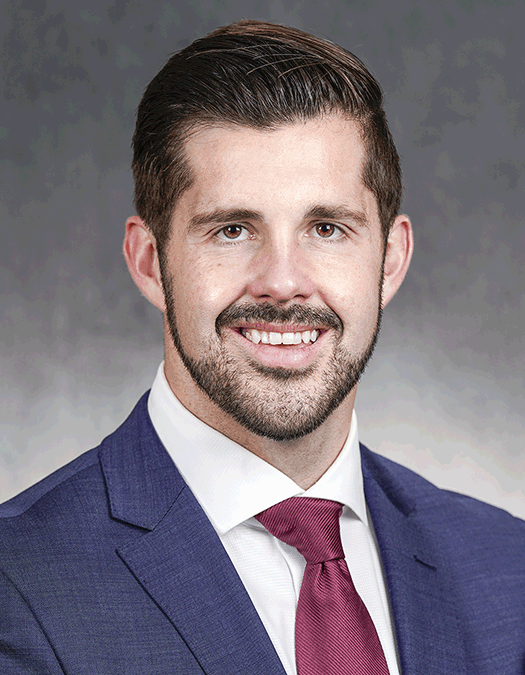
Maddy summaryHF 2254 adds a $400 "baby bonus" to Minnesota's existing child credit for each qualifying child born during the tax year. This directly affects Minnesota taxpayers with newborn children, increasing their state income tax credit. The bill modifies the child credit calculation by adding the $400 per newborn (without reducing the minimum credit amount) and allows for potential advance payments. It takes effect for tax years beginning after December 31, 2024.
Sponsored bills
Maddy summaryHF 1582 modifies Minnesota's Teachers Retirement Association (TRA) benefits for educators. It allows teachers with 30 years of service to retire at age 60 without reduced annuity payments (previously requiring 35 years), adjusts early retirement penalties, and increases postretirement cost-of-living adjustments. The bill also raises employer contribution rates for school districts (from 13.3% to 17.3% for basic members) and increases pension adjustment revenue rates for school districts starting in 2026. These changes directly affect current and future TRA members, school districts funding retirement costs, and the state's retirement system budget.
Maddy summaryHF 2110 appropriates $3.15 million from the general fund for fiscal year 2026 to reconstruct 322nd Street in St. Cloud and Stearns County. The funds cover design, engineering, environmental analysis, land acquisition, and construction between County Highway 4 and County Highway 133. This bill directly provides funding for a specific infrastructure project benefiting Stearns County and the city of St. Cloud.
Maddy summaryHF 2114 creates a $3.15 million grant program to train real-time stenographic writers (court reporters and closed captioners) in Minnesota. It awards two annual $300,000 grants - one to an institution in the seven-county metro area and one outside it - to fund training programs and job placement. Recipients must report annually on program effectiveness and best practices, and scholarship recipients must agree to work as stenographic writers for six months per semester received. The funds, appropriated for fiscal year 2026, cannot be used for AI transcription and expire June 2029. This directly affects Minnesota higher education institutions and aspiring stenographic writers seeking training.
Maddy summaryHF 2139 appropriates $2 million for fiscal year 2026 and $2 million for 2027 to fund the Gateways2Growth Initiative through the Center for African Immigrants and Refugees Organization (CAIRO). The initiative provides training in information technology, commercial driver's license (CDL) programs, and healthcare careers (like nursing assistants and pharmacy technicians) specifically targeting historically underserved groups, including immigrants, refugees, rural residents, and those experiencing economic displacement. CAIRO must allocate funds equally between the Twin Cities metro area and other regions, prioritize underserved participants, and partner with employers for job placements. The bill requires annual reports tracking participant numbers, employment outcomes, wage growth, and how well the program addresses workforce shortages in these key sectors.
Maddy summaryHF 2144 appropriates unspecified funds from the general fund for the Family Homeless Prevention and Assistance Program under Minnesota Statutes § 462A.204, for fiscal years 2026 and 2027. The bill directly affects families in Minnesota at risk of homelessness by providing funding for prevention and assistance services. Key provisions include directing the Housing Finance Agency to administer the program using these allocated funds. This is a funding bill with no new policy requirements, solely authorizing budget resources for an existing state program.
Maddy summaryHF 541 establishes a $2.5 million reimbursement program to cover training costs for peace officers on use of force, including deadly force. Certified postsecondary schools providing approved in-service training must meet specific requirements, including scenario-based drills with nonlethal ammunition, stress management instruction, and de-escalation techniques. Schools receive $450 per officer completing the free training, which must be offered at no cost to officers or their law enforcement agencies. The program is administered by the Office of Higher Education using funds from the state general fund.
Maddy summaryThis bill creates a refundable sales and use tax exemption for materials and equipment used in constructing Stearns County's new justice center (including jail, law enforcement, and judicial facilities). Contractors and vendors selling these materials to the project will pay the tax upfront but receive a full refund from the state. The exemption applies only to purchases made between January 1, 2025, and January 1, 2031, and covers all construction phases like building, renovation, or expansion. Stearns County and its contractors directly benefit from this tax relief.
Maddy summaryHF 2111 allocates $1 million in fiscal year 2026 to fund the Fursad Fund Initiative, administered by the Center for African Immigrants and Refugees Organization (CAIRO), to support small businesses in greater Minnesota. It directly assists businesses outside the seven-county metro area owned by immigrants, refugees, or communities of color with fewer than 25 employees and demonstrated financial need. The initiative provides technical assistance (e.g., business coaching and financial literacy), capacity building (e.g., regulatory navigation), and access to capital (e.g., microloans and culturally aligned lending). CAIRO must report by July 2027 on program outcomes, including businesses served, capital deployed, job creation, and economic impact in greater Minnesota.
Maddy summaryHF 2022 amends Minnesota Statutes to increase the maximum annual employer contribution for the supplemental retirement plan covering employees of the Minnesota State Colleges and Universities (MnSCU) system. Specifically, it raises the cap from $2,700 to $4,300 per employee per year for employer matching of employee contributions under this plan. This change directly affects MnSCU employees participating in the supplemental retirement plan, as it allows their employers to contribute more toward their retirement savings. The provision applies only to plans established under collective bargaining agreements or personnel policies that require dollar-for-dollar matching of employee contributions. The bill does not create new retirement programs but adjusts the funding limit for an existing plan.