

Maddy summaryThis bill creates a pilot program in Minnesota to help farmers implement rotational grazing systems, which involve dividing pastures into smaller sections and rotating livestock to reduce soil damage and protect water sources. The program will provide grants to Minnesota farmers for establishing perennial forages or purchasing infrastructure like fencing and watering systems, with each farmer required to contribute a 50% match through cash, materials, or services. Grants are limited to $25,000 per farmer and must be reimbursed after the farmer completes the project and provides proof of implementation. The commissioner of agriculture must submit a report by January 2028 detailing the program's results, including how many grants were awarded and their geographic distribution. The bill appropriates $2 million from the environment and natural resources trust fund to support this pilot program in fiscal year 2027.
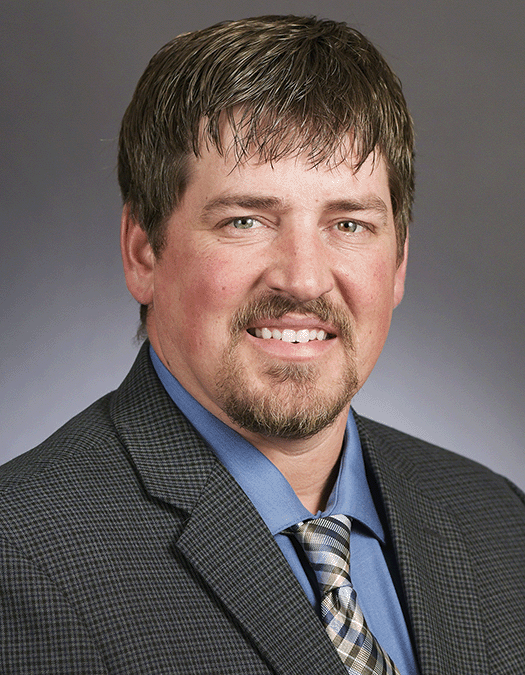
Rep. Nathan Nelson
Sponsored bills
Maddy summaryThis bill increases funding for the Minnesota Department of Agriculture by approximately $350,000 over two years, primarily to support various agricultural programs and services. The legislation appropriates money for soil health assistance grants, compensation for livestock and crop damage caused by wolves and elk, laboratory equipment replacement, meat inspection services, and grants to counties for agricultural inspectors. Key provisions include setting spending limits on individual grant recipients, allowing administrative cost allocations, and establishing eligibility requirements for county funding. The bill modifies existing appropriations in the 2025 budget and allocates funds for fiscal years 2026 and 2027.
Maddy summaryThis bill expands the authority of Minnesota hospital districts to provide financial and in-kind support to a wider range of licensed health care providers and facilities beyond hospitals and nursing homes. It allows hospital districts to enter into agreements with organizations such as primary care clinics, behavioral health providers, dental clinics, home health agencies, urgent care centers, and community-based health service organizations to support their operations. The bill requires that any funding agreements specify how the money will be used for identified programs benefiting district residents, mandate regular financial reporting from recipients, and prohibit the use of funds for executive compensation, shareholder dividends, or profit distribution. Hospital districts must also establish internal policies to ensure compliance with these requirements, while the legislation clarifies that this expansion does not grant additional taxing authority to the districts.
Maddy summaryHF 3669 reduces Minnesota's watercraft licensing fees for most boat owners and operators. It cuts standard watercraft fees from $59 to $27, rental boat fees from $14 to $9, personal watercraft fees from $85 to $37.50, and dealer license fees from $142 to $67.50, among other reductions. The bill affects recreational boaters, rental businesses, nonprofit safety programs, and boat dealers by lowering their annual licensing costs. These changes take effect July 1, 2026, and repeal an outdated definition of "other commercial operation" in the statutes.
Maddy summaryHF 1911 provides $5 million in one-time funding for Minnesota counties to cover costs related to implementing the Department of Human Services' service delivery transformation IT initiatives. It also allocates $40 million for the Department of Children, Youth, and Families to improve its social services information systems. The bill funds county IT modernization projects that connect with state systems and encourages collaboration between larger and smaller counties. Counties must apply for grants using a formula based on service population and other factors. This is a one-time appropriation for fiscal year 2026, with the DCF funding available until June 2027.
Maddy summaryThis bill allocates $450,000 from the environment and natural resources trust fund in fiscal year 2027 to support Minnesota farmers, aggregators, and processors involved in the oat industry. The funds will be distributed as grants to help these recipients invest in infrastructure or equipment for cultivating, harvesting, processing, storing, transporting, wholesaling, or distributing oats. The legislation aims to improve soil health and water quality by reducing erosion and nitrate leaching through these investments. The appropriation is exempt from certain income repayment requirements under Minnesota law.
Maddy summaryThis bill modifies eligibility requirements for the Dairy Assistance, Investment, Relief Initiative (DAIRI) program in Minnesota, which provides financial support to dairy farmers. The legislation adjusts the program's funding structure and specifies how allocated money will be distributed across various agricultural research and development initiatives. Key provisions include directing funds toward dairy-related research, equipment modernization, and supporting beginning and transitioning livestock operations. The bill also outlines reporting requirements to ensure transparency in how agricultural funds are utilized and administered.
Maddy summaryThis bill provides $4 million in state funding for Minnesota food shelf programs during fiscal years 2026 and 2027. It directs the state agency overseeing food shelves to use these funds to support community food banks that serve people facing food insecurity. The money comes from the state general fund and is added to existing base funding for these programs. This directly affects food shelves across Minnesota and the families and individuals they serve.
Maddy summaryHF 2897 would provide free angling (fishing), deer hunting, and small game hunting licenses to Minnesota residents aged 70 or older. The bill amends state law to require license issuers to provide these licenses without fees to eligible seniors. Specifically, it creates a permanent angling license and annual licenses for deer (by firearm or archery) and small game. Proof of age can be shown using a driver's license or Minnesota ID card at any license agent location.
Maddy summaryHF 1660 requires Minnesota's Commissioner of Children, Youth, and Families to conduct a statewide assessment of out-of-school youth programs for children and teens under 21. The commissioner must gather data on current programs, funding, and populations served, while engaging youth, families, and community providers to identify barriers and gaps. By February 2026, the commissioner must submit a report with findings and recommendations to legislative committees, including proposals to improve access and quality. The bill appropriates a one-time $ amount in fiscal year 2026 specifically for this assessment and reporting process.