

Maddy summaryHF 82 clarifies the scope of practice for licensed athletic trainers in Minnesota. The bill defines "athletic training" to include specific activities like injury prevention, emergency care, assessment, rehabilitation, and clinical decision-making within the trainer's expertise. It requires athletic trainers to work under a primary physician's direction, with documented protocols updated yearly, and limits initial treatment of undiagnosed injuries to 30 days (or less as specified by the physician). This directly affects athletic trainers, primary physicians, and healthcare facilities employing them, ensuring clear boundaries for their practice while preventing overlap with other licensed professions like physical therapy or medicine.
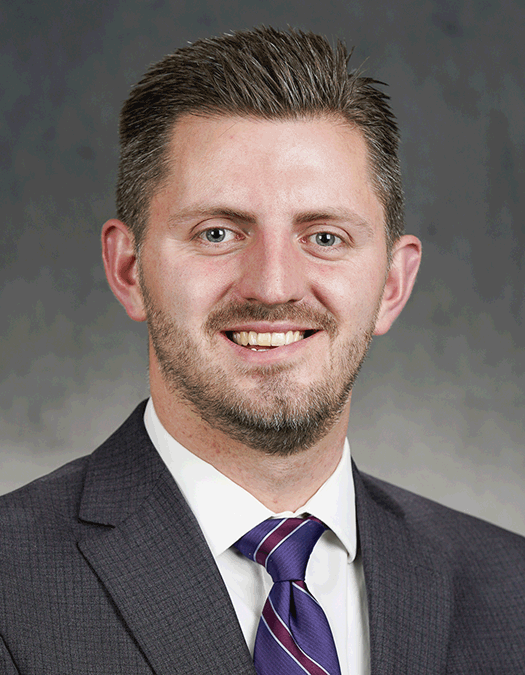
Rep. Isaac Schultz
Sponsored bills
Maddy summaryHF 3532 expands eligibility for burial in Minnesota state veterans cemeteries to include honorably discharged National Guard members and other reserve component veterans, along with their spouses and dependent children. It modifies existing rules to explicitly cover these new groups while maintaining fee-free burial for active-duty service members and veterans as defined by federal law. The bill also establishes a fee schedule for the new eligibility group and requires the Veterans Affairs commissioner to create a policy for waiving fees for indigent applicants. These changes directly affect National Guard/reserve veterans and their families seeking burial in state cemeteries.
Maddy summaryThis bill allows Minnesota counties to create official lists of agricultural lands that should be protected from electric power facility development. Counties can designate parcels as agricultural priority land if they have high crop productivity ratings or have been classified as prime farmland by the Natural Resources Conservation Service. Once a county submits its list to the state Public Utilities Commission, the commission cannot issue site permits for large power plants on those designated lands unless the county board specifically approves an exception. Landowners have the right to opt out of having their property included on the list before the county submits it to the state. The new rules would take effect on January 1, 2027.
Maddy summaryThis bill modifies Minnesota law to allow county commissioners to enter into agreements with other government units for services that those units are authorized to provide themselves, even if the county does not currently have the specific power to perform that service. The legislation also mandates that county sheriffs must sign agreements with federal agencies to carry out authorized federal functions without needing prior approval from the county board. By creating these exceptions to the usual requirement that all parties in an agreement must share common powers, the bill expands the ability of local governments to collaborate on service delivery and fulfill federal mandates.
Maddy summaryHF 1333 requires Minnesota to issue at least two moose hunting licenses annually through a public lottery and two through a public auction, with all applicants paying a $25 nonrefundable fee. The bill creates a "moose research account" funded by license fees and auction revenue, which must be used to study moose mortality, calf survival, disease, and habitat needs. It restricts lottery eligibility to Minnesota residents who haven't held a moose license since 1991, while auctions are open to all eligible applicants. The legislation amends existing statutes to implement these license distribution methods and direct funds toward specific moose conservation research goals. This directly affects residents seeking moose hunting permits and funds state wildlife management efforts.
Maddy summaryHF 482 establishes "Choose Life" special license plates for Minnesota motor vehicle owners. To obtain these plates, applicants must pay a $25 initial fee and $25 annual contribution to a dedicated "Choose Life account," in addition to standard registration fees. Funds collected are deposited into this account and distributed by Choose Life Minnesota, Inc., to non-profit agencies within each county that assist pregnant women making adoption plans - excluding any agencies involved in abortion services or charging fees for services. The bill also specifies plate design requirements (featuring the "Choose Life" logo and inscription) and limits administrative costs for the program to 15% of funds. The program becomes effective January 1, 2026.
Maddy summaryThis bill establishes the SAVE Minnesota Act, which requires voters to present a specific photo identification card to register to vote and to cast their ballots. To obtain this new voter identification card, applicants must provide proof of their U.S. citizenship and may receive certain vital records, such as birth certificates, without a fee. The legislation also creates a new voter identification card program, modifies existing driver's license requirements, and sets up a process for handling provisional ballots. Additionally, the bill includes funding provisions to support the administration of these new election procedures and establishes a children's trust fund.
Maddy summaryThis bill creates a new 100% tax on money obtained through fraud by individuals or organizations, regardless of whether they have already paid fines or restitution. It applies to those convicted by a court, those identified by the state revenue commissioner as having committed fraud, and anyone paid to help facilitate such fraudulent activities. The revenue collected from this tax must be used exclusively to provide relief for state income or property taxes. The law takes effect retroactively for fraud cases determined after December 31, 2019.
Maddy summaryThis bill is a House resolution that formally impeaches Minnesota Governor Timothy J. Walz for alleged corrupt conduct in office. It directly affects the Governor by charging him with four specific articles of misconduct, including concealing fraud in state programs, obstructing oversight investigations, prioritizing political narratives over transparency, and failing to enforce laws protecting public funds. If adopted by the House, the resolution would immediately suspend the Governor's duties while the Senate conducts a trial to determine whether he should be removed from office. The bill also requires the Speaker of the House to serve formal notice of the charges to the Governor and directs the Chief Clerk to send copies of the resolution to relevant state officials.
Maddy summaryThis Minnesota bill prohibits employers from asking, requiring, or forcing employees to have a microchip implanted under their skin. The law defines a microchip as a device containing personal information that can be read by an external scanner, while explicitly excluding medical implants used for health diagnosis or treatment. Employees who feel they were coerced into such implantation can file a lawsuit to seek damages, court orders, and legal fees. The rules apply to all types of employers in the state, including government agencies and municipalities, as well as job applicants.