

Maddy summaryHF 1542 changes Minnesota's earned sick and safe time law by making employer participation optional. Currently, certain employers must provide these benefits; this bill amends Minnesota Statutes § 181.9445 to allow employers to choose whether to offer sick time benefits. The key change removes the mandatory requirement, shifting it to a permissive standard under which employers decide whether to participate. This directly affects Minnesota employers who currently must provide sick time under the law, giving them flexibility to opt out. The bill does not alter eligibility for employees who remain covered if their employer chooses to participate.
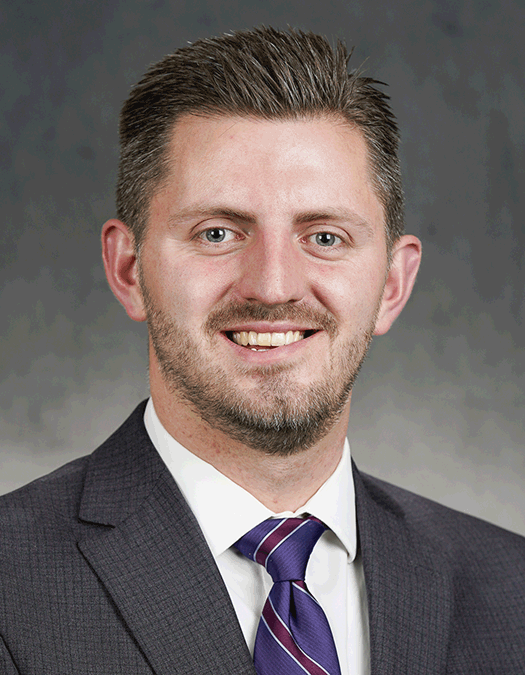
Rep. Isaac Schultz
Sponsored bills
Maddy summaryHF 1513 requires Minnesota voters to present a photo ID when registering to vote and when casting a ballot. It creates a new state-issued voter ID card, which can be obtained without fees for vital records needed to verify identity (per Section 3.1-3.3). The bill establishes provisional ballots for voters who lack ID but provide required documentation, and mandates annual reports on ID card usage. These changes take effect June 1, 2026, and apply to all voters participating in Minnesota elections.
Maddy summaryHF 1359 increases funding for solid waste management by changing how fees collected from waste management are allocated. Starting in 2026, 7% of these fees will go to a resource management account (rising to 20% in 2027 and 30% after 2028), instead of the general fund. The funds must be distributed to counties for waste management programs under state law. This directly affects counties receiving these allocations and changes the percentage of fees dedicated to environmental resource management over time. The bill takes effect July 1, 2025.
Maddy summaryHF 1475 abolishes Minnesota's Metropolitan Council and transfers its core responsibilities to other state entities. Specifically, it moves the Council's duties to the commissioners of Administration and Natural Resources, shifts transportation and transit functions to the Department of Transportation, and creates a new metropolitan area sanitary sewer district. The bill also repeals land use planning provisions previously managed by the Council and ends its oversight of the Metropolitan Airports Commission. These changes reorganize regional governance for key services like transportation, environmental management, and sewer infrastructure across the metropolitan area.
Maddy summaryHF 284 expands background checks for noncitizen applicants seeking a permit to carry firearms in Minnesota. The bill requires sheriffs to conduct an Immigration Alien Query (IAQ) check for noncitizens and mandates applicants to provide their country of birth and alien number. This amendment to Minnesota Statutes § 624.714 specifically modifies the application form requirements and investigation process for noncitizen applicants, adding these new data points and verification steps to the existing criminal record checks. The change directly affects noncitizen applicants by expanding the scope of information collected and verified during the background check process.
Maddy summaryThis bill expands Minnesota's sales tax exemption to include additional baby products, directly affecting parents and caregivers who purchase these items. It adds baby wipes, cribs and bassinets (including mattresses and sheets), changing tables and pads, strollers, car seats and bases, baby swings, bottle sterilizers, and infant eating utensils to the list of tax-exempt items. The exemption applies to sales and purchases made after June 30, 2025. This change removes sales tax from these specific baby products, aligning with the existing exemption for items like breast pumps and baby bottles.
Maddy summaryHF 946 allows approved third-party programs (such as driving schools) to conduct the behind-the-wheel road test for class D driver's licenses (standard driver's licenses) in Minnesota. It establishes requirements for these programs and testers, mandates regular audits of third-party programs, and permits applicants to appeal decisions made by the Commissioner of Public Safety. The bill also updates website rules to show real-time appointment availability, display next available dates/times by location, and allow address-based searches without requiring personal information. This directly affects driver's license applicants and third-party testing programs seeking to administer road tests.
Maddy summaryHF 1325 modifies Minnesota's earned sick and safe time law to provide employers with a grace period and adjust pay requirements. It adds a penalty waiver (Section 1), preventing monetary penalties for initial violations until after January 1, 2026. The bill also adjusts pay rates: small employers (25 or fewer full-time equivalent employees) must pay half the hourly rate, and new employers in their first 12 months may optionally provide paid leave (Section 2). Employees accrue one hour of leave for every 30-40 hours worked, up to a maximum of 48 hours annually (Section 5), while expanding the definition of "family member" to include more relatives and up to one annually designated individual (Section 4). This primarily affects Minnesota employers and their workers covered under the law.
Maddy summaryHF 2 requires state agency employees to immediately report suspected fraud to law enforcement and legislative committee leaders when they have reason to believe fraud exists in agency programs. It mandates that all state agencies post current organizational charts online with contact details for leadership and division heads. The bill strengthens grant management by requiring agencies to conduct unannounced monitoring visits before final payments for grants over $50,000 (and annually for grants over $250,000), perform financial reconciliations prior to disbursement, and withhold funds from grantees failing to submit required progress reports. Violating these grant management requirements constitutes a misdemeanor under the bill.
Maddy summaryHF 477 modifies how Minnesota allocates funds from the workforce development fund. It requires 25% of these funds for fiscal year 2026 and 50% for fiscal year 2027 to be directed toward performance-based grants under Minnesota Statutes §116J.8747. These grants are awarded to pass-through entities (like local workforce boards) that meet specific performance metrics. The bill directly affects organizations receiving workforce development grants and the state's budget allocation for these programs.