

Maddy summaryHF 67 repeals Minnesota's automatic voter registration system, which previously added eligible residents to voter rolls when they applied for or renewed a driver's license or state ID. The bill removes provisions requiring DMV staff to offer automatic registration and eliminates related requirements in statutes governing voter registration (Minnesota Statutes 2024, sections 13.607 and 201.161). It also amends related laws to adjust processes for voter preregistration and application forms. This change directly affects voters who would have been automatically registered through DMV interactions, requiring them to proactively register instead.
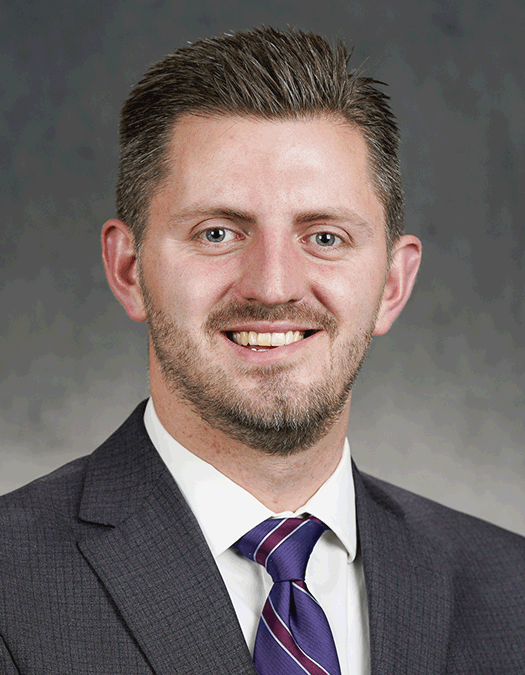
Rep. Isaac Schultz
Sponsored bills
Maddy summaryHF 2351 increases criminal penalties for human trafficking and prohibits employers from knowingly hiring individuals without legal work authorization in the U.S. It requires state agencies providing assistance to people without legal status to report annual spending by December 15, including goods, services, and costs. Employers violating the hiring ban face fines of $1,000-$10,000 per violation and potential license suspension, while using fake IDs to verify employment becomes a felony punishable by up to two years in prison. The bill amends Minnesota Statutes to strengthen enforcement of immigration-related employment rules and reporting obligations.
Maddy summaryThis bill requires Minnesota's wildlife commissioner to establish an annual open season for wolf hunting after wolves are delisted from federal protection under the Endangered Species Act. It directly affects state wildlife managers, hunters, and livestock owners by creating a mandatory yearly process for setting hunting seasons. Key provisions include requiring the commissioner to consult with the agriculture commissioner and USDA's animal health agency before determining seasons, and to review data on wolf attacks on livestock and human conflicts. The bill mandates public comment opportunities for all proposed seasons, ensuring transparency in the annual decision-making process.
Maddy summaryHF 2447 establishes a dedicated account for financial assurance funds collected from gas development permits. It requires the commissioner of natural resources to deposit these funds into an account managed by the State Board of Investment, with earnings credited back to the account. The funds can only be used for financial assurance purposes related to specific gas permits under chapters 93 and 103I of Minnesota Statutes. This bill directly affects gas development permit applicants and the commissioner's office, creating a new mechanism for handling and investing these required funds.
Maddy summaryHF 4 proposes a constitutional amendment requiring Minnesota to return budget surplus funds to taxpayers. If approved, it would create a "Minnesota tax relief account" funded by revenue exceeding 105% of projected spending, using those funds to refund or reduce property and income taxes. Taxpayers would receive direct refunds or tax reductions, but only up to the amount they owe in taxes, with the account funded annually from the state's general fund surplus. The amendment must be voted on by voters in the 2026 general election.
Maddy summaryHF 274 appropriates $25,000 from the all-terrain vehicle account to update the C.J. Ramstad/North Shore State Trail Master Plan, specifically allowing ATV use on portions of the trail within Cook and Lake Counties. The bill requires the commissioner of natural resources to complete this plan update by February 1, 2026, and submit a report to relevant legislative committees. This funding change directly affects the management of the trail in those counties by modifying its designated uses. The provision is a procedural update to the trail's master plan, not a new regulatory standard.
Maddy summaryHF 2468 appropriates $500,000 for fiscal year 2026 and $500,000 for fiscal year 2027 from the general fund to support mental health initiatives in Minnesota's construction industry. The funds, available until June 30, 2027, are designated for outreach, education, stigma reduction programs, and worksite strategies to prevent suicide. They can be used for grants to industry groups and developing resources targeting construction workers. This bill directly affects construction industry workers by funding concrete mental health support services through state-administered programs.
Maddy summaryHF 26, titled the "Never Again Act," shifts emergency declaration authority from the governor to the Minnesota legislature. It repeals the governor's power to declare emergencies and establish a new process requiring legislative approval for emergency declarations and extensions. The bill also prohibits the governor from issuing emergency orders with the "full force and effect of law" and explicitly protects citizens' rights, including free speech, religious freedom, assembly, travel, gun rights, and the ability to operate businesses. These changes amend multiple sections of Minnesota Statutes to clarify that only the legislature may enact emergency measures with legal force during crises.
Maddy summaryHF 2170 defines "cell-cultured meat" and "cell-cultured poultry" as products grown from animal cells in a controlled environment, rather than from slaughtered animals. The bill requires food labels to clearly state when a product contains cell-cultured meat or poultry, and mandates restaurants to prominently indicate such items on menus. It amends Minnesota food labeling laws (sections 31.12 and 31.633) and updates definitions in food product statutes (section 31A.02) to include these products under "meat food product" and "poultry food product." This directly affects food manufacturers, retailers, and restaurants selling or serving cell-cultured meat or poultry products in Minnesota.
Maddy summaryMinnesota's legislature has passed a resolution requesting Congress to call a constitutional convention under Article V of the U.S. Constitution. The resolution asks for proposed amendments to impose budget rules on federal spending, reduce federal government authority over states, and limit terms for federal officials and members of Congress. This is a procedural step - Minnesota is formally petitioning Congress, not creating new laws. The resolution serves as Minnesota's ongoing application for such a convention, pending similar actions by two-thirds of states.