

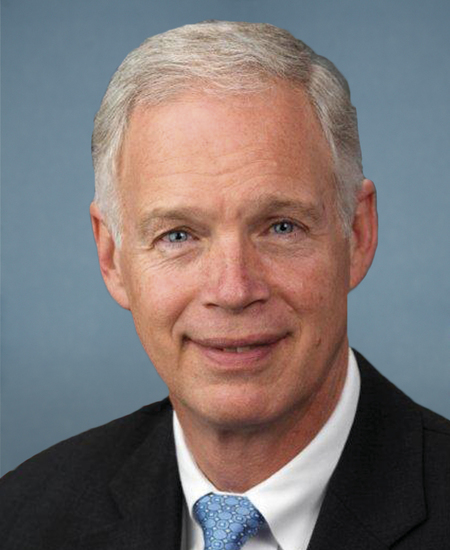
Photo of Ron Johnson
R United States Senate · Wisconsin

Sen. Ron Johnson

Compare
Total votes
1,037
all sessions
Attendance
99%
9 missed
Near the chamber average
With party
92%
of cast votes
Lower than 77% of chamber peers
Bipartisan score
5%
crosses aisle rarely
Near the chamber average
Sponsored
391
bills & resolutions
Lower than 96% of chamber peers
Committees
9
assignments
391 bills and resolutions

Sponsored bills

Total
391
Primary
54
Co-sponsor
337
This page
391
matching current filters
Co-sponsor S 3624
In committee · Michigan Senate · Co-sponsor
Protecting Life in Foreign Assistance Act

Maddy summaryS 3624, the Protecting Life in Foreign Assistance Act, restricts U.S. federal funding for organizations that perform, promote, or support abortions internationally. It prohibits federal funds from being provided to foreign or domestic groups (including NGOs and multilateral organizations) that conduct abortion services, provide related counseling or referrals, develop abortion tools, or financially support such activities. The bill also blocks funding for groups that fail to maintain strict separation between abortion-related work and other programs receiving U.S. aid. This directly affects foreign aid recipients and domestic organizations administering international programs that involve abortion-related services.

In committee Jan 18, 2024 1 co-sponsor
Co-sponsor S 2824
In committee · Michigan Senate · Co-sponsor
Secure the Border Act of 2023

Maddy summary# Summary of "Secure the Border Act of 2023" (Employment Eligibility Verification Provisions) This legislation (primarily Sections 801-816) fundamentally reforms the U.S. employment eligibility verification system by replacing the current E-Verify program with a new, mandatory verification system for employers. ## Key Provisions: 1. **Mandatory Verification System**: Requires all employers to verify the work authorization of new hires through a new verification system established under Section 274A(d). 2. **Phased Implementation Timeline**: - Large employers (10,000+ employees): 6 months after enactment - Medium employers (500-10,000 employees): 12 months after enactment - Small employers (20-500 employees): 18 months after enactment - Very small employers (<20 employees): 24 months after enactment - Agricultural workers: 36 months after enactment 3. **Verification Process**: - Requires examination of specific documents to verify identity and work authorization - Establishes a verification system with confirmation or tentative nonconfirmation within 3 business days - Requires secondary verification process for tentative nonconfirmations 4. **Penalties for Non-Compliance**: - Civil penalties ranging from $2,500 to $25,000 per violation - Criminal penalties for pattern or practice violations ($5,000 per unauthorized alien) - Potential debarment from federal contracts for repeat violators 5. **Fraud Prevention Measures**: - Blocks social security account numbers subject to unusual multiple use - Allows suspension of compromised social security numbers - Protects children's identities from being used for employment verification 6. **Agricultural Workforce Provisions**: - Extended timeline for agricultural workers (36 months) - Specific definitions of agricultural labor - Study on agricultural workforce composition and recommendations 7. **Good Faith Defense**: - Allows employers to avoid penalties if they can demonstrate good faith compliance - Requires reasonable security measures for identity verification This legislation represents a significant expansion of employer verification requirements with substantial penalties for non-compliance, designed to strengthen enforcement against unauthorized employment while establishing a more comprehensive verification system. The phased approach aims to give employers time to adjust to the new requirements based on business size.

In committee Jan 11, 2024 1 co-sponsor
Co-sponsor SJRES 32
Vetoed · Michigan Senate · Co-sponsor
A joint resolution providing for congressional disapproval under chapter 8 of title 5, United States Code, of the rule submitted by the Bureau of Consumer Financial Protection relating to "Small Business Lending Under the Equal Credit Opportunity Act (Regulation B)".

Maddy summaryThis bill (SJRES 32) seeks congressional disapproval of a specific rule issued by the Bureau of Consumer Financial Protection (CFPB) on May 31, 2023. The rule, published as Regulation B under the Equal Credit Opportunity Act (ECOA), addressed how lenders must evaluate small business loan applications to prevent discrimination. If passed, the resolution would block this rule from taking effect, meaning lenders would not be required to follow these specific small business lending provisions. The bill directly affects the CFPB's regulatory authority and financial institutions that process small business loans under ECOA.

Vetoed Jan 10, 2024 1 co-sponsor
Co-sponsor S 3562
In committee · Michigan Senate · Co-sponsor
A bill to designate the medical center of the Department of Veterans Affairs in Tomah, Wisconsin, as the "Jason Simcakoski Department of Veterans Affairs Medical Center".

Maddy summaryThis bill (S 3562) designates the existing Department of Veterans Affairs medical center in Tomah, Wisconsin, as the "Jason Simcakoski Department of Veterans Affairs Medical Center" for all official references. It does not change services, funding, or eligibility for veterans; it only updates the facility's official name in all federal records, maps, and documents. The change honors Jason Simcakoski, a veteran and advocate, but has no direct impact on veterans' care or benefits.

In committee Jan 9, 2024 1 co-sponsor
Co-sponsor SRES 492
Passed · Michigan Senate · Co-sponsor
A resolution honoring the life of the First Lady Rosalynn Carter.

Maddy summaryThis is a ceremonial Senate resolution (SRES 492) honoring the late First Lady Rosalynn Carter. It expresses the Senate's condolences for her passing and recognizes her lifetime of humanitarian work, including her advocacy for mental health care, founding of caregiver support programs, and service with The Carter Center. The resolution does not create new laws or policies; it is purely a commemorative statement. It was introduced by a bipartisan group of senators and adopted by the Senate on December 7, 2023.

Passed Dec 7, 2023 1 co-sponsor
Co-sponsor SJRES 43
Failed · Michigan Senate · Co-sponsor
A joint resolution providing for congressional disapproval under chapter 8 of title 5, United States Code, of the rule submitted by the Department of Education relating to "Improving Income Driven Repayment for the William D. Ford Federal Direct Loan Program and the Federal Family Education Loan (FFEL) Program".

Maddy summaryThis bill (SJRES 43) is a joint resolution seeking to block a Department of Education rule that would have improved income-driven repayment plans for federal student loans. It targets a specific rule (88 Fed. Reg. 43820, July 10, 2023) affecting borrowers in the William D. Ford Federal Direct Loan Program and the Federal Family Education Loan (FFEL) Program. If passed, the resolution would make this rule void, preventing it from taking effect. The resolution uses a specific procedural mechanism under Title 5 of U.S. Code to achieve this disapproval. It directly impacts student loan borrowers who rely on income-driven repayment options.

Failed Nov 15, 2023 1 co-sponsor
Co-sponsor SJRES 49
In committee · Michigan Senate · Co-sponsor
A joint resolution providing for congressional disapproval under chapter 8 of title 5, United States Code, of the rule submitted by the National Labor Relations Board relating to a "Standard for Determining Joint Employer Status".

Maddy summarySenate Joint Resolution 49 seeks congressional disapproval of a National Labor Relations Board (NLRB) rule that would have established a new standard for determining when two or more companies are considered "joint employers" under labor law. The rule, published in October 2023, would have affected businesses with complex employment structures, such as franchisors and contractors, by altering how joint employer liability is assessed for wage, hour, and union representation matters. If passed, the resolution would block the rule from taking effect, preserving the previous standard for joint employer determinations. The bill was introduced by Senators Cassidy, Manchin, Braun, McConnell, Marshall, Cramer, Capito, and Paul and referred to the Health, Education, Labor, and Pensions Committee.

In committee Nov 9, 2023 1 co-sponsor
Co-sponsor S 3271
In committee · Michigan Senate · Co-sponsor
Hmong Congressional Gold Medal Act

Maddy summaryThis bill authorizes Congress to award a gold medal to the Hmong people in recognition of their service during the Vietnam War. It directs the Secretary of the Treasury to strike the medal and transfer it to the Smithsonian Institution for display and research. The medal honors the Hmong's military contributions, including fighting communist forces, gathering intelligence, and suffering high casualties. The bill specifically affects the Hmong community in the U.S. (over 327,000 people), acknowledging their historical role and displacement after the war.

In committee Nov 9, 2023 1 co-sponsor
Co-sponsor S 3168
Introduced · Michigan Senate · Co-sponsor
Israel Supplemental Appropriations Act of 2023

Maddy summaryThis bill appropriates $13.5 billion in supplemental funding for Israel to support military and diplomatic assistance in response to the situation in Israel. It provides $4.4 billion for defense operations, $4 billion for Iron Dome and David's Sling defense systems, $1.2 billion for Iron Beam system development, and $3.5 billion for foreign military financing. The bill authorizes $7 billion in drawdown authority from Defense Department stockpiles for defense articles and services, with specific limitations preventing funds from being used for Ukraine assistance or for entities in Gaza controlled by Hamas. All funding must be designated as an emergency requirement by the President and is available for specific defense and diplomatic purposes. The bill includes provisions for transfer authority between accounts and notification requirements for congressional committees.

Introduced Oct 31, 2023 1 co-sponsor
Co-sponsor S 3135
Introduced · Michigan Senate · Co-sponsor
Israel Supplemental Appropriations Act of 2023

Maddy summaryThe Israel Supplemental Appropriations Act of 2023 provides $13.4 billion in supplemental funding to support Israel's security needs, primarily for defense systems and diplomatic efforts. Key provisions include $4 billion for Iron Dome and David's Sling systems, $1.2 billion for the Iron Beam system development, and $3.5 billion for military financing. The bill prohibits using funds for the Ukraine war or entities controlled by Hamas, requires emergency designation by the President for all funding, and authorizes transfers between defense accounts and drawdowns from DOD stockpiles. This legislation directly affects the U.S. Government's ability to provide security assistance to Israel, with specific restrictions on how funds may be used.

Introduced Oct 26, 2023 1 co-sponsor
Showing 131 to 140 of 391 bills
Previous 1 13 14 15 40 Next